Filter Categories
All A-Z
Consumer Psychology
Education
General Psychology
Literature
Major psychologists
Music
Philosophy & Theory
Psychoanalysis
Sports
Trauma
Work & Organizations

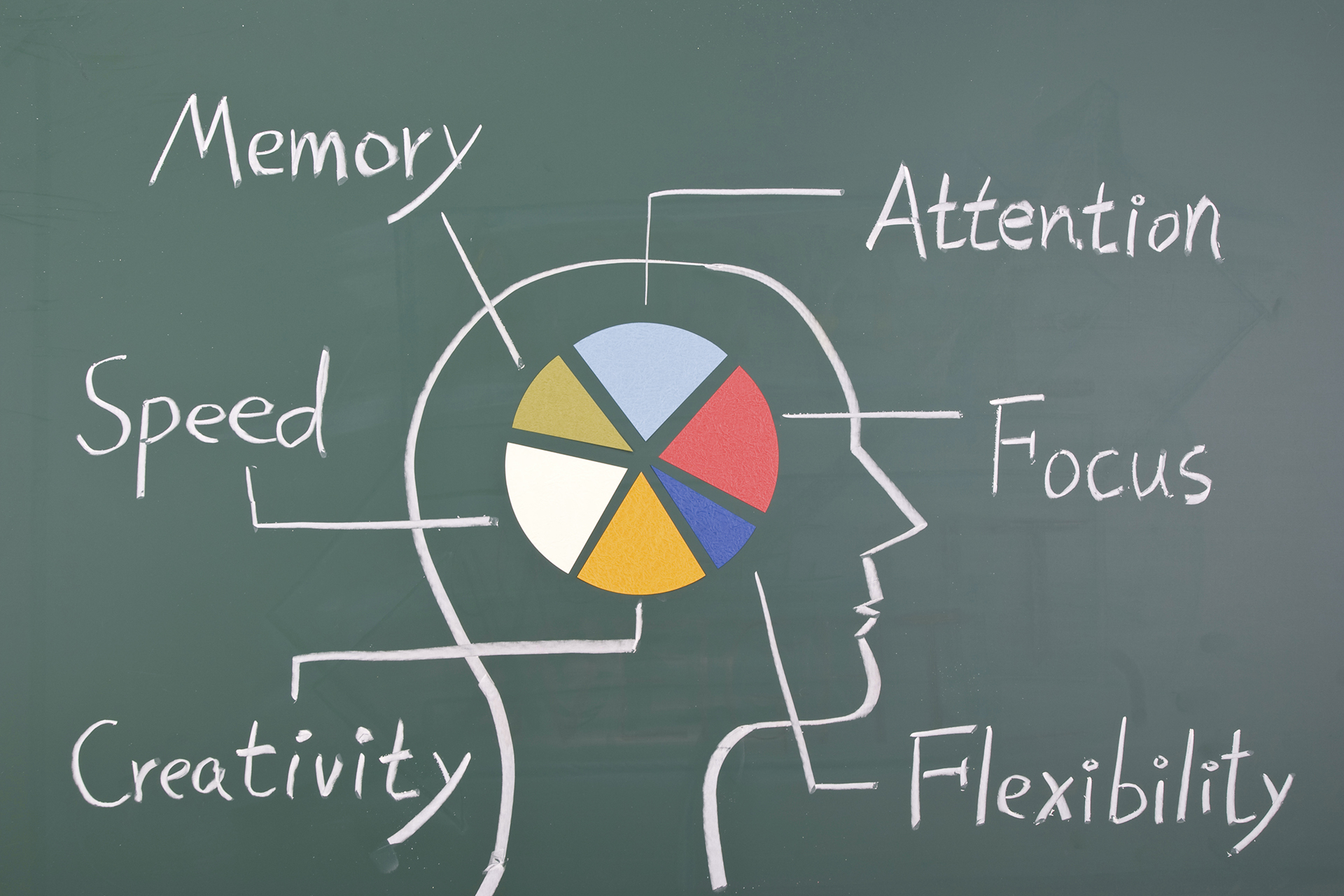
This overview provides a brief introduction to psychology, the study of the mind, behavior, emotions, and human development. It highlights the field’s major areas of study, related disciplines, and resources for exploring the profession of psychology in greater depth.
Psychology is the scientific study of the mind, brain, and behavior. It looks at how people perceive the world, process information, experience emotions, learn, develop over time, and interact with others.
By examining both biological factors (the brain) and social influences (family, culture, and environment), psychology helps explain why people think, feel, and behave the way they do in everyday life. Psychology looks at what we can see, like actions and speech, and the mental processes of the mind, such as emotions, thoughts, and motivations.
Psychologists use research and experiments to better understand how the brain, personal experiences, and the environment all work together to shape behavior.
For an in-depth description of the field of psychology, read Section 1.1, What is Psychology? from the peer-reviewed OpenStax textbook Psychology 2e.
Psychology is a broad field with many subfields, each focusing on different aspects of behavior and mental processes. Listed below are the main subfields of psychology traditionally taught in most universities. Links to in-depth descriptions of each subfield and their concepts are provided by the American Psychological Association.
Psychology is an interdisciplinary field that draws on knowledge and insights from many other academic disciplines. These include neuroscience, sociology, anthropology, education, health sciences, philosophy, law, criminal justice, business, and economics.
If you’re thinking about majoring in psychology, these resources can provide useful background information and help guide your next steps. They explain what to expect from the major and the wide variety of career paths available to you:
After selecting a topic, conducting a literature review is an essential step in the research and writing process. Writing a literature review helps you:

If you are new to doing psychology literature reviews, the following databases are great places to start. They help you locate major publications and relevant scholarship on psychology topics.
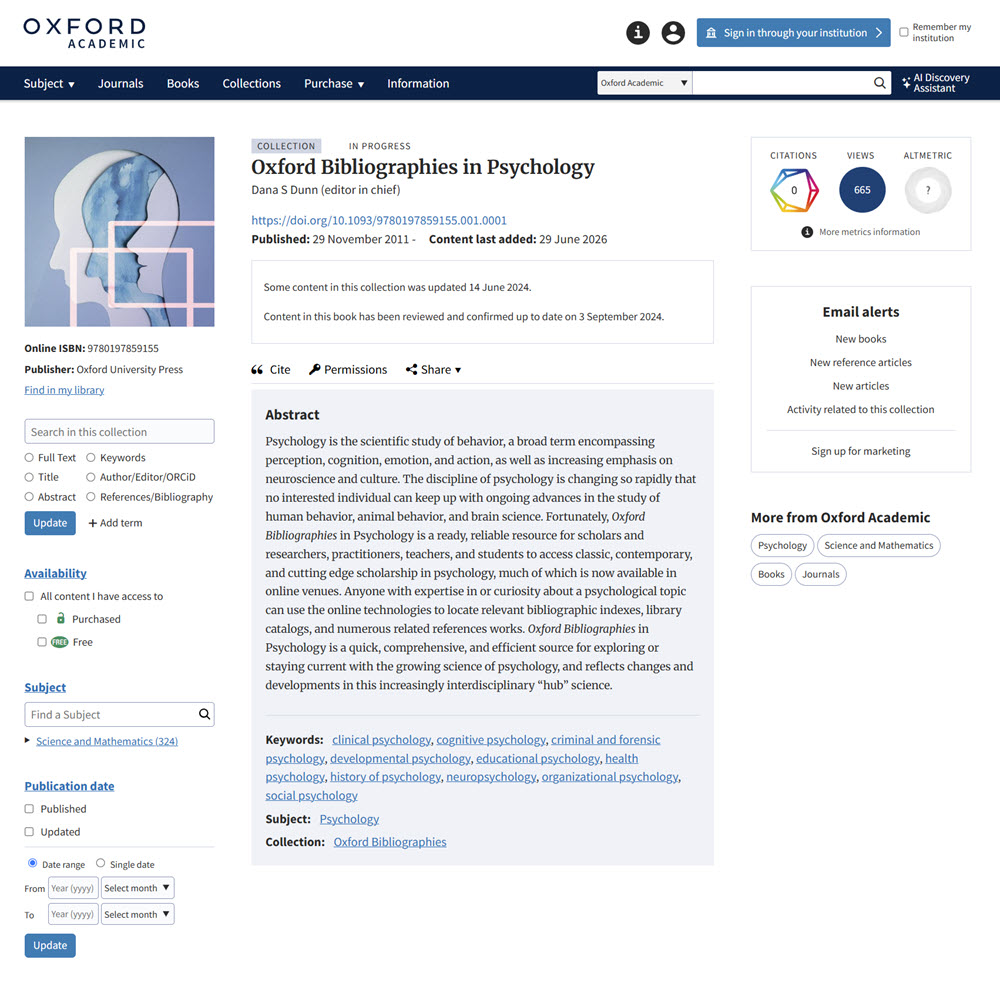
Oxford Bibliographies provides scholarly bibliographies in most social science disciplines, including psychology. Each bibliography includes authoritative books, journal articles, websites, and other materials selected and organized by academic scholars. These bibliographies can also help researchers begin building literature reviews by identifying important authors, major debates, foundational studies, and key publications on different psychology topics.
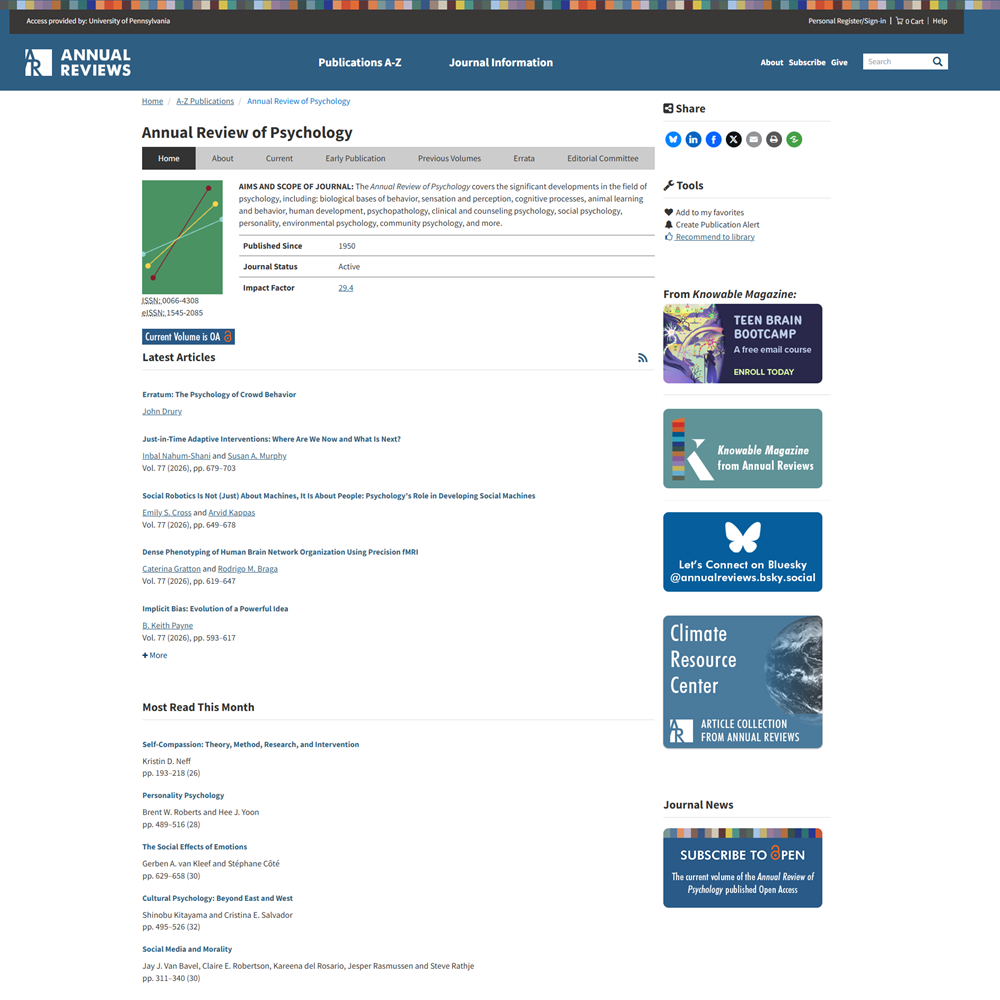
The Annual Review of Psychology provides authoritative literature review articles that summarize and interpret major developments happening in the field of psychology. Each year, a new volume is released, consisting of articles written by leading experts in the field, providing overviews of the most important and influential research and scholarship in the scientific study of behavior.
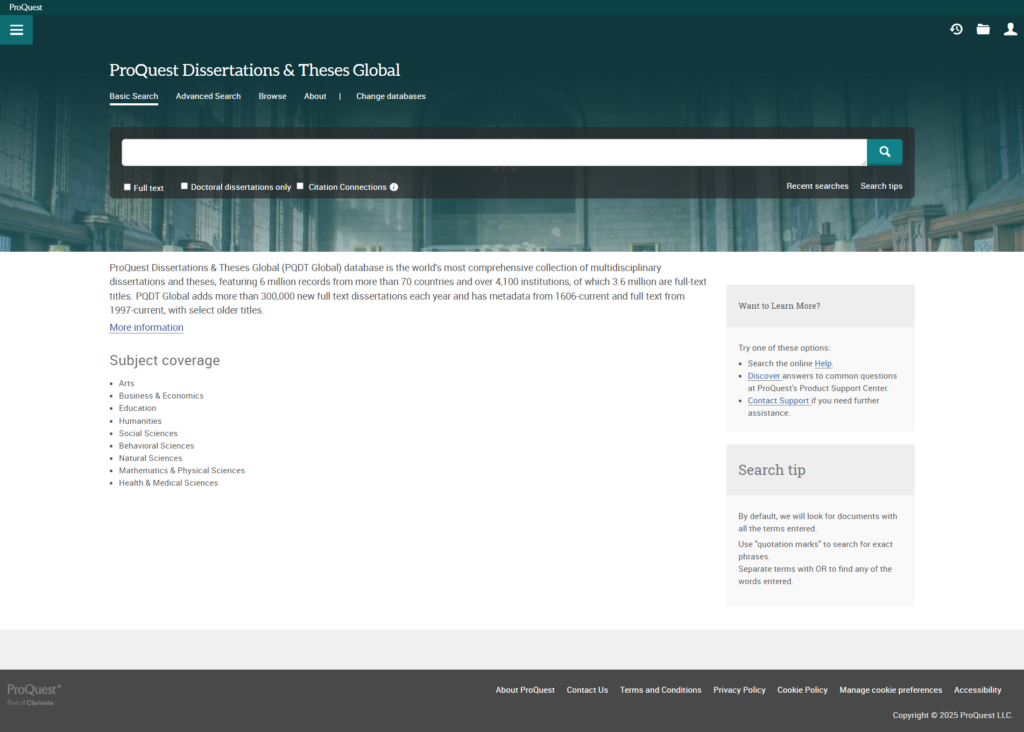
When searching for literature reviews, don’t overlook dissertations found in ProQuest Dissertations & Theses. Doctoral students are typically required to write extensive literature reviews. Each review will examine major debates, theories, methods, and key publications related to their research topic, which can help you identify important authors, major studies, useful keywords, and gaps in the existing research.
To learn more about finding resources for a literature review, see “How to Locate Resources for a Literature Review.”
A bibliography lists sources cited in research papers, such as books, articles, documents, websites, and other academic materials.
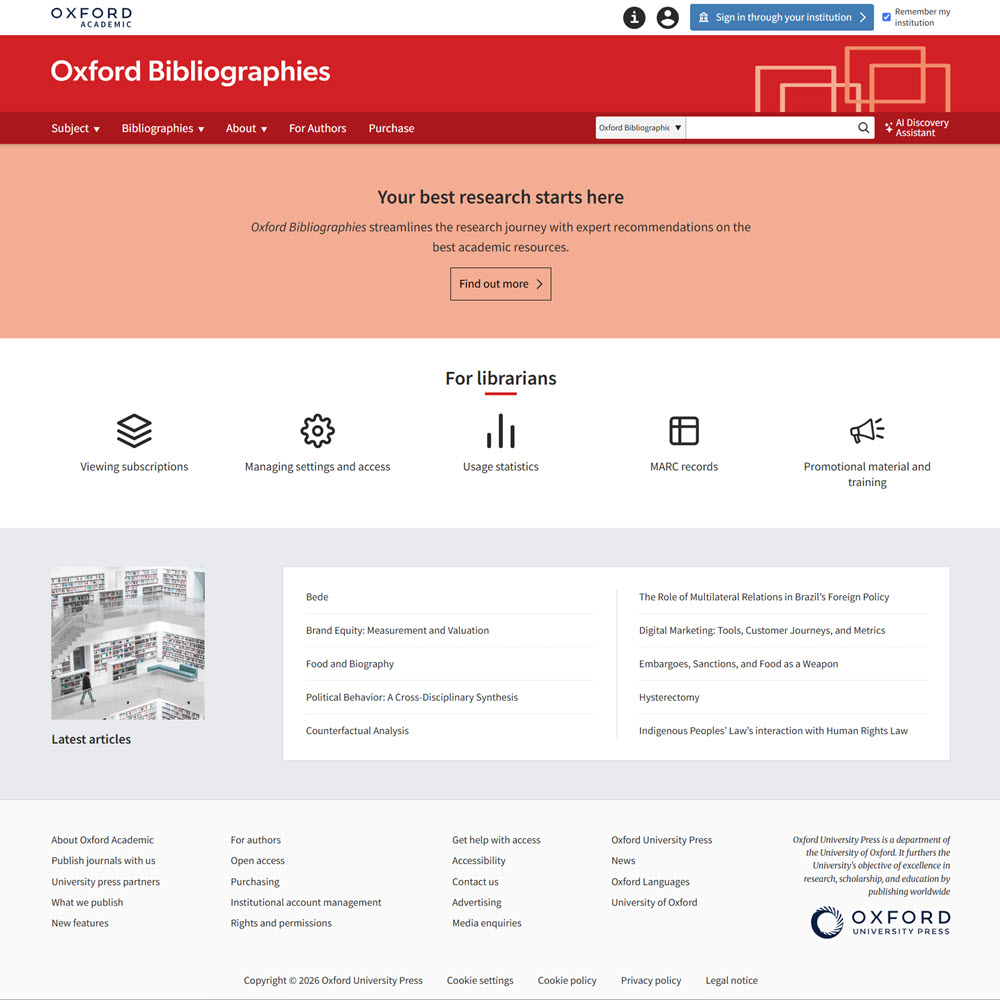
Oxford Bibliographies is a leading scholarly source for expert-curated bibliographies, providing scholarly bibliographies in most social science disciplines, including anthropology, communication, criminology, economics, international relations, political science, psychology, and sociology. Each bibliography provides a list of authoritative books, journal articles, websites, and other materials, all organized by academic scholars.
Companions offer concise yet comprehensive introductions to a subject. Written by experts, introductions present key ideas, theories, and debates clearly and understandably. The following books are ideal for readers new to anthropology, providing foundational knowledge without requiring prior expertise.
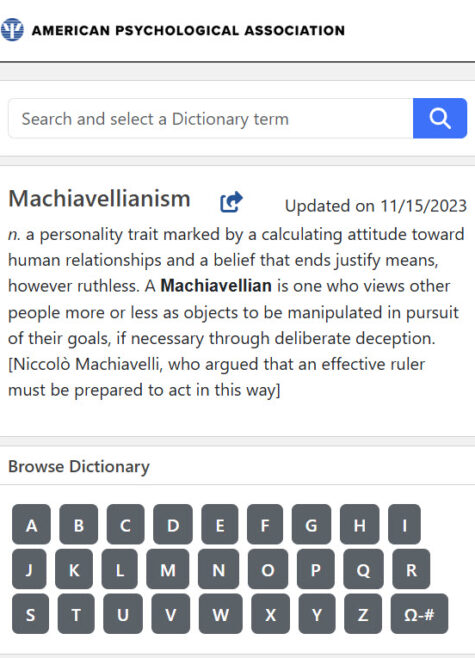
Dictionaries are important for understanding words, concepts, and terminology. Anthropology dictionaries provide clarity when exploring complex concepts or theories, offering clear definitions of key anthropological terms.
Subject encyclopedias are specialized reference works that provide in-depth information on specific discipline topics. Unlike general encyclopedias, which cover a wide range of topics, subject encyclopedias focus exclusively on one field, offering detailed and comprehensive entries written by experts. For a list of general and specialized encyclopedia databases, go to Getting Started—Reference Resources.
Handbooks provide authoritative overviews, in-depth analyses, and critical discussions of a particular academic field, discipline, or topic. The most important series of handbooks in the field of psychology is the APA Handbooks in Psychology® — a major multivolume reference series published by the American Psychological Association. It provides comprehensive coverage of key psychology subfields, methods, theories, and applications in psychology. View the entire list of APA Handbooks in Psychology® here.
Listed below are other important handbooks in psychology.
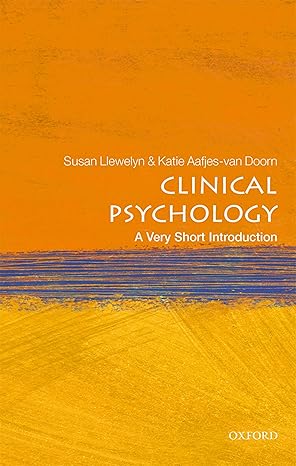
Introductions explain the fundamentals of psychology and its subfields, including its concepts, methods, and major fields, in a clear, accessible way. They are especially helpful for students who are new to psychology and need background knowledge.
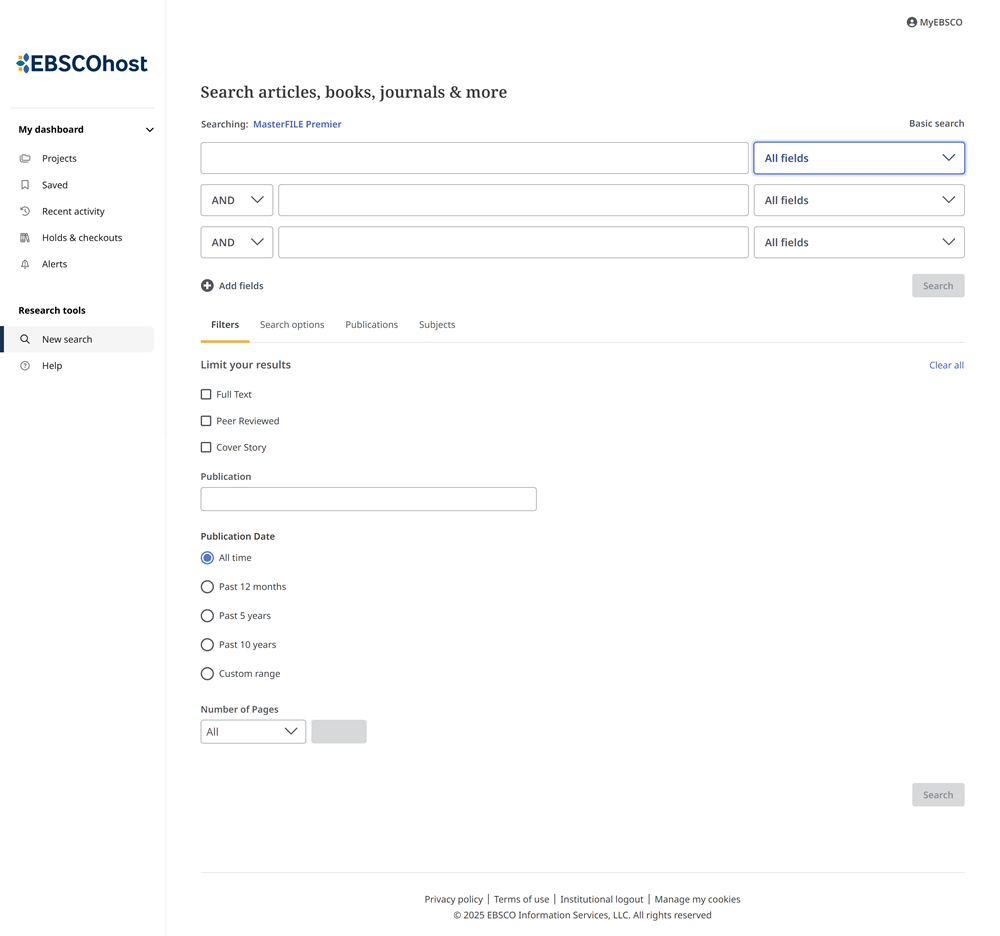
EBSCO is a major research database platform that allows users to search multiple EBSCO databases simultaneously. The difference between EBSCOhost and Academic Search is that Academic Search can be searched as part of the EBSCOhost platform or searched separately if your institution has a subscription. To check if your institution subscribes to EBSCOhost, use EBSCO’s Find your institution page.
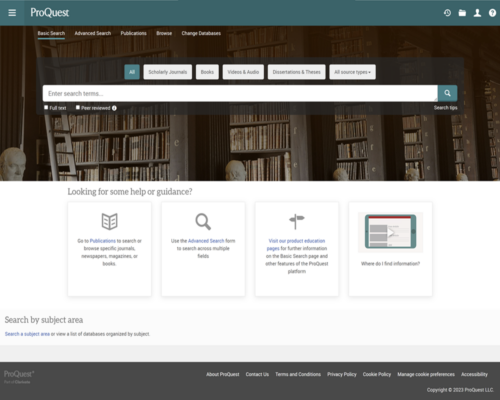
ProQuest is a major database vendor and platform that provides access to hundreds of database collections. The ProQuest platform provides a multidisciplinary search with access to scholarly ebooks, journals, video and audio, newspapers, and more, all searchable simultaneously. ProQuest is unique in providing dissertations and theses, historical newspapers, and other primary sources.
Scholarly research databases provide peer-reviewed academic journal articles, book reviews, and other scholarly resources authored by scholars, researchers, or academics who are experts in their fields.
Unlike magazines, which focus on current events and general-interest stories, articles in scholarly journals undergo rigorous peer review before publication. The following is a list of the most important multidisciplinary scholarly research databases.
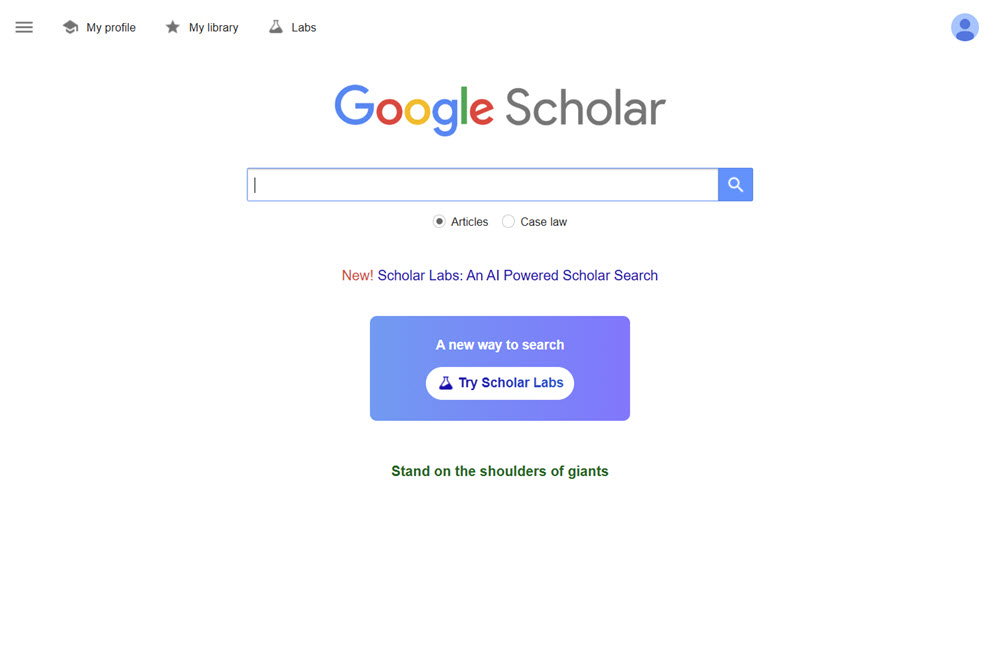
Google Scholar is a free academic search engine that helps researchers and students find scholarly literature across disciplines. It indexes journal articles, books, conference papers, theses, patents, and other resources from academic publishers, universities, and professional organizations.
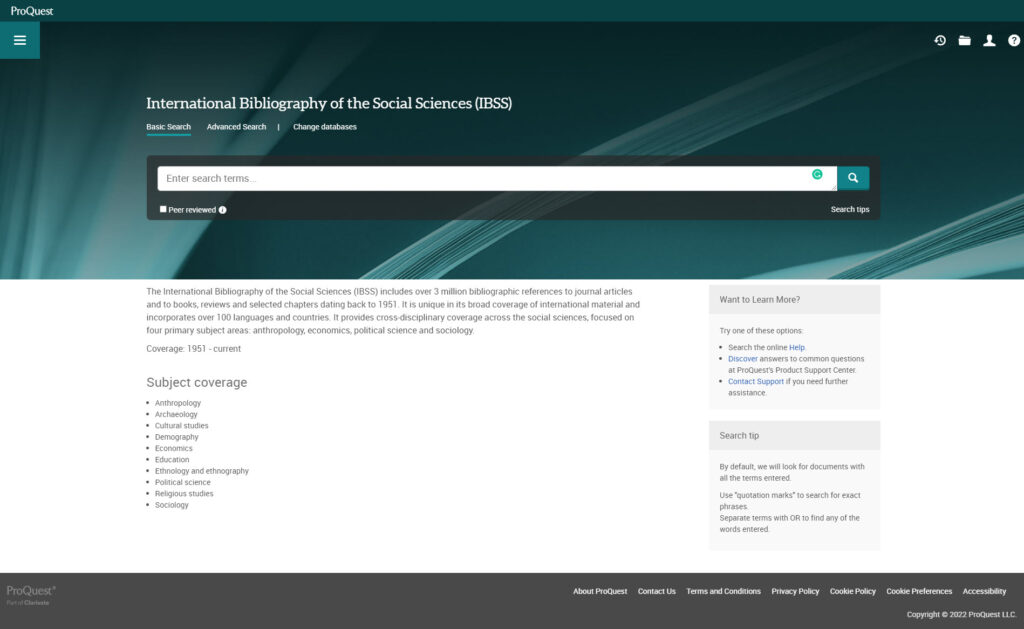
The International Bibliography of the Social Sciences (IBSS), compiled by the British Library of Political and Economic Science at the London School of Economics, provides access to a vast collection of scholarly literature in the social sciences. Covering multiple disciplines, IBSS includes references to journal articles, books, newspapers, and dissertations, with records dating back to 1951.
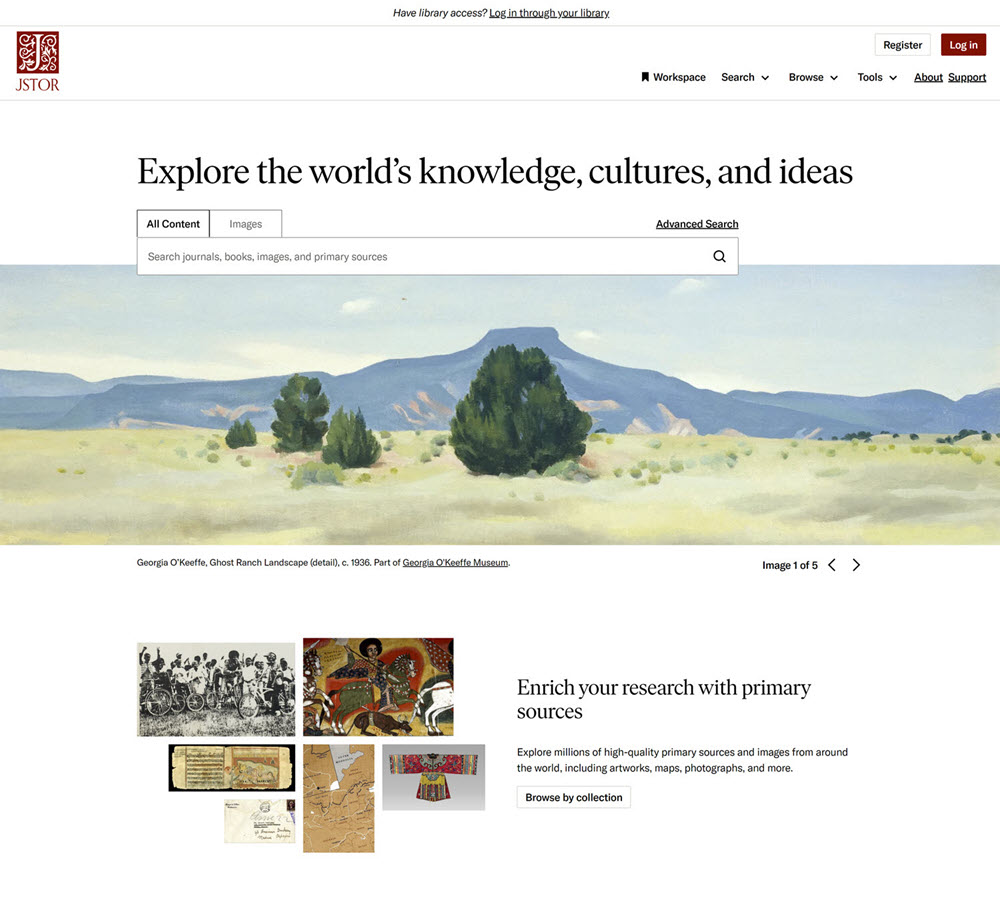
JSTOR is an important scholarly research database for the humanities, social sciences, and sciences. It provides the full text of articles from thousands of influential academic journals. In addition to journal articles, users can access eBooks, book chapters, images, and primary source documents. JSTOR also provides an AI research tool that provides key points and arguments of articles.
JSTOR contains the full text of more than 2,000 journals from 1,000 publishers, with publication dates ranging from 1665 to 2015 (for certain titles). JSTOR also provides:
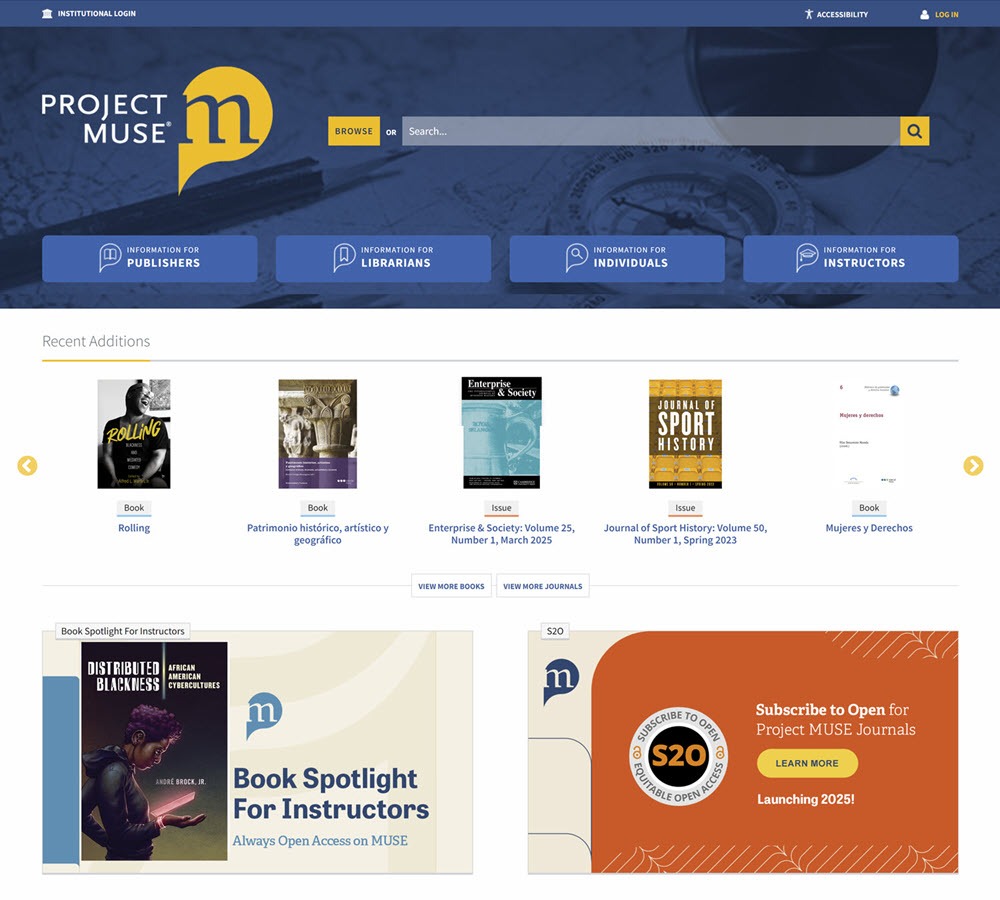
Project MUSE offers online access to a vast collection of scholarly journals, books, and academic resources in the humanities, social sciences, and arts. As a leading provider of digital humanities content, it features high-quality, peer-reviewed publications from prestigious university presses, scholarly societies, and academic publishers.
ProQuest Dissertations & Theses is a database of dissertations and theses from universities worldwide. It provides access to millions of full-text works across many disciplines, including the social sciences, humanities, sciences, and business. Each dissertation includes an abstract or summary that provides a concise overview of the research, its methodology, and key findings.
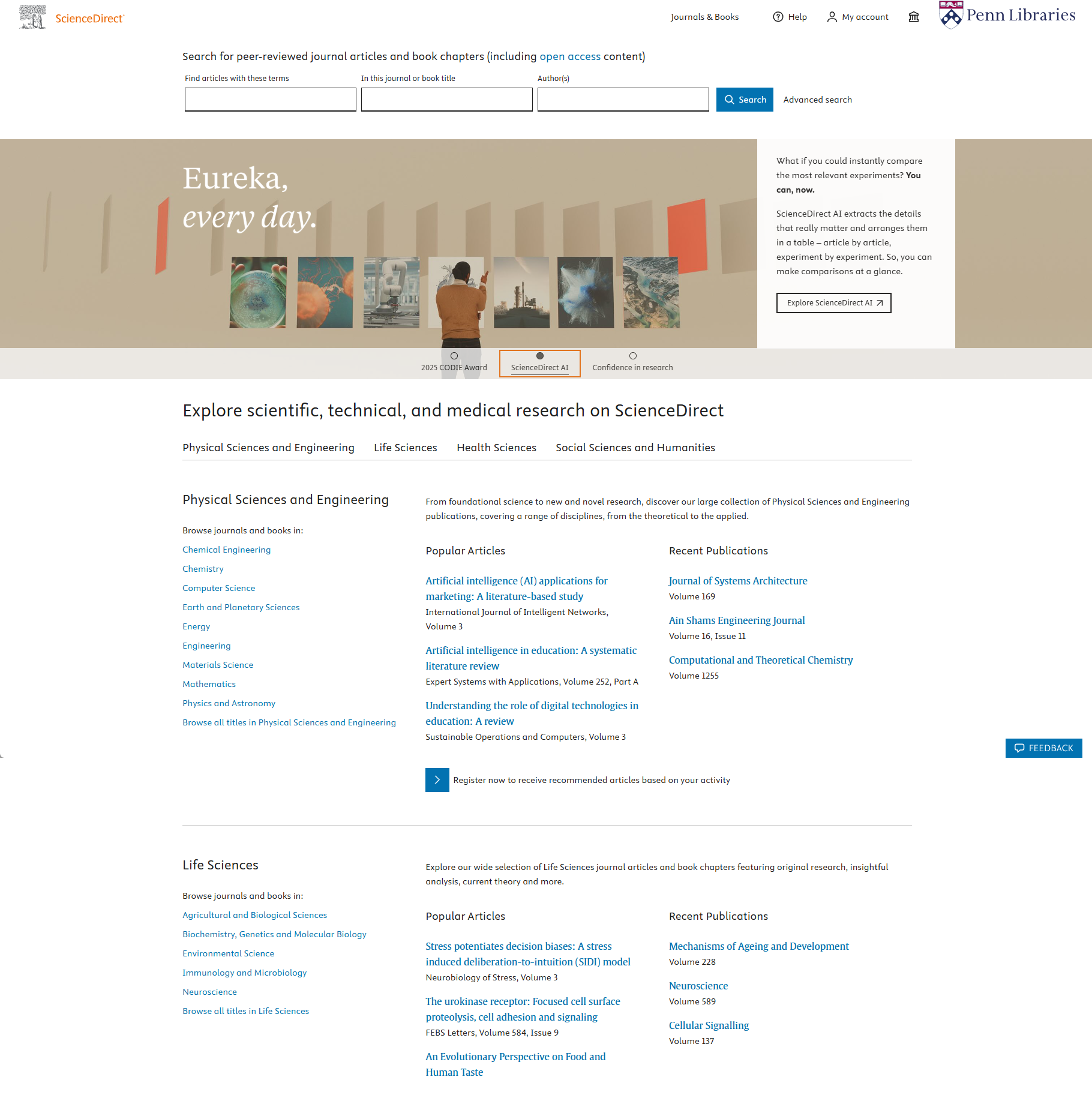
ScienceDirect is a leading full-text scholarly scientific database that provides journal articles and book chapters from more than 2,500 peer-reviewed journals and more than 11,000 books. It covers over 24 major subjects in the physical sciences and engineering, life sciences, health sciences, social sciences, and the humanities.
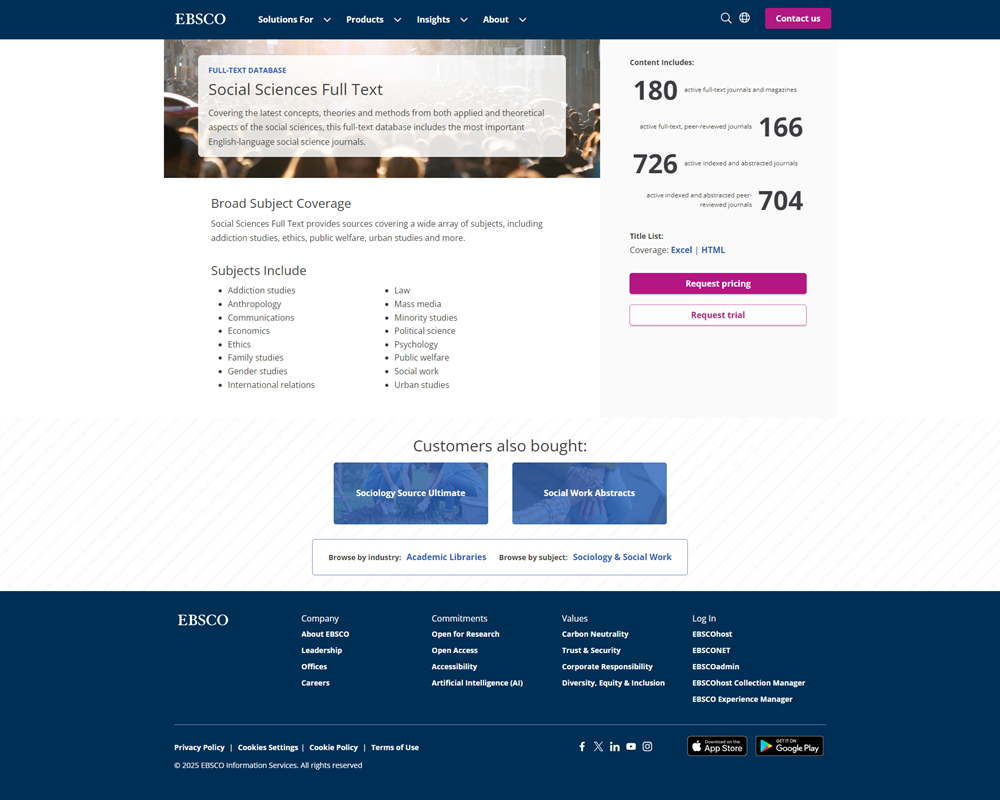
Social Sciences Full Text provides access to a wide range of scholarly literature in the social sciences. It covers many disciplines, including sociology, psychology, international relations, political science, anthropology, economics, and education.
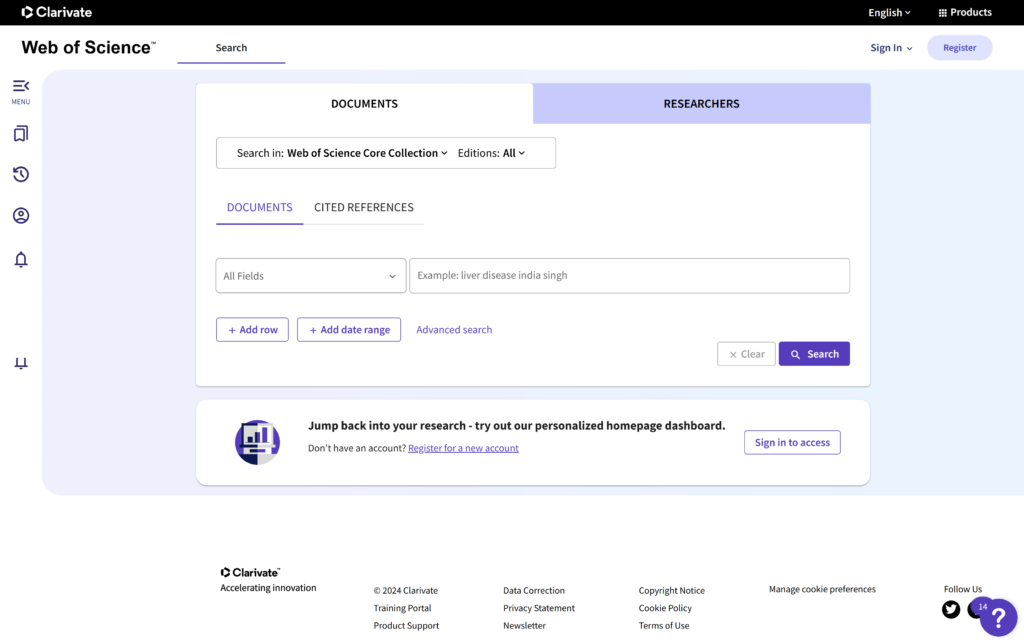
Web of Science is a comprehensive, multidisciplinary research and citation index that provides access to a wide range of scientific, technical, social science, and humanities research. It maintains rigorous criteria for the journals and publications it indexes, ensuring that only high-quality, peer-reviewed content is included. Web of Science includes 98 million papers dating back to 1900.
The Annual Review of Psychology provides authoritative literature review articles that summarize and interpret major developments happening in the field of psychology. Each year, a new volume is released, consisting of articles written by leading experts in the field, providing overviews of the most important and influential research and scholarship in the scientific study of behavior.
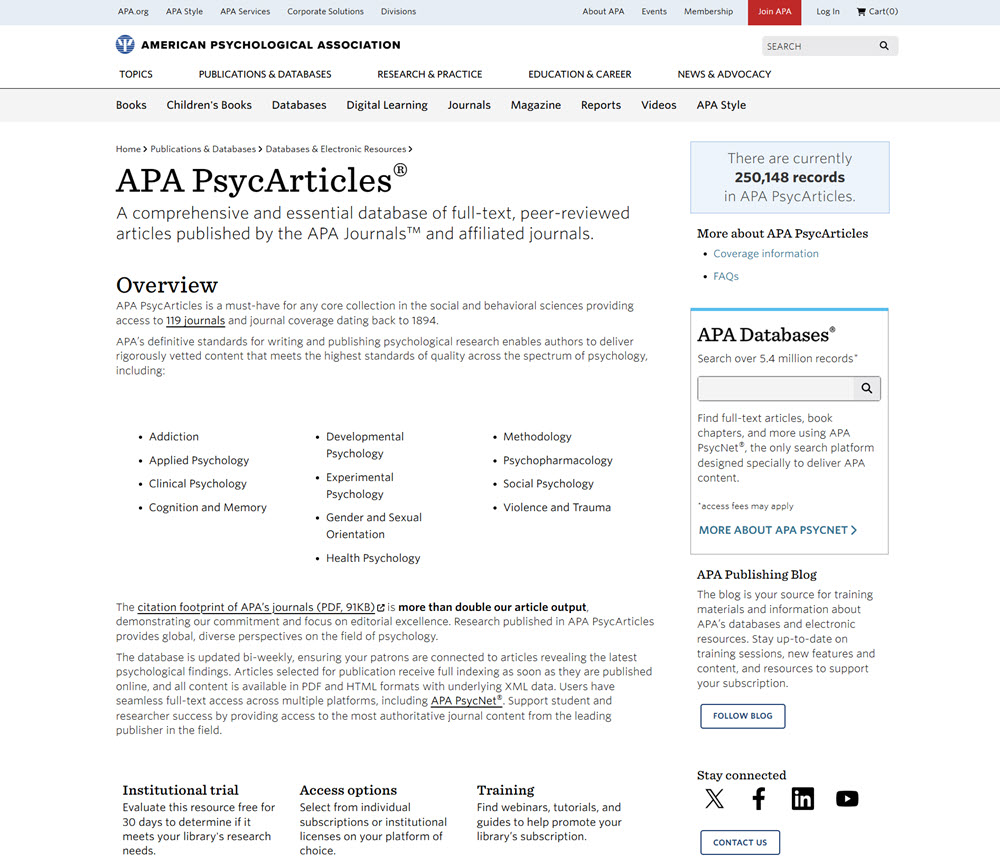
APA PsycArticles® is a research database from the American Psychological Association (APA). It provides full-text, peer-reviewed articles from scholarly journals in psychology and related fields. Provides access to 119 journals back to 1894.
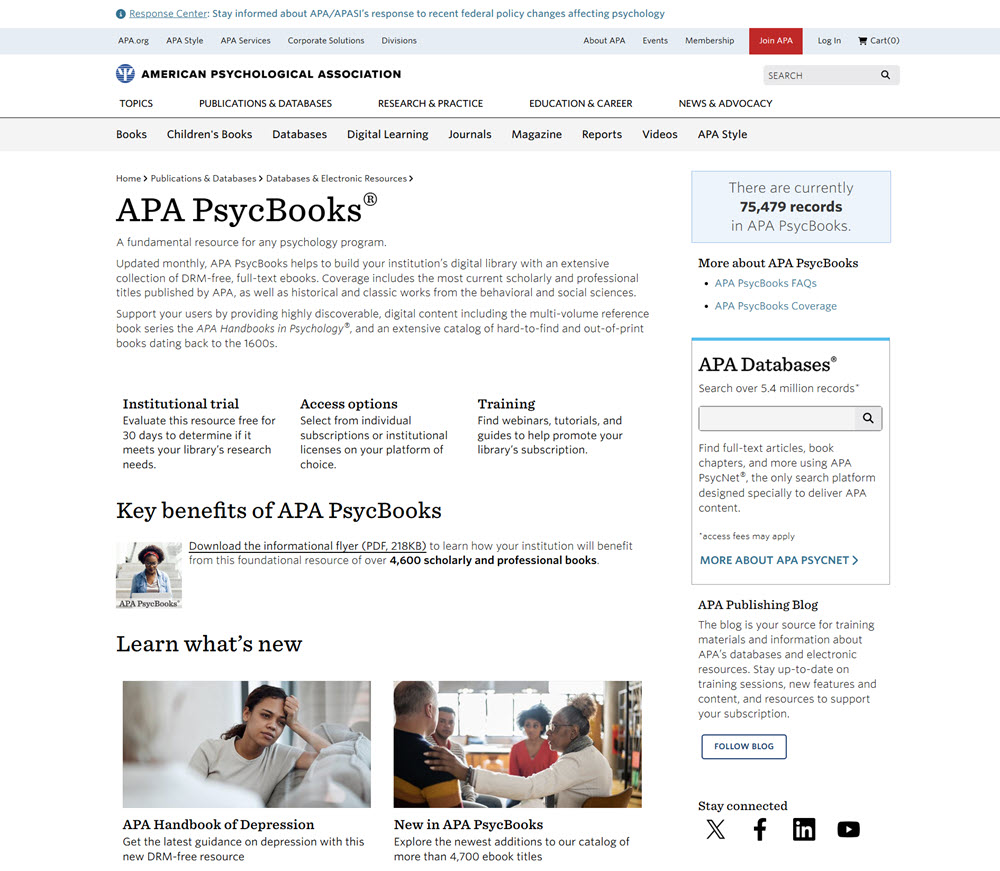
APA PsycBooks is a research database from the American Psychological Association (APA) that provides full-text access to books published by APA and its partners. It includes classic works, handbooks, reference titles, and scholarly books covering many areas of psychology.
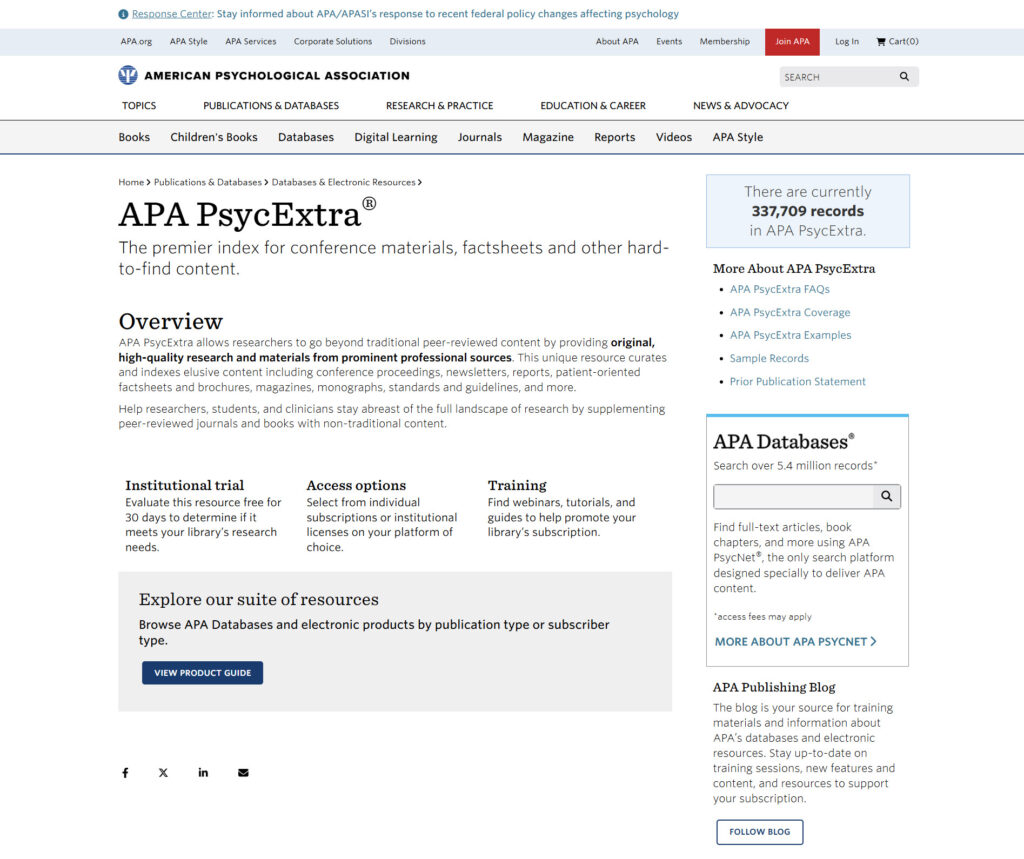
APA PsycExtra is a research database from the American Psychological Association that focuses on psychology-related material you usually won’t find in academic journals. It includes reports, newsletters, conference papers, fact sheets, standards, and other practical documents produced by organizations, researchers, and practitioners.
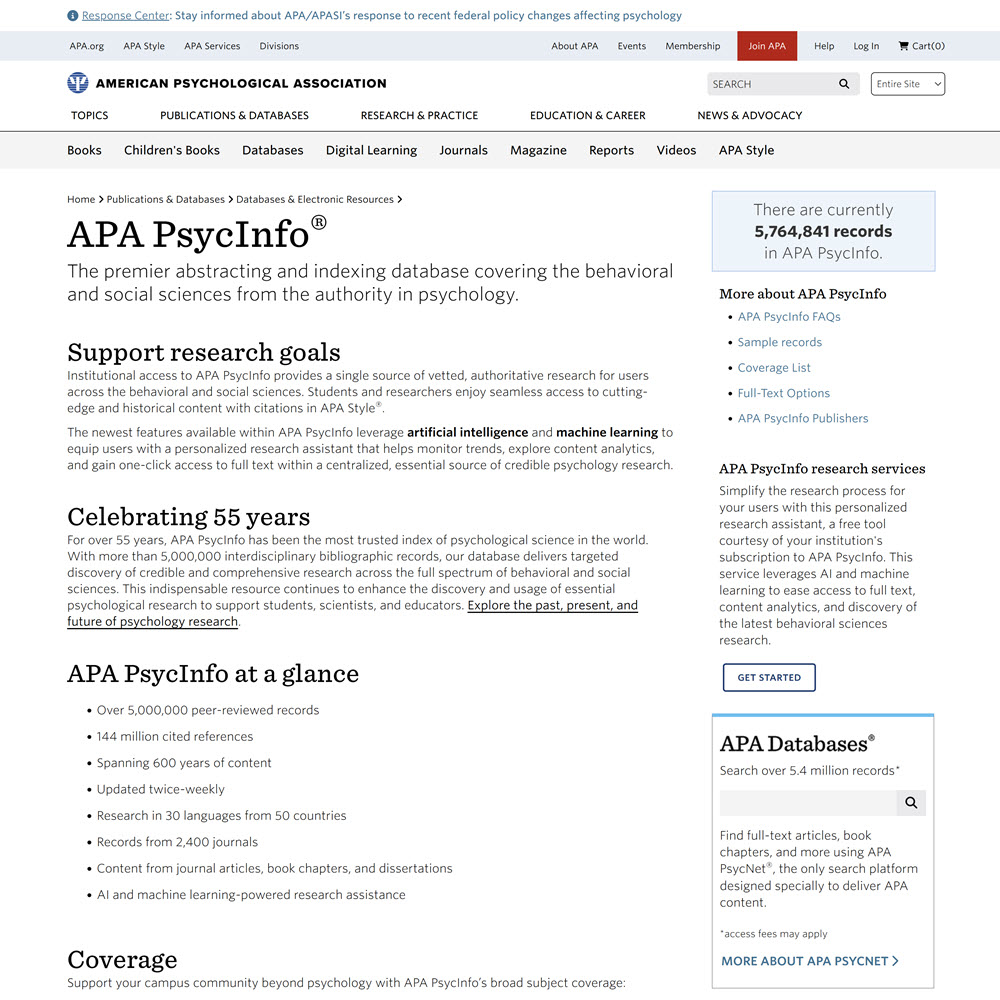
APA PsycInfo is a comprehensive research database produced by the American Psychological Association (APA). It focuses on psychology and related fields, including psychiatry, education, social work, sociology, and more. PsycInfo indexes journal articles, books, chapters, dissertations, and reports in psychology and behavioral sciences. It contains citations, abstracts, and some full text, depending on your library’s subscription level. PsycInfo is available through multiple academic platforms, including EBSCOhost, ProQuest, and OVID.
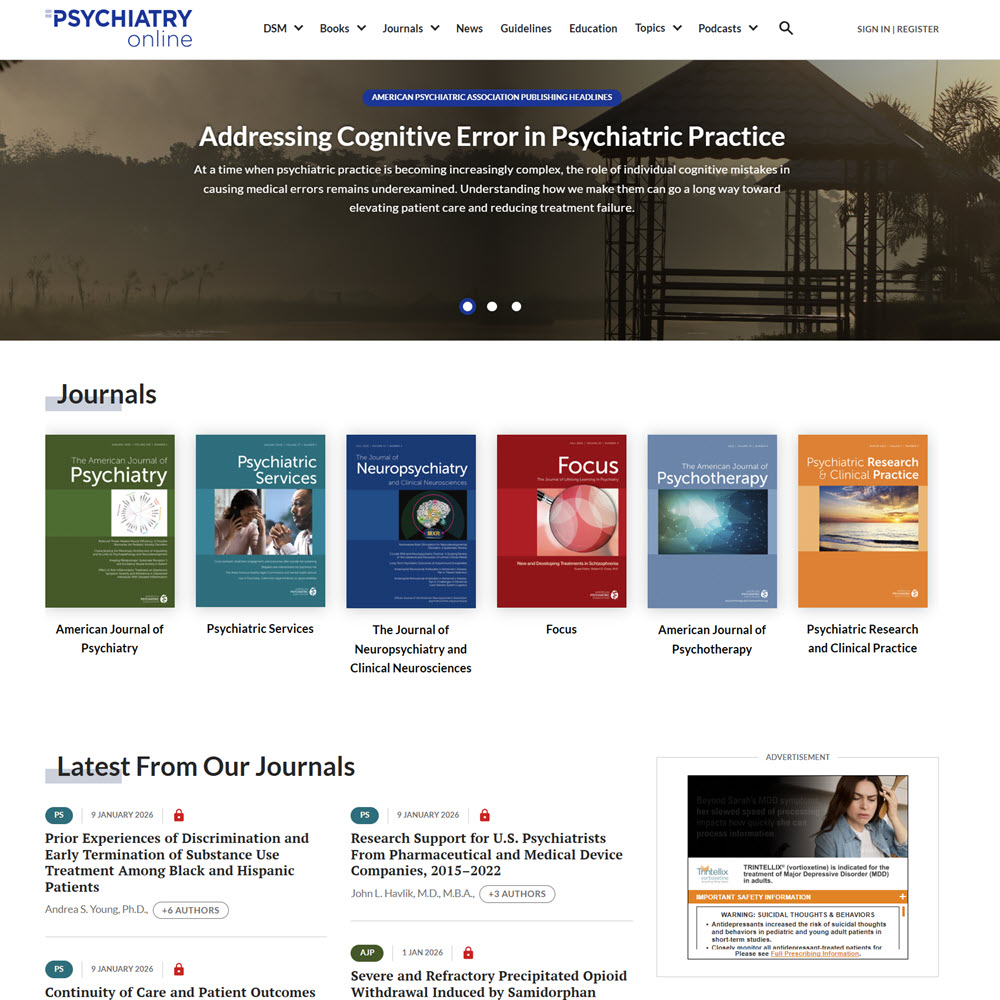
PsychiatryOnline is published by the American Psychiatric Association and provides access to key psychiatry resources. It includes scholarly journals, reference books, and the Diagnostic and Statistical Manual of Mental Disorders (DSM) in one search interface.
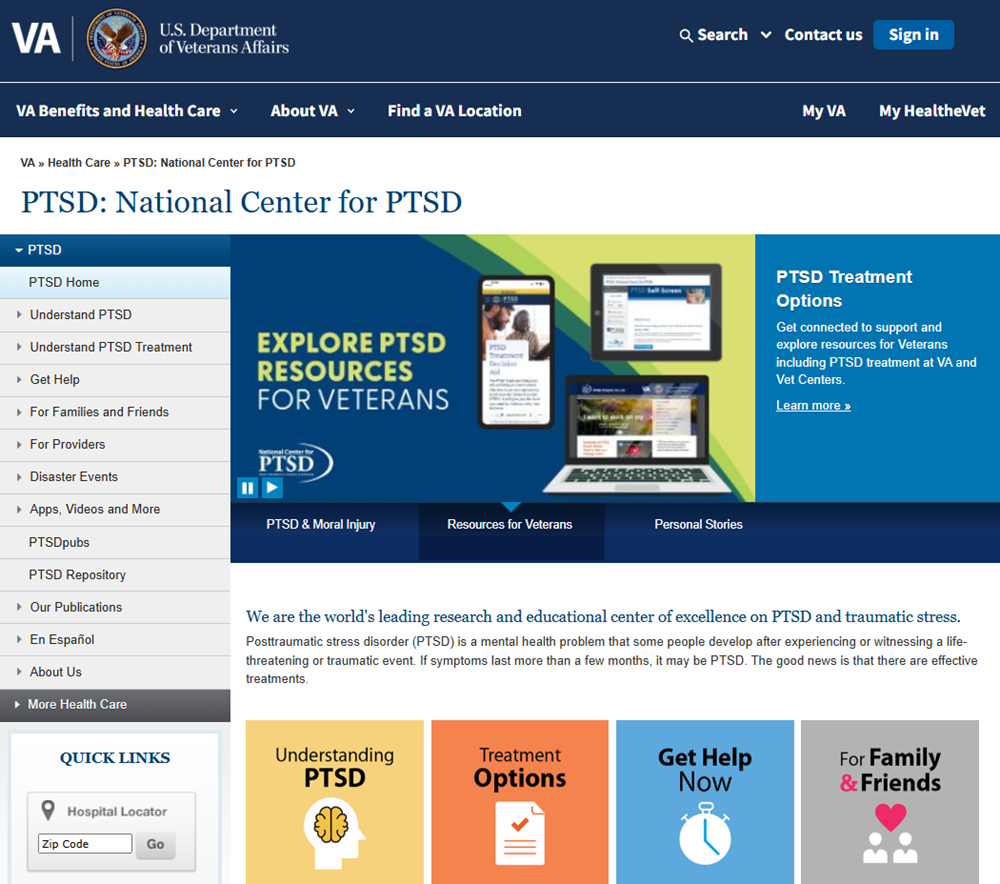
PTSDpubs (from the National Center for PTSD) is a free, online research database that focuses on post-traumatic stress disorder (PTSD) and other mental health effects of trauma. It’s produced by the National Center for PTSD, part of the U.S. Department of Veterans Affairs, and was formerly known as PILOTS (Published International Literature On Traumatic Stress).
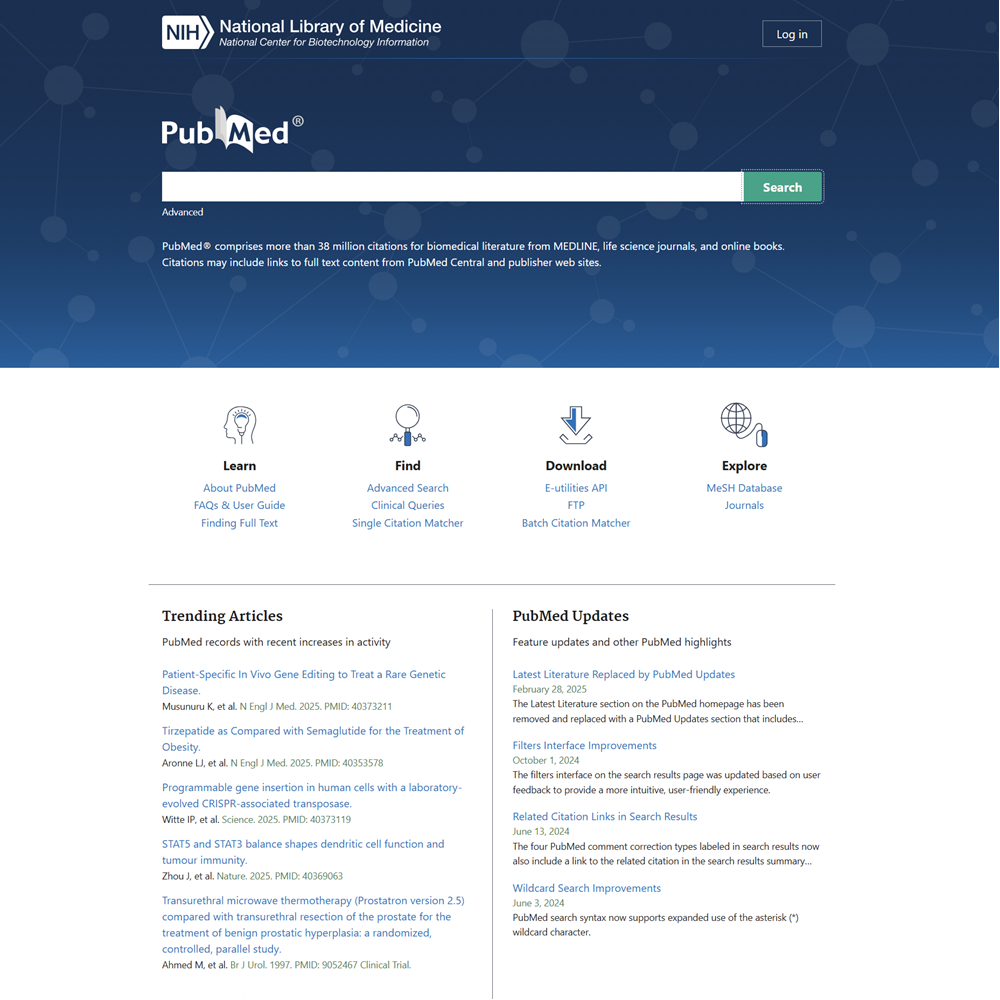
PubMed® is a free, open-access online database from the National Library of Medicine providing research articles about medicine, health, and related fields like biology and psychology. PubMed® provides over 38 million citations and abstracts for biomedical literature from MEDLINE, the National Library of Medicine’s (NLM) main bibliographic database.
Although PubMed® is free to search, it does not own or publish most of the articles. It simply indexes articles found in scientific journals. Some articles link to publisher websites that require payment or institutional access. Check your library’s database resources to see if PubMed is listed and search from there. PubMed will recognize your institution and display “Full Text” buttons if your library subscribes to the journal in which your article is located.
There is no single database that has every test measurement. However, we’ve listed the main databases people rely on for locating psychology tests, instruments, and measurement scales.
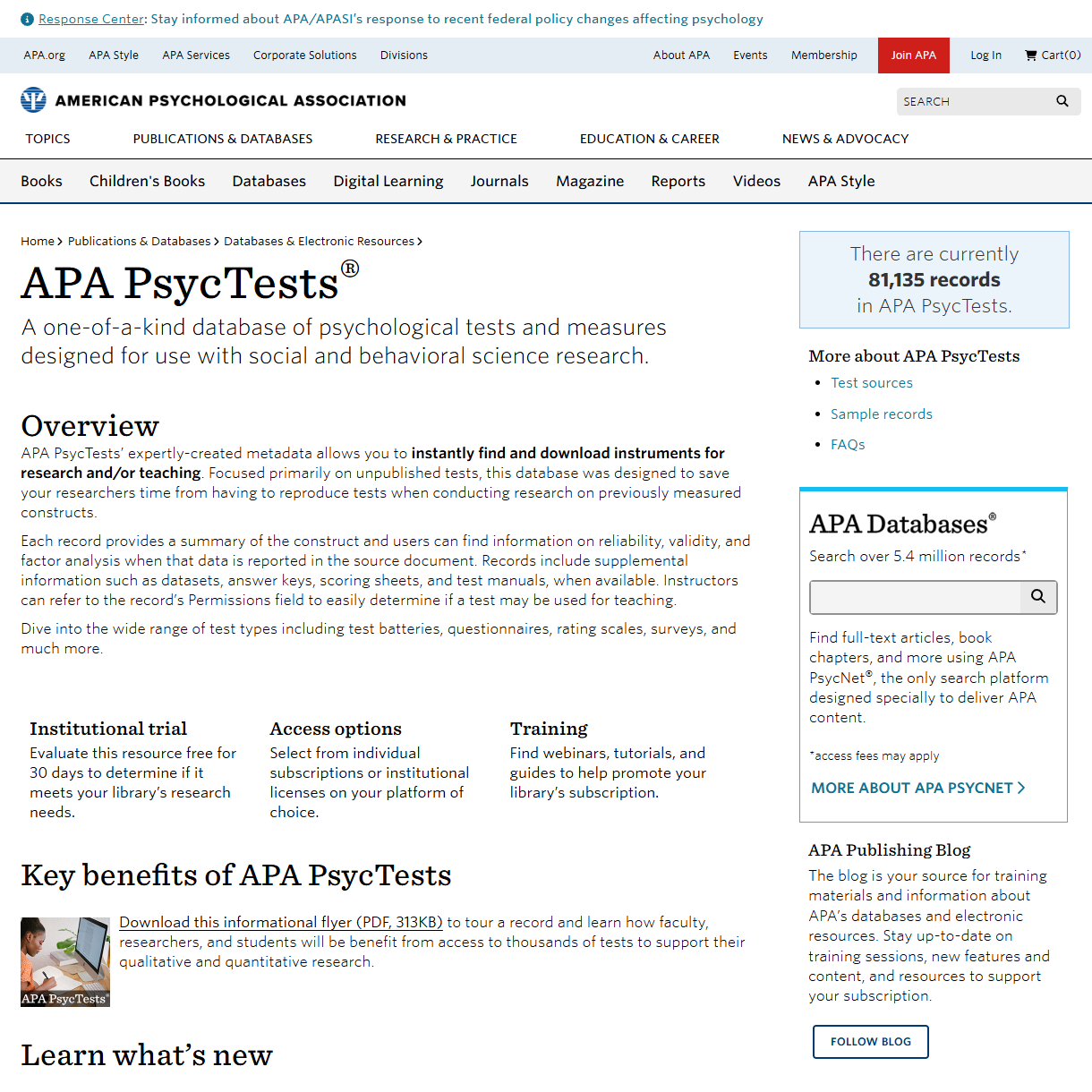
APA PsycTests is a database of psychological tests, measures, and assessment instruments. It includes descriptive records for thousands of tests and provides the full text of many research instruments, along with information on administration, scoring, reliability, validity, and supporting literature. 75% of the tests in APA PsycTESTS include the actual test instrument in full text.
ERIC (Education Resources Information Center) is an internet-based digital library of education research and information sponsored by the Institute of Education Sciences (IES) of the U.S. Department of Education, providing access to journal and non-journal literature from 1966 to the present. We link to the free public version; however, subscription versions are available through EBSCO (EBSCOhost), ProQuest, and Ovid.
Although ERIC is not a dedicated test database like APA PsycTests or Health and Psychosocial Instruments (HaPI), it is an excellent resource for finding information about educational and psychological assessments, particularly those used in schools and educational settings.
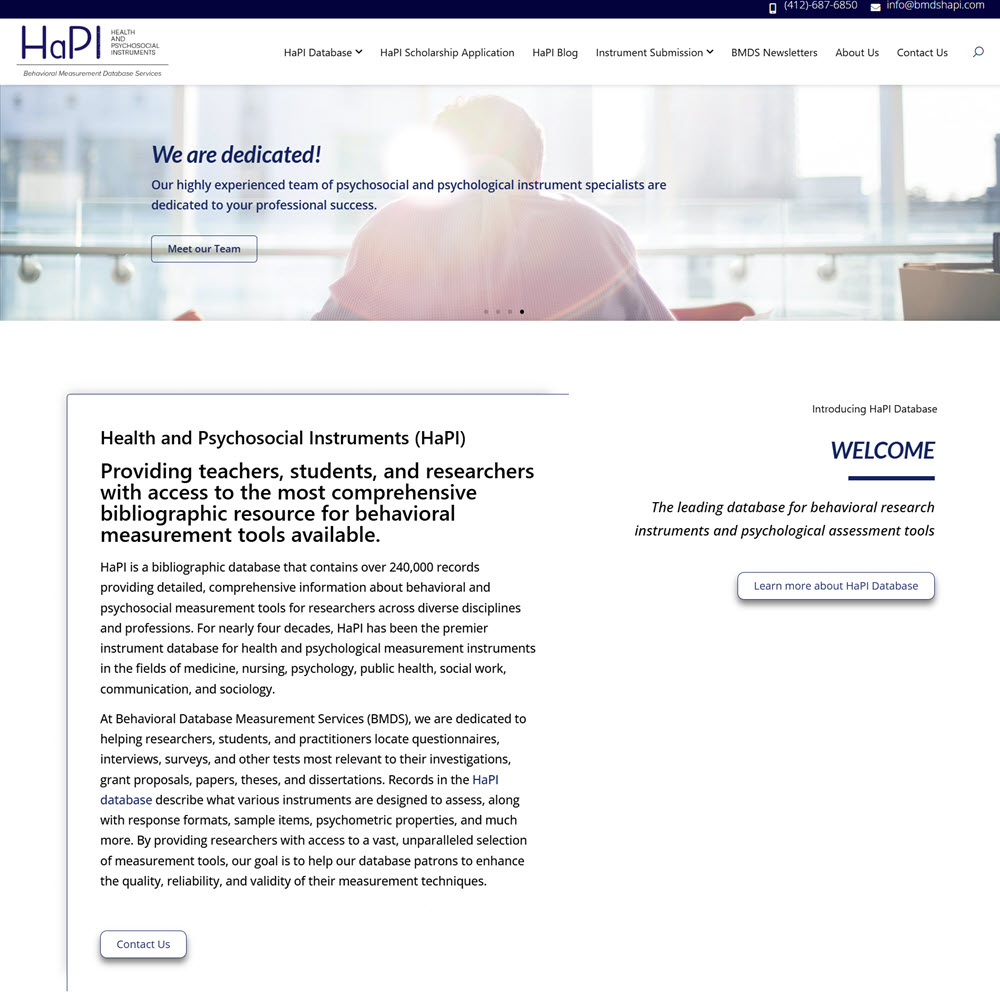
Health and Psychosocial Instruments (HaPI) produced by Behavioral Measurement Database Services (BMDS), is an index-only database of non-commercial behavioral instruments in the health and social sciences. It helps researchers identify and evaluate health and psychosocial measurement instruments. It generally does not provide the full text of the instruments themselves. Instruments include questionnaires, rating scales, surveys, interview schedules, checklists, coding schemes, tests, and other measurements. HaPI is available on two platforms: EBSCO and OvidSP.
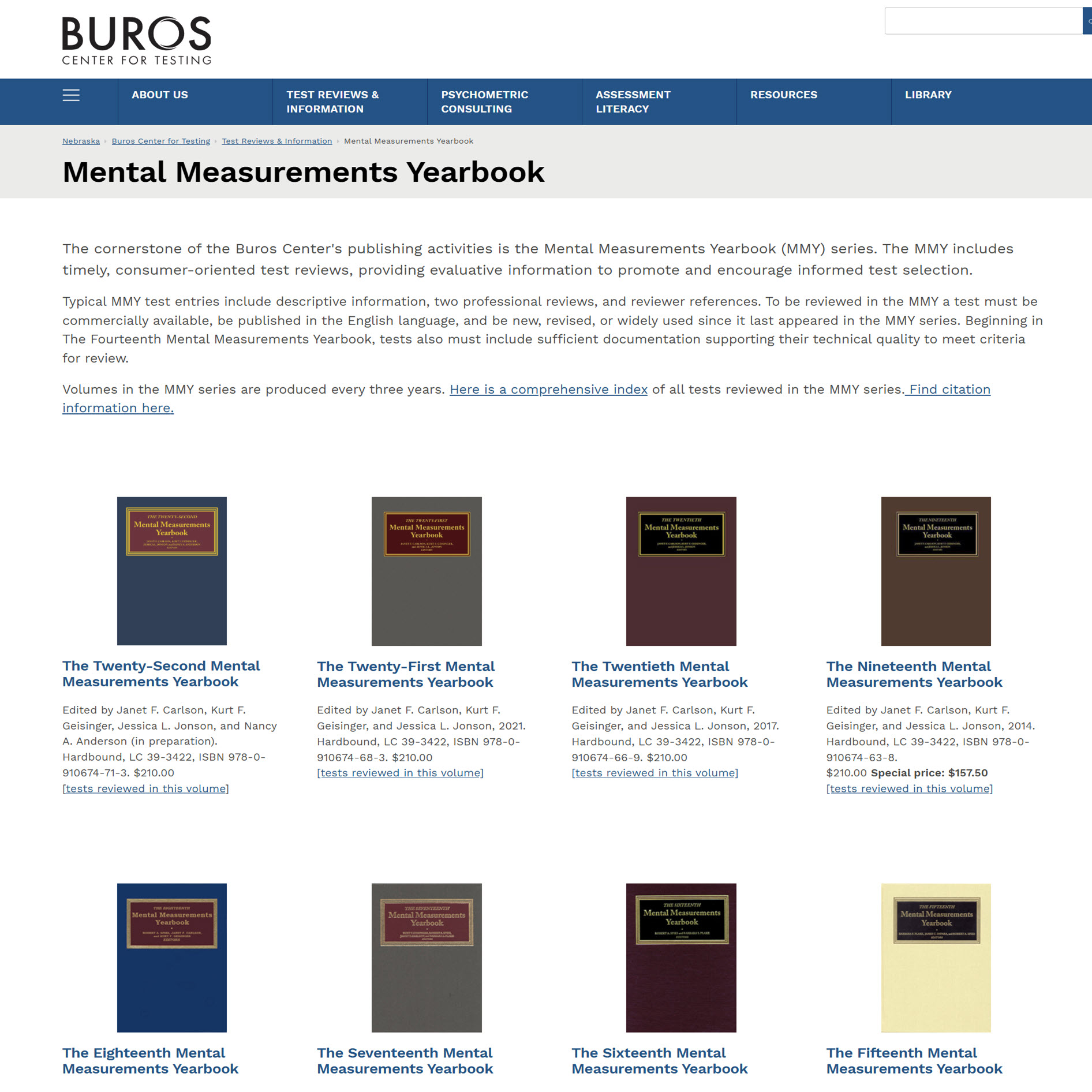
Mental Measurements Yearbook is a comprehensive reference resource for evaluating commercially published psychological, educational, and occupational tests. It includes full-text, expert reviews of tests, but it does not provide the full text of the tests themselves. Available through the EBSCO platform.
ProQuest Dissertations & Theses is a database of published dissertations and theses from universities worldwide. Graduate researchers are required to fully document their methodology, which may include test instruments. To locate test instruments, search the instrument’s full name in quotes.
If the dissertation is available in full text, the instrument may appear:
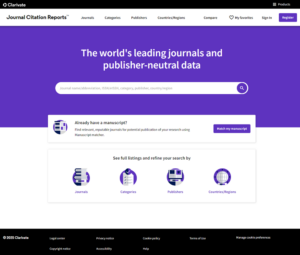
Journal Citation Reports (JCR) is widely regarded as the leading subscription-based resource for identifying high-quality, peer-reviewed journals and assessing the impact, influence, and quality of scholarly journals across all academic disciplines. To learn more about JCR and journal impact, go to Journal Databases.
Psychological Bulletin is an academic journal that publishes reviews of existing research in psychology rather than new experiments. It brings together findings from many studies to explain what is already known about a topic and where research is still needed.
Psychological Medicine is a peer-reviewed academic journal that publishes research on mental health, psychiatry, and clinical psychology. It contains studies on topics such as depression, anxiety, schizophrenia, and treatments for mental disorders. It covers a mix of biological, psychological, and social aspects of mental illness, including studies on causes, treatments, and how disorders affect the brain and behavior.
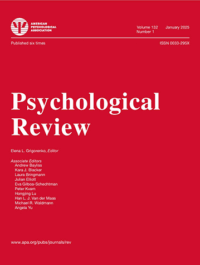
Psychological Review is a scholarly journal focused on major theories about how the mind works. It publishes articles on broad ideas and frameworks that advance psychological science. It publishes theories rather than experiments, and new ideas, models, or frameworks that help explain how the mind works, instead of reporting fresh data from studies.

The Annual Review of Psychology is a journal that summarizes and explains important developments in psychology, providing clear overviews of research findings and trends across different areas of the field. It covers major areas such as the biological bases of behavior, cognition, human development, clinical psychology, and social psychology. It comes out once a year, giving researchers a yearly snapshot of where the field stands.
Frontiers in Human Neuroscience is an open-access journal that publishes research how the brain and nervous system influence human thoughts, emotions, perception, and behavior. It covers topics such as cognition, memory, language, and brain function, including how these processes develop, mature, and decline with age.
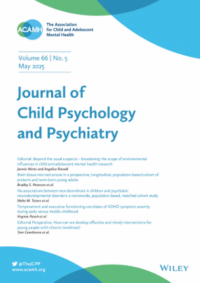
Journal of Child Psychology and Psychiatry is a peer-reviewed journal that publishes original research and clinical studies on the mental health, development, and behavior of children and adolescents. Topics covered include emotional disorders, learning difficulties, neurodevelopmental conditions, and the factors that influence psychological well-being, helping to improve understanding and care for young people.
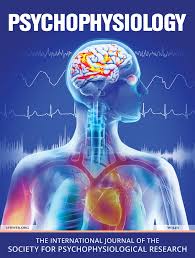
Psychophysiology is a peer-reviewed journal that publishes research on how the brain and body work together to influence thoughts, emotions, and behavior. It features studies using methods such as brain imaging, physiological measurements, and cognitive experiments to better understand the biological processes underlying human experience and mental functioning.

The Journals of Gerontology: Series B is a peer-reviewed journal that publishes research on the psychological and social aspects of aging. It has two sections: one on psychology and one on social sciences. The psychology section covers topics such as cognition, emotion, neuropsychology, and personality as they relate to aging, while the social sciences section looks at topics like caregiving, retirement, and social relationships among older adults.
Psycho-Oncology is a peer-reviewed journal that publishes research on the psychological, social, and emotional aspects of cancer. It looks at how patients, their families, and caregivers respond psychologically to cancer, and how psychological, behavioral, and social factors might influence the disease itself. It examines how cancer affects patients, families, and caregivers, as well as ways to improve mental health, quality of life, and supportive care throughout the cancer experience.
Vision Research is a peer-reviewed journal that publishes research on how humans and animals see and process visual information. It covers topics such as perception, eye movements, color vision, visual attention, and the neural mechanisms of sight, helping researchers better understand how the visual system supports behavior and everyday experience.
Psychology news and magazine sources highlight emerging research topics and trends, sparking ideas for research.
Most U.S. newspapers do not have a standalone “Psychology News” section; however, many major city newspapers publish psychology-related reporting under health sections. Here are links to some of the best-known news sources you will likely already be familiar with. While some of the articles will be free to read, each requires a subscription for full access to most articles. Do a title search in your library’s catalog to see if your institution has a subscription.
In most cases, online magazine articles are free to read. However, some of the following resources have a subscription icon, which indicates that you will need a subscription to read most of the articles on the site (although a few articles may be initially free). Check your library catalog to see if the titles are available through your institution.
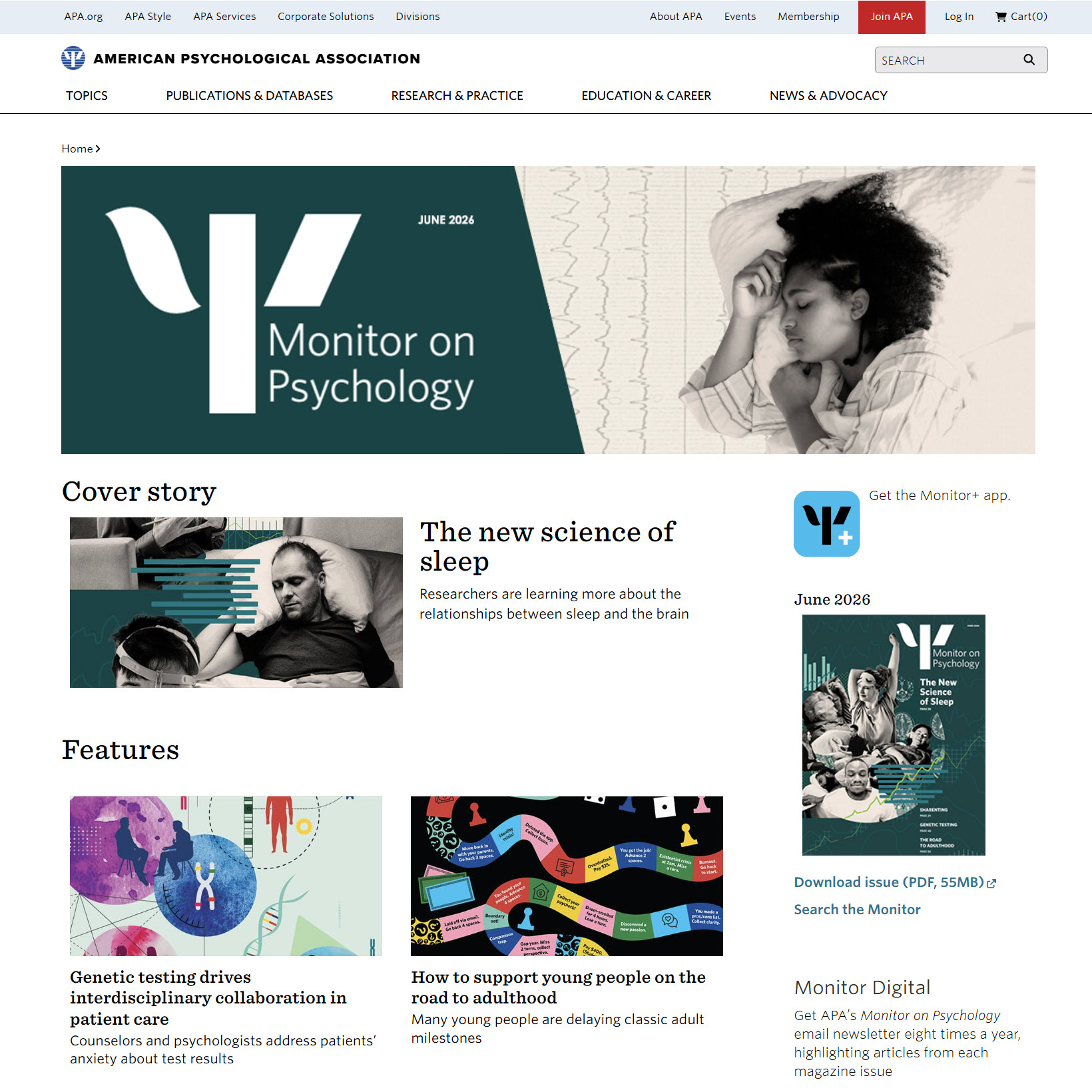
Monitor on Psychology is the magazine of the American Psychological Association, the largest professional organization for psychologists in the United States. It reports on developments across the field, including new research, trends in mental health care, workplace and education issues, ethics, and news about the association and its policies. It’s available in print and online at the APA’s website.
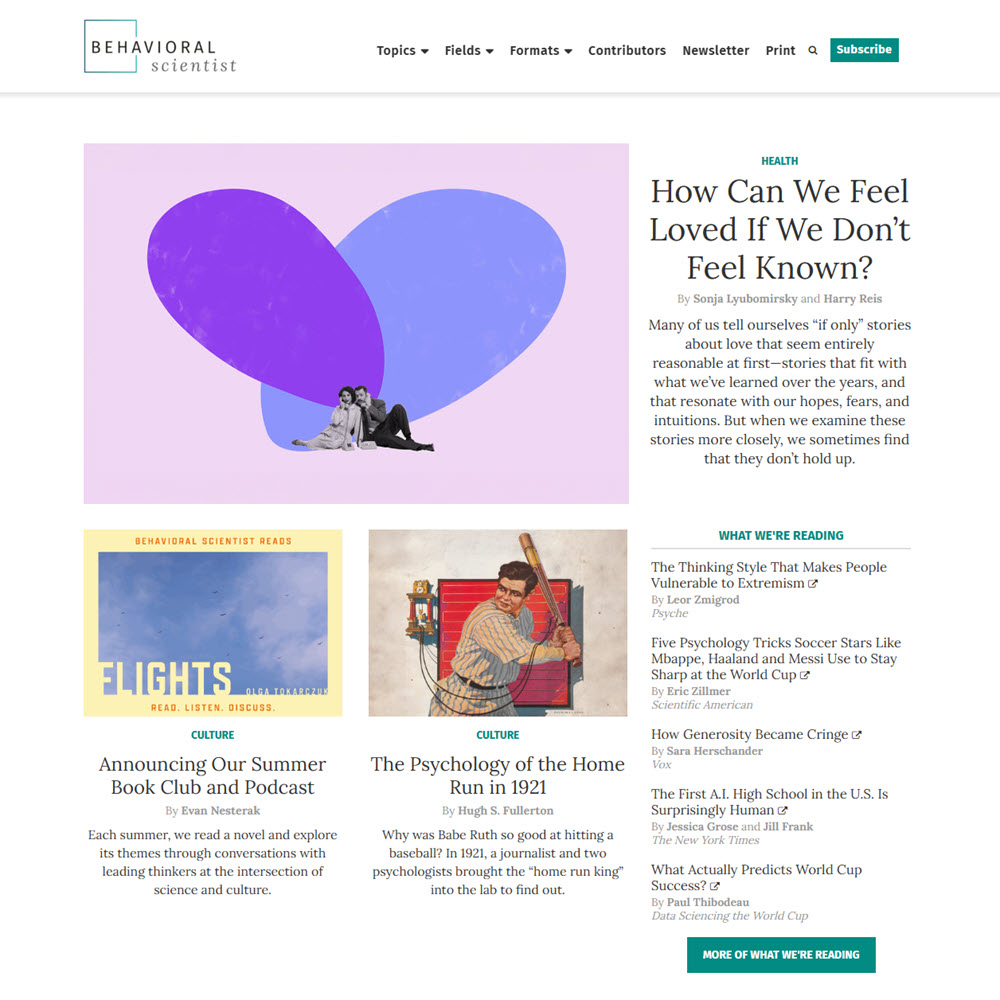
Behavioral Scientist is a digital magazine started in 2017 that publishes original reports on behavioral science and human behavior. Its content is largely written by academic and applied behavioral scientists who write columns and commentaries on social, political, economic, and technological challenges.
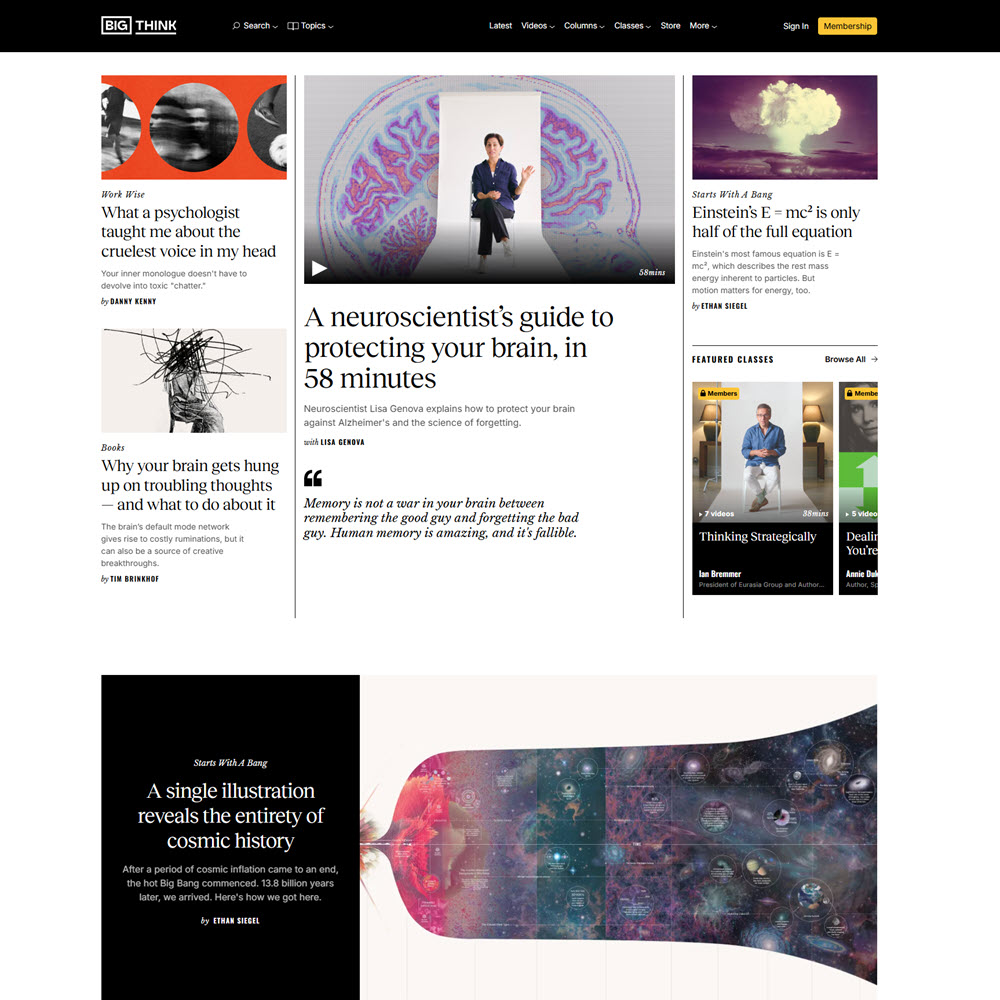
Big Think is a digital magazine that provides articles on science, technology, business, and philosophy accessible to general readers. Big Think also explores psychology topics such as human behavior, decision-making, mental health, and the science of the mind.
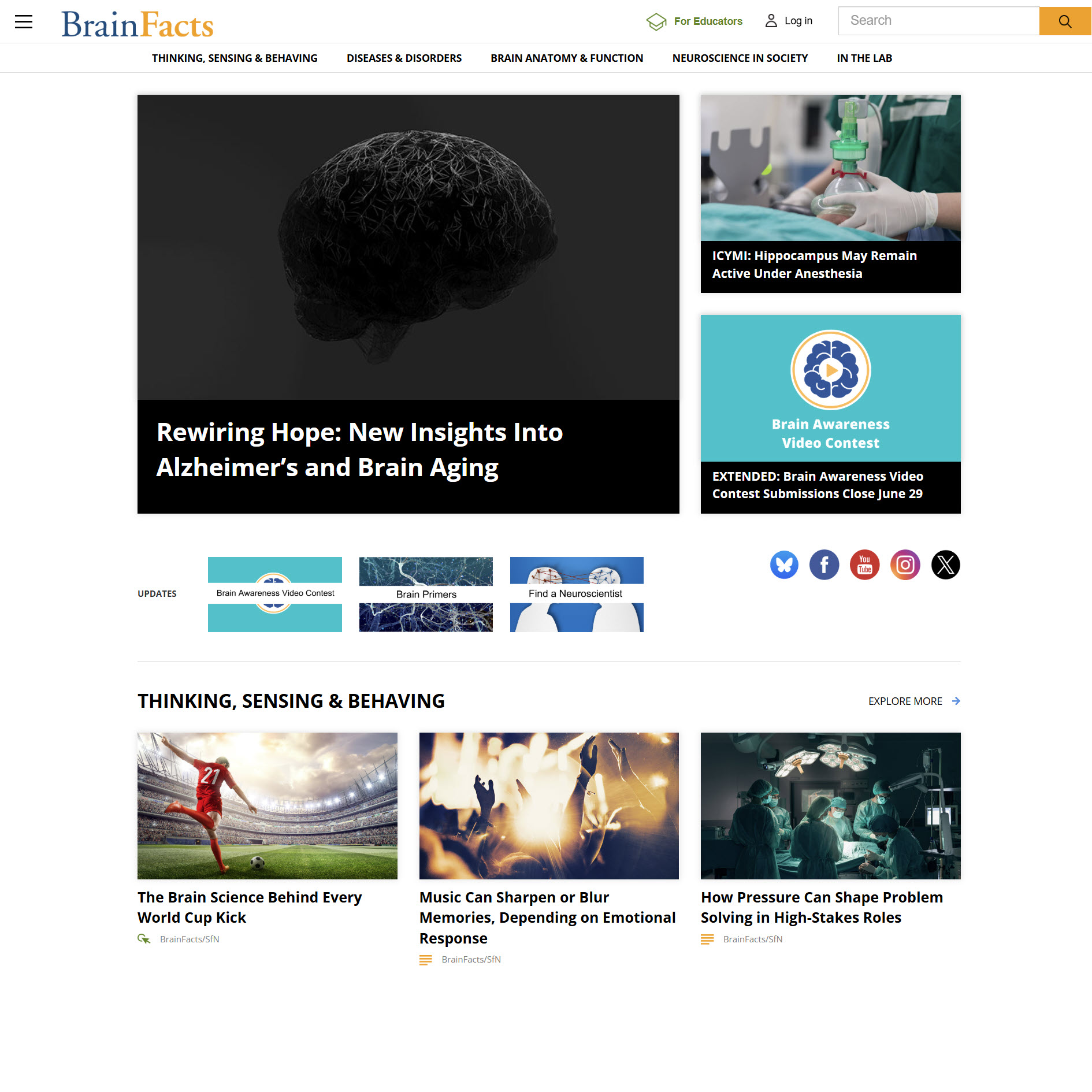
BrainFacts.org is a free website about the brain and nervous system, run by the Society for Neuroscience with support from the Dana Foundation. Developed specifically for the general public, students, and teachers, it publishes articles on how the brain works, including topics like memory, sleep, emotions, addiction, Alzheimer’s, and brain development.
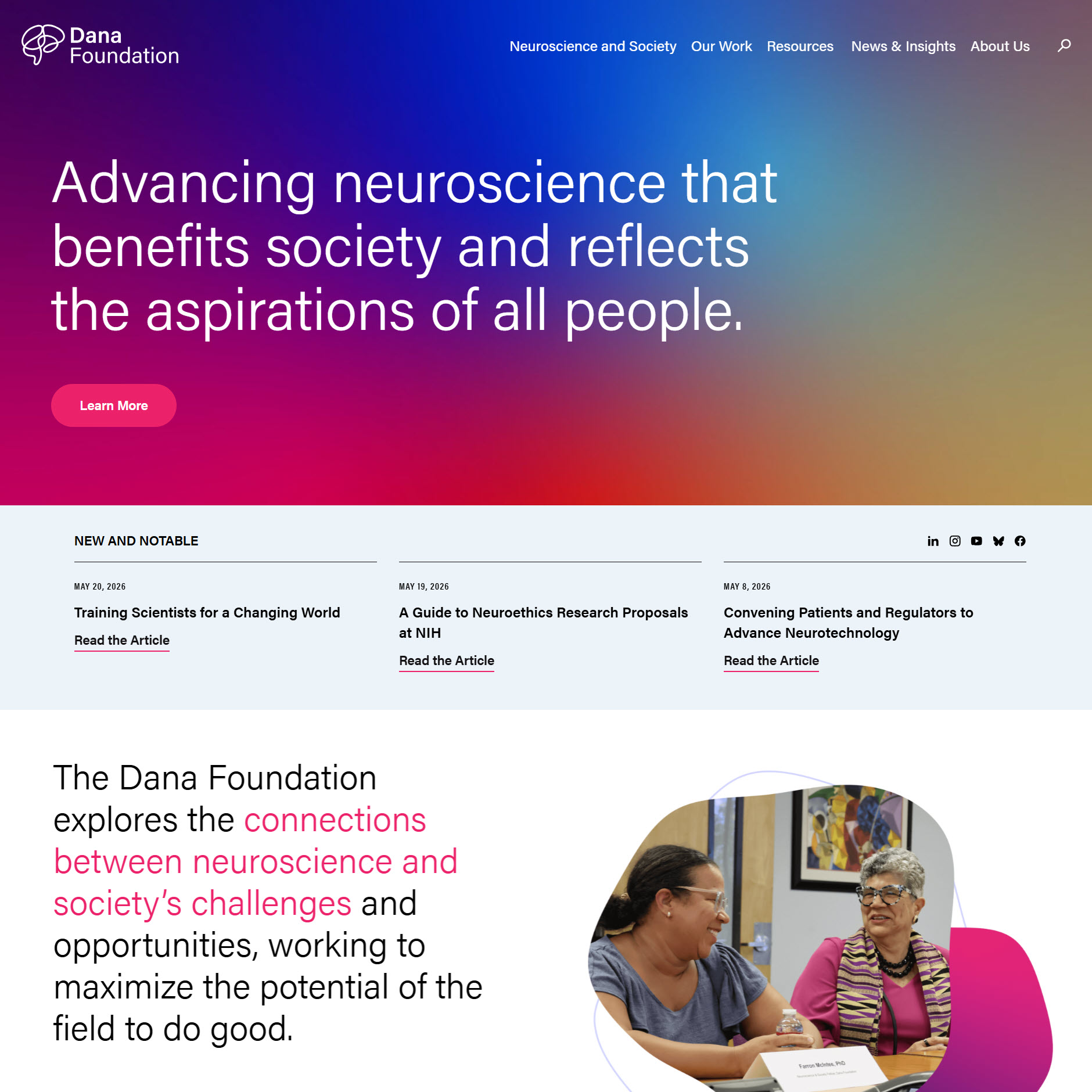
Dana.org is the official website of the Dana Foundation, a nonprofit organization working in the field of neuroscience and brain research. It provides news articles and resources about the role of brain research in everyday life, including topics like addiction, the aging brain, neuroethics, law, and education.
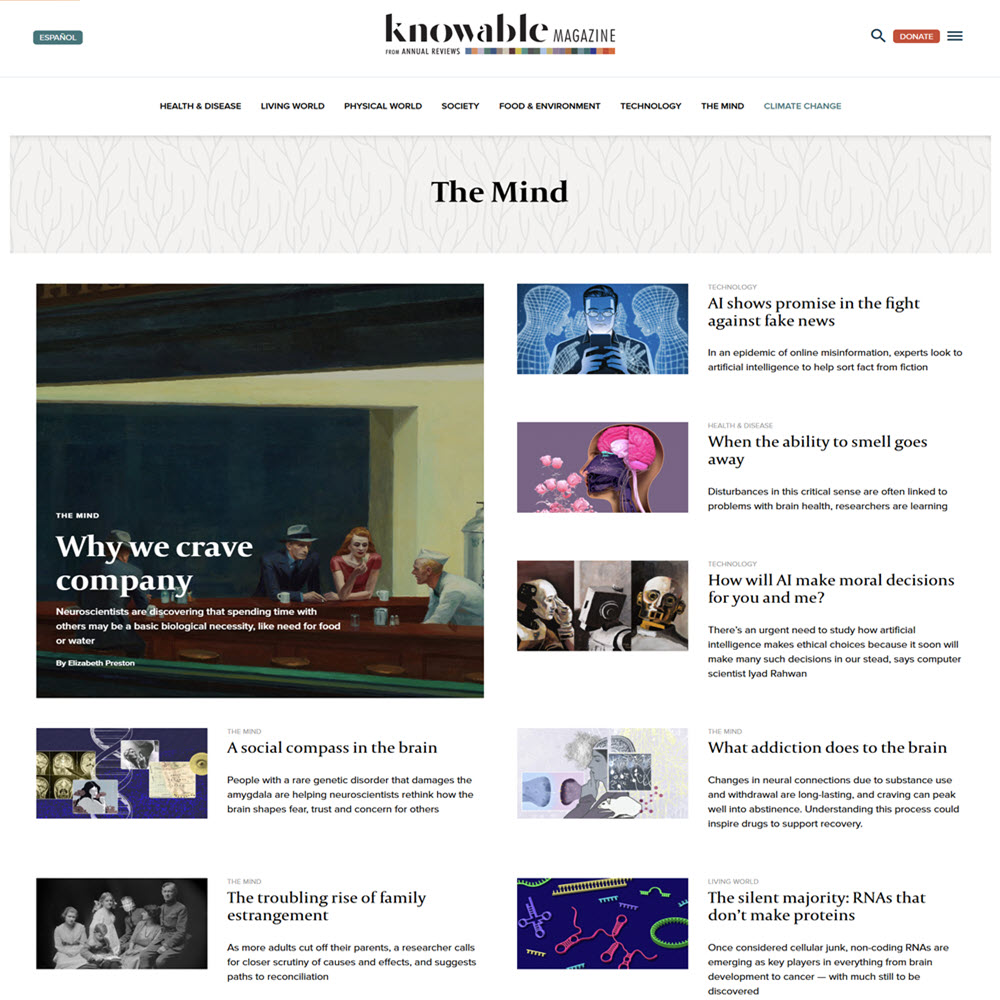
Knowable Magazine is a free, nonprofit digital publication from Annual Reviews that translates scholarly research into engaging, accessible journalism. It explores what researchers know—and are still discovering—across science, health, technology, psychology, society, and the environment.
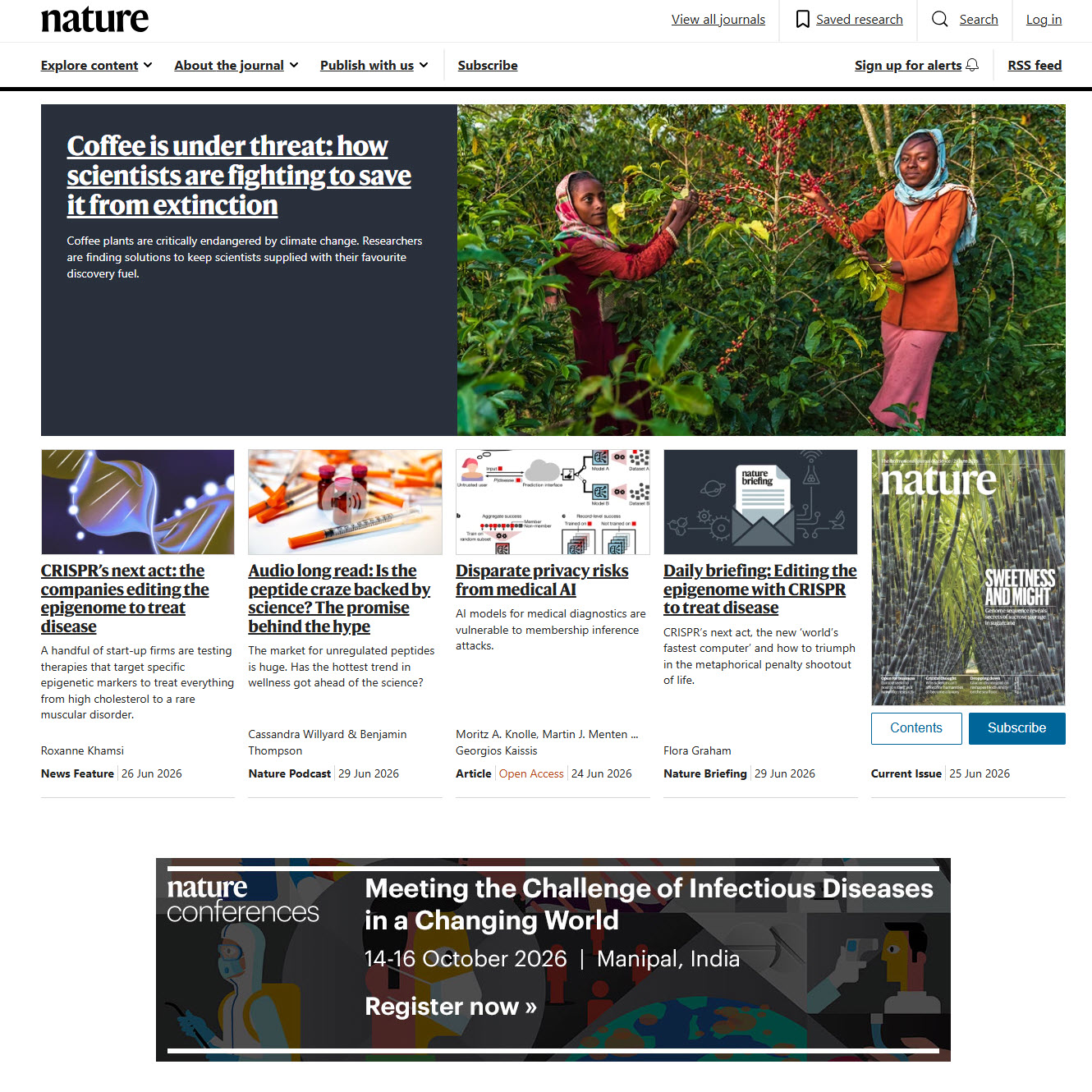
Nature – Psychology provides psychology-related research, news, commentary, and reviews published on Nature.com, one of the most authoritative online sources for scientific research and news. Coverage includes topics such as cognition, behavior, memory, mental health, social interaction, and emerging developments in psychological and behavioral science.
Nautilus is an award-winning popular science and culture magazine known for combining serious scientific ideas with unusually strong narrative writing, illustration, philosophy, and the humanities. As an interdisciplinary magazine, its articles range from physics, astronomy, and biology to neuroscience, psychology, anthropology, geology, ecology, technology, and mathematics.
The Observer is the member magazine of the Association for Psychological Science, a US-based organization for researchers in psychology. Published since 1988, it provides new research findings, profiles of scientists, teaching tips, career advice, and updates on the organization itself. It’s available both in print and online at the APS website.
Psych Central is an evidence-based consumer mental health and psychology website, owned by Healthline Media since 2020. It publishes articles on psychological conditions such as depression, anxiety, ADHD, bipolar disorder, and PTSD, along with content on therapy, relationships, and everyday coping.
Psychology Today is a well-known magazine and popular website that provides articles on the psychology of everyday life. It includes coverage of issues such as personal relationships, mental health, parenting, personality, and personal growth. Most of its content is written by contributing psychologists, therapists, and academics who write short, easy-to-read articles.
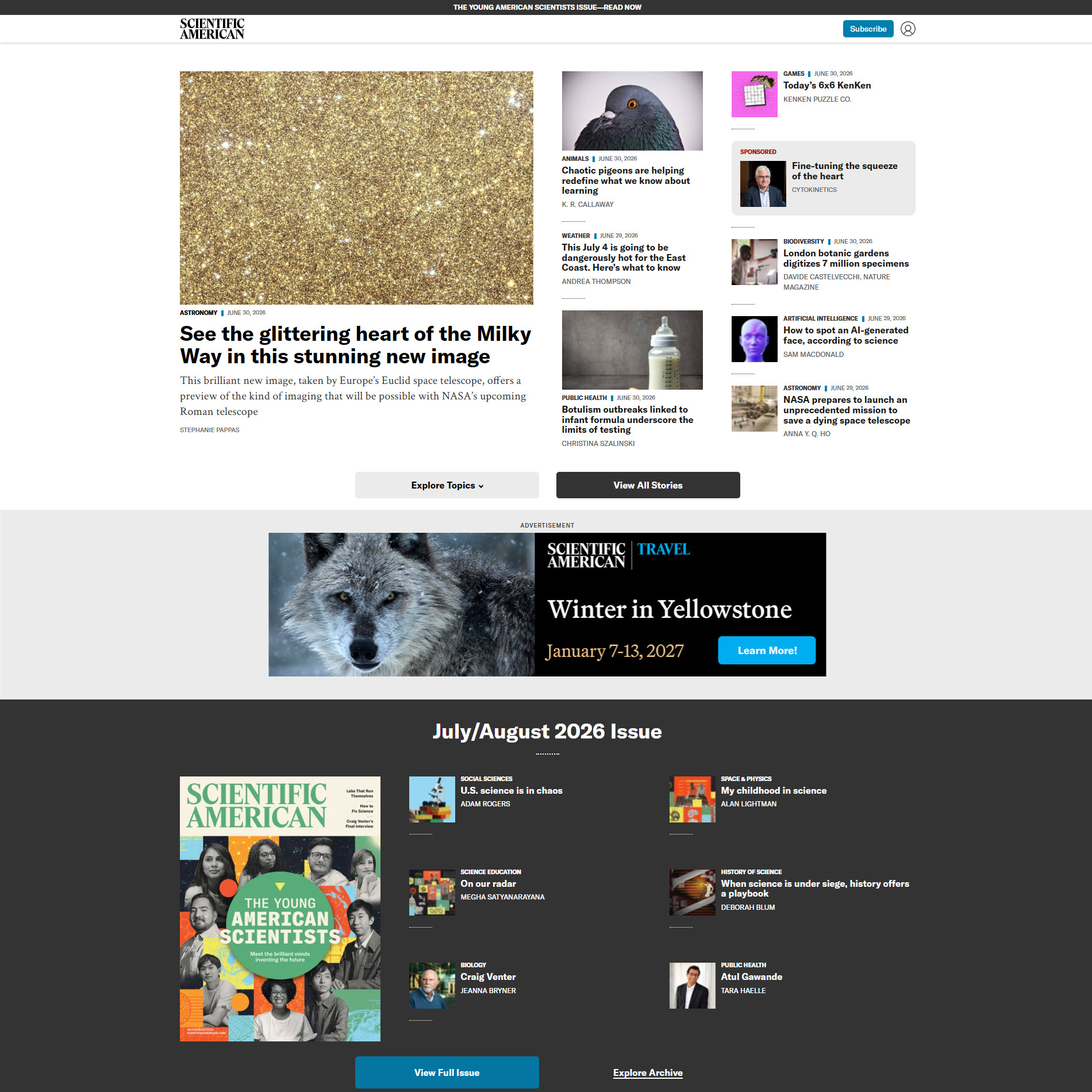
Scientific American – Mind & Brain is the brain research section of Scientific American, the well-known popular science magazine available in print and online. It provides articles on the latest discoveries in neuroscience, psychology, cognition, and mental health. Research-based articles focus on explaining how the brain works and why people think and behave as they do.
Verywell Mind is a mental health and psychology website that provides expert-reviewed articles, practical wellness advice, and the latest research on topics such as emotional health, relationships, stress, therapy, personality, and psychological science. Content is written by journalists and mental health professionals and reviewed by a board of clinicians.
We’ve listed the best quality online university psychology department news pages from major universities. Each features easy-to-read articles on psychology research, discoveries, and human behavior.
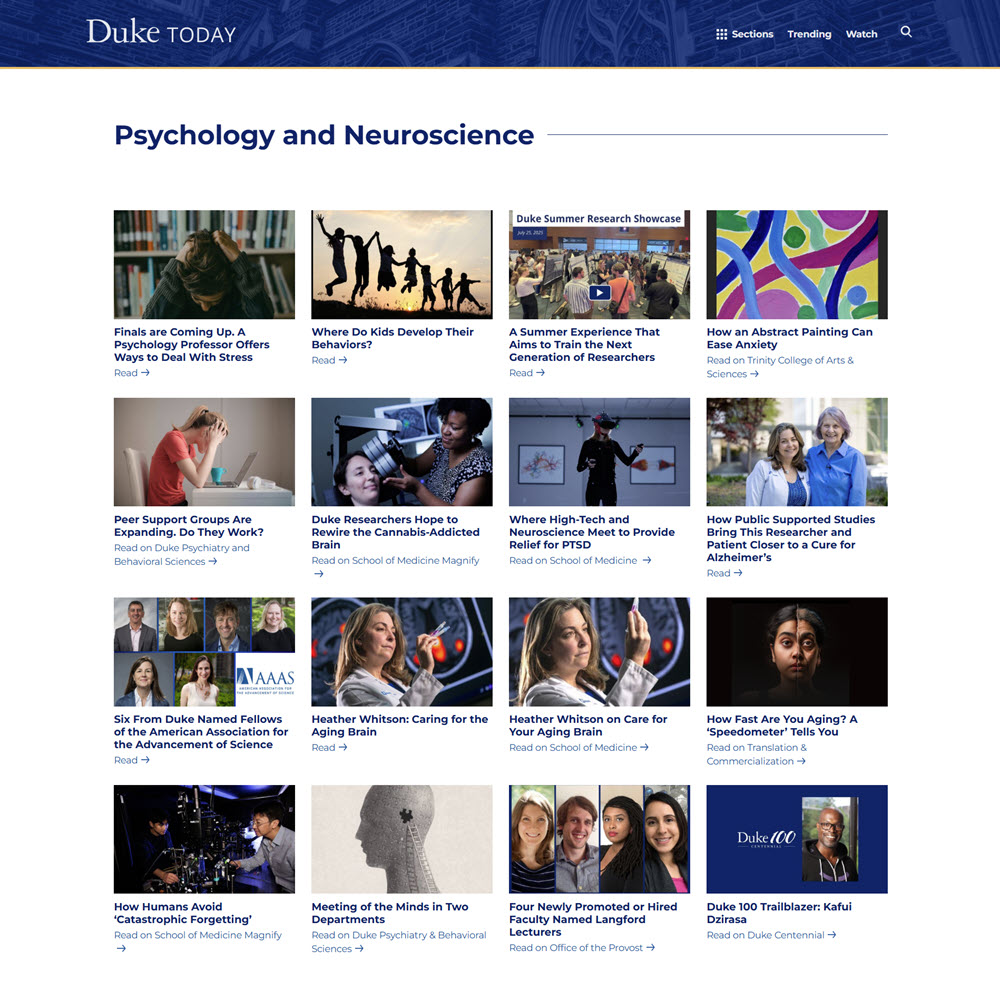
The Psychology and Neuroscience page of Duke Today provides coverage related to the mind, brain, and behavior. Stories feature faculty from the Department of Psychology & Neuroscience and related units, including research announcements, expert advice pieces, videos, and other features.
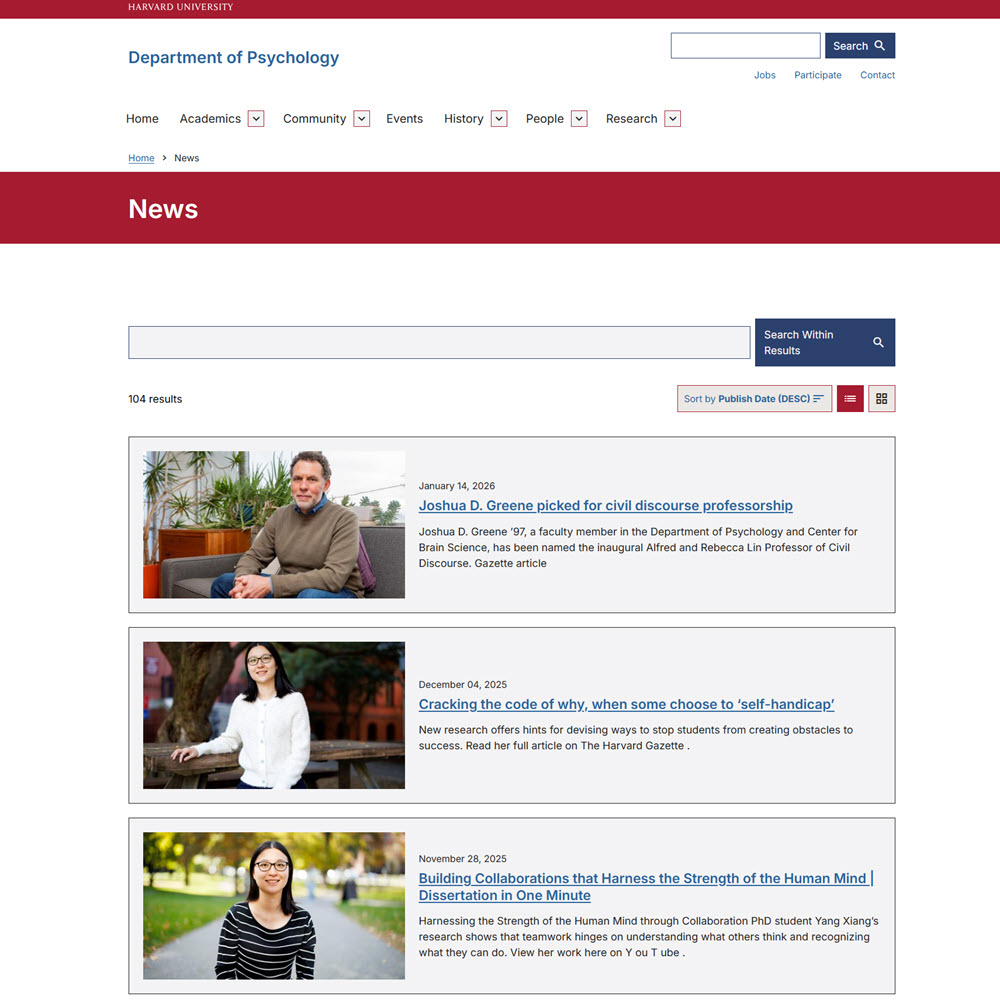
The News section of Harvard’s Department of Psychology website is the department’s news archive. Like UChicago’s and Duke’s psychology department pages, it’s department-specific, providing a searchable, filterable archive showcasing the academics, communities, research, events, history, and people of the Harvard Department of Psychology.
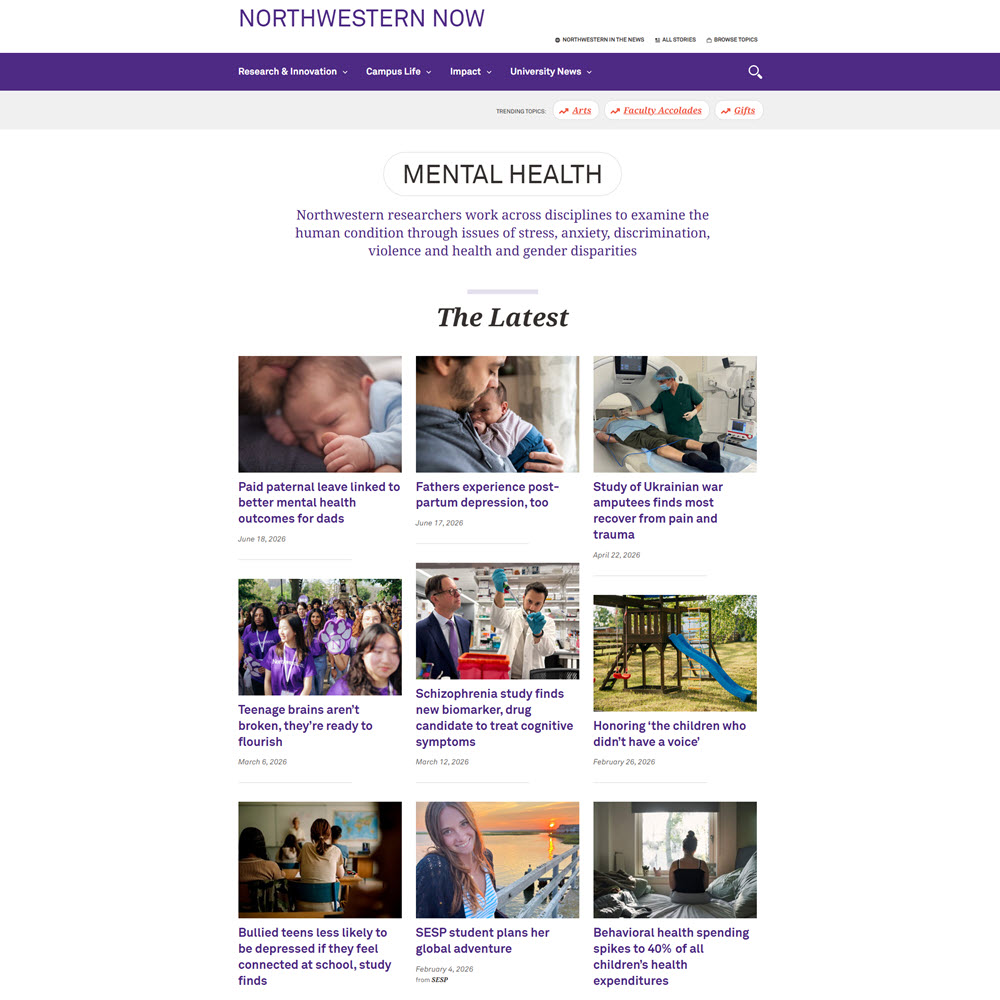
The Mental Health topic page on Northwestern Now is a section of Northwestern University’s official news site that collects campus-wide stories on mental and behavioral health. It features research announcements, expert commentary, and features from across Northwestern’s schools — covering topics like depression, anxiety, adolescent development, trauma, and health disparities.
The News & Events page of Princeton’s Department of Psychology serves as the department’s center for research highlights, announcements, and event listings. Its research news currently spotlights work at the intersection of psychology, neuroscience, and AI.
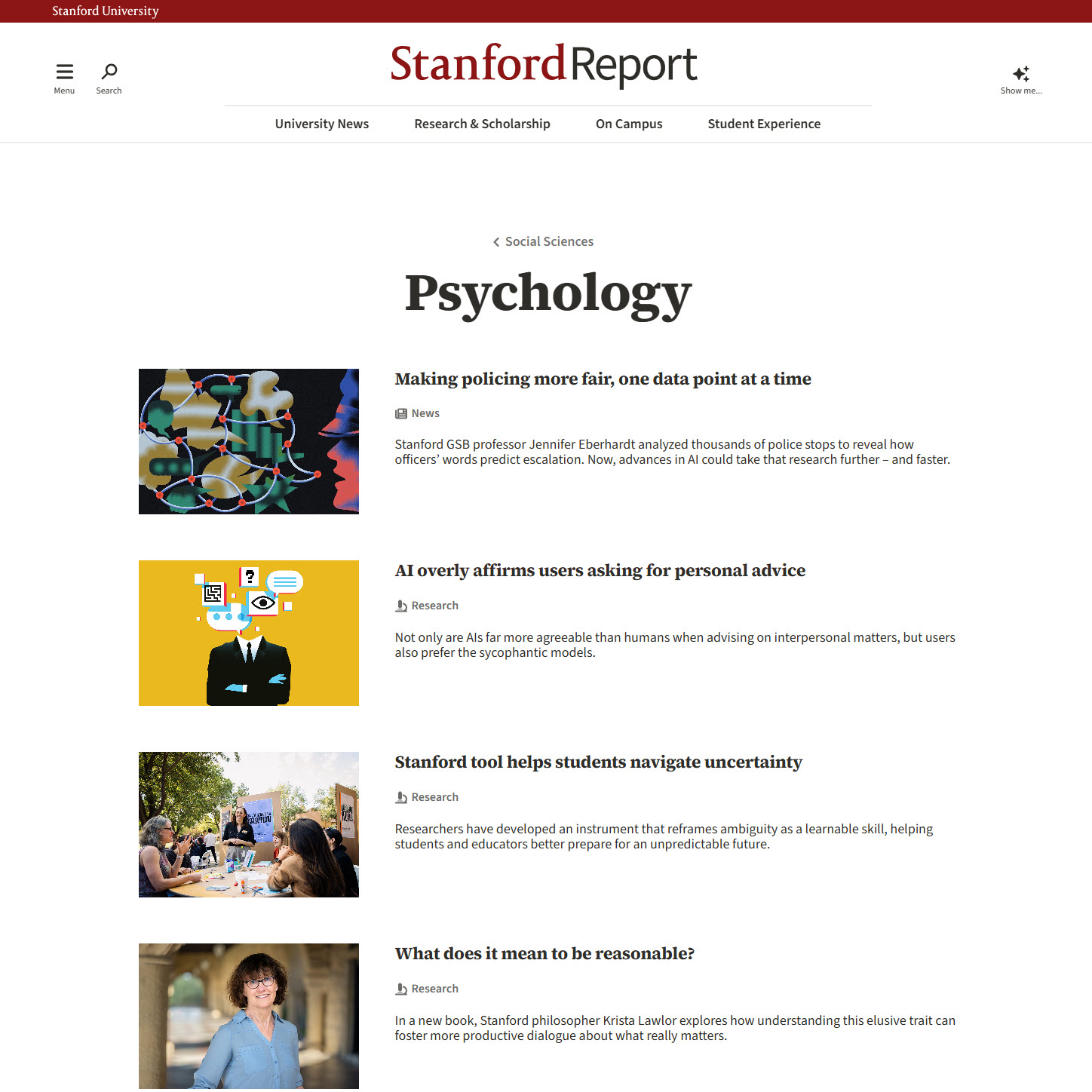
The Stanford Report is Stanford University’s official news publication, covering research, scholarship, campus life, and university news across all of Stanford’s schools and disciplines. Its psychology coverage highlights the work of Stanford’s psychologists and behavioral scientists for a general audience. Recent stories reflect a strong emphasis on the intersection of psychology and AI.
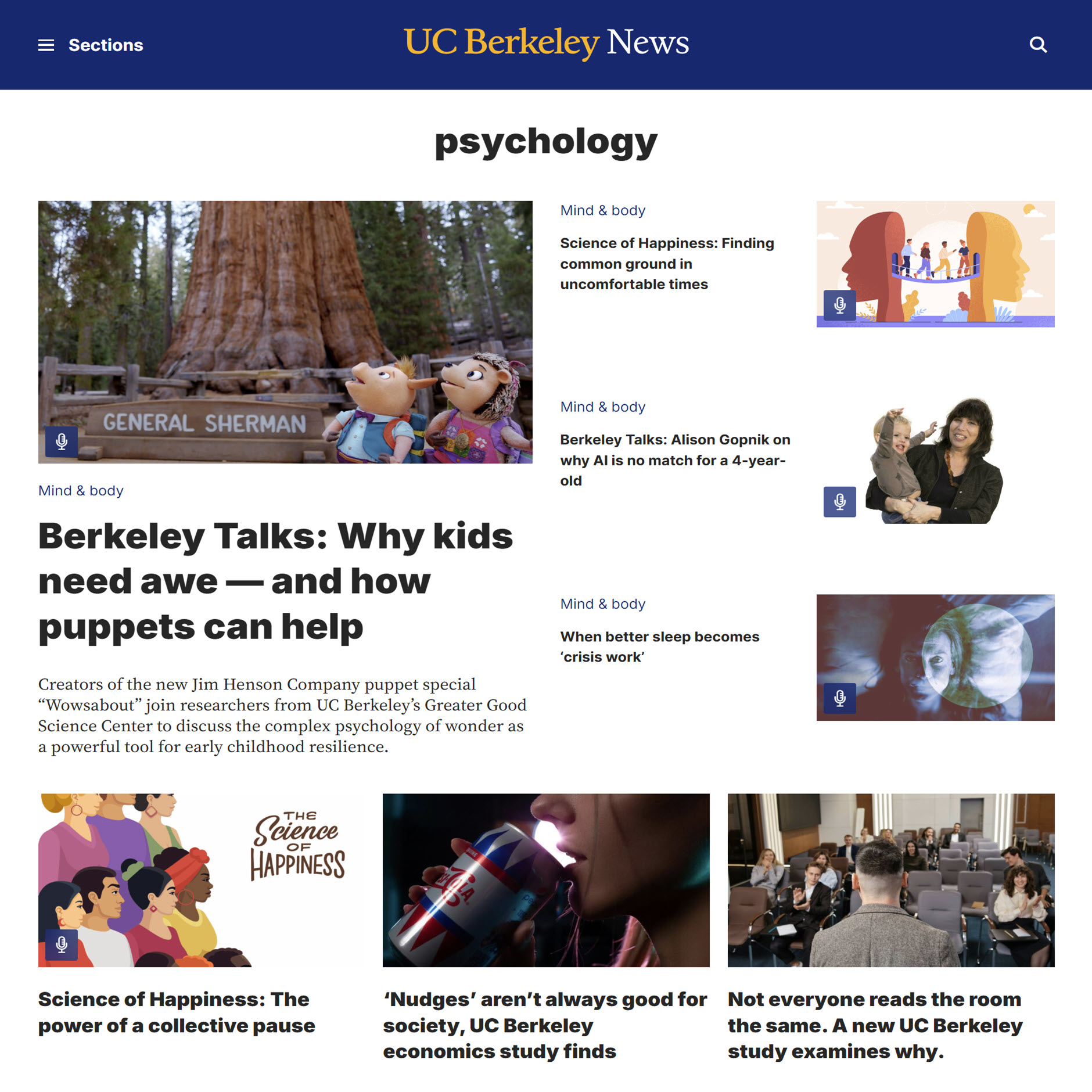
The psychology section of Berkeley News collects the site’s coverage of psychology-related stories from across the UC Berkeley campus. It features articles on faculty research, including topics like emotions, relationships, child development, cognition, mental health, and the aging brain, along with stories about the Psychology Department.
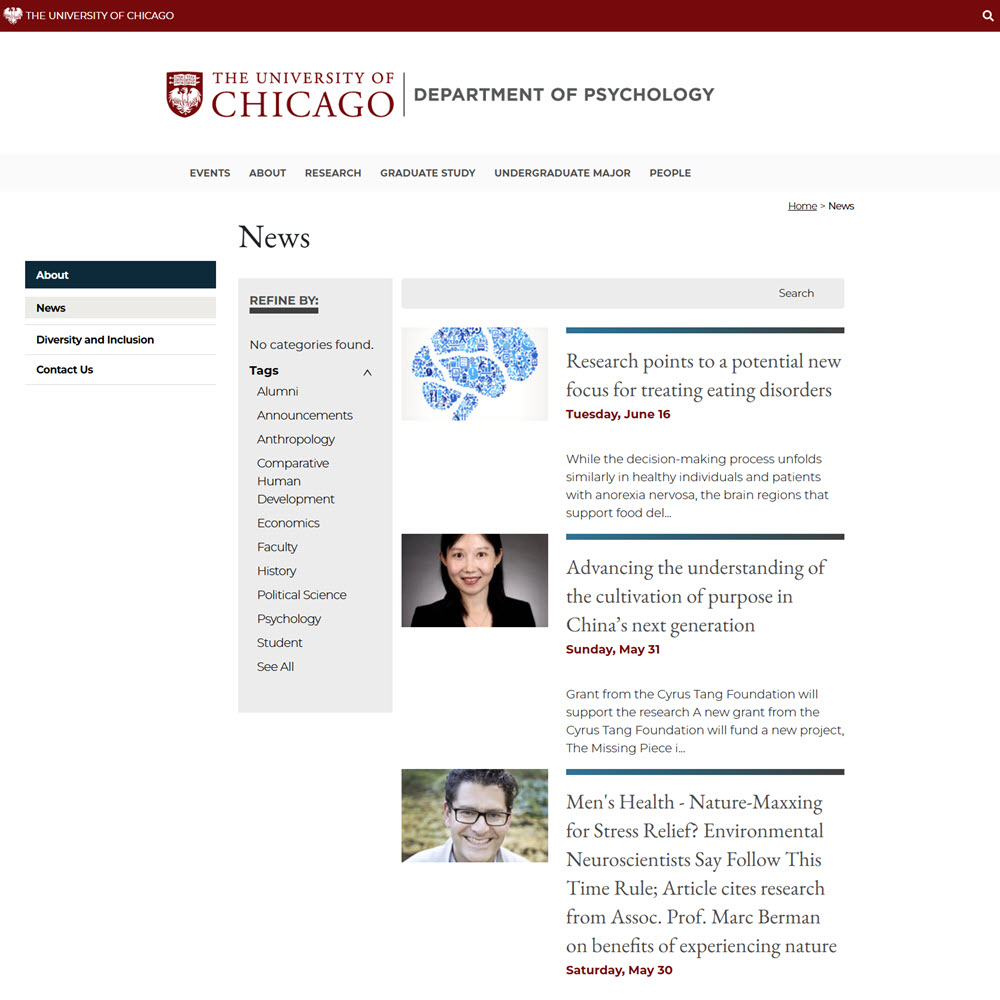
The News Page of the University of Chicago’s Department of Psychology is the department’s own news hub, hosted on its website within the Division of the Social Sciences. Unlike Berkeley News (a campus-wide publication), this page is department-specific: it aggregates stories about the research, faculty, students, and alumni of UChicago Psychology.
Sage Research Methods is a major subscription database that guides users in understanding research methodologies across different academic disciplines. It provides electronic access to reference books, journal articles, instructional videos, and other research methods resources.
Open source/ Free
Subscription required