International trade statistics track the movement of goods and services between countries. Below are listings of the most commonly used international trade statistics resources.
International Trade
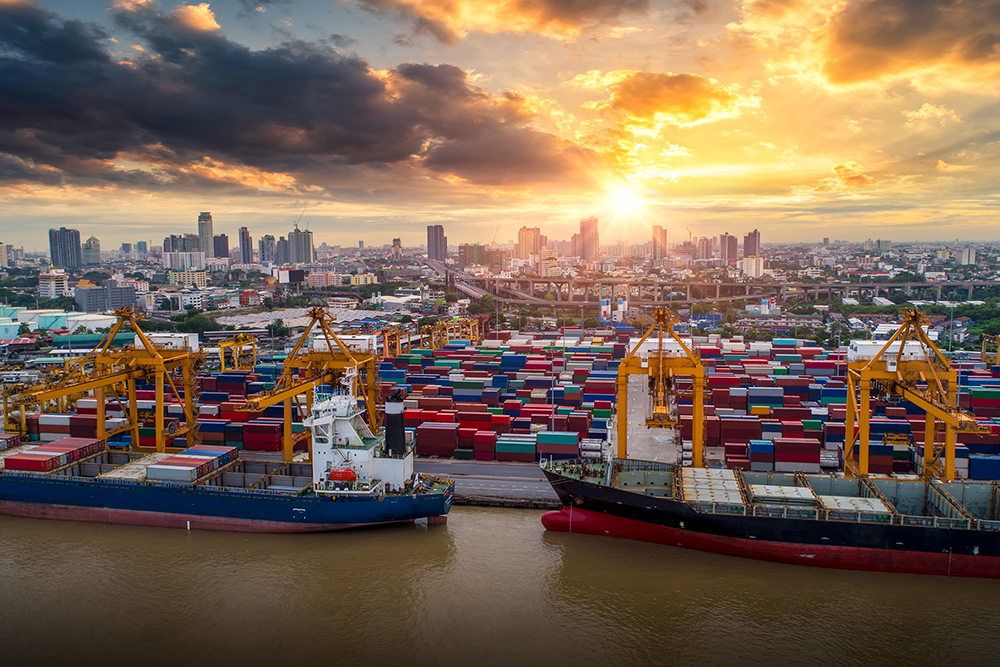
International trade is the exchange of goods, services, and capital across international borders or territories. It allows countries to access products and resources they may not produce domestically. This guide directs you to authoritative information resources that provide information on the global trade environment, including data and statistics on imports and exports, international treaties and agreements, tariffs, and trade law.
Trade Classifications
What are trade classifications and why are they important?
All imports and exports must be classified for Customs purposes. Therefore, each individual good and service is assigned a classification code within a specific classification system.
Trade classification systems are important tools for organizing and analyzing international trade data. They provide standardized frameworks for categorizing goods and services, making it possible to compare trade statistics across countries and over time. The following highlights commonly used systems for merchandise trade:
Harmanized System (HS)
The Harmonized System (HS) is an internationally standardized system of names and numbers used to classify traded products and used by all customs services. Developed and maintained by the World Customs Organization (WCO), the HS is used by more than 200 countries as the basis for their customs tariffs and for compiling international trade statistics.
North American Industry Classification System (NAICS)
The North American Industry Classification System (NAICS)
is the standard used by the United States, Canada, and Mexico to classify businesses by type of economic activity. NAICS provides a consistent framework for collecting, analyzing, and publishing statistical data on the North American economy.
Standard International Trade Classification (SITC)
The Standard International Trade Classification (SITC) is a system developed by the United Nations to classify internationally traded goods in a way that facilitates economic analysis. Unlike other systems designed for customs or tariffs, SITC is intended for statistical and analytical use. It is particularly useful for comparing trade data over time and across countries.
Schedule B (Statistical Classification of Domestic and Foreign Commodities)
Schedule B (Statistical Classification of Domestic and Foreign Commodities)
A system used by the U.S. Census Bureau to classify products exported from the United States for statistical purposes. It is based on the international Harmonized System (HS), which shares the same first six digits but sometimes extends to 10 digits to provide more detailed classification tailored to U.S. export reporting needs. Exporters are required to use Schedule B codes when filing export documentation through the Automated Export System (AES).
Concordances
Concordances link these different classification schemes. These tools help you interpret trade flows, conduct market analyses, or comply with reporting requirements.
Trade Statistics
Trade statistics are important for research and policy analysis when studying international trade. This section lists free and subscription-based resources used by academic and professional researchers to access international trade data.
International Trade Statistics
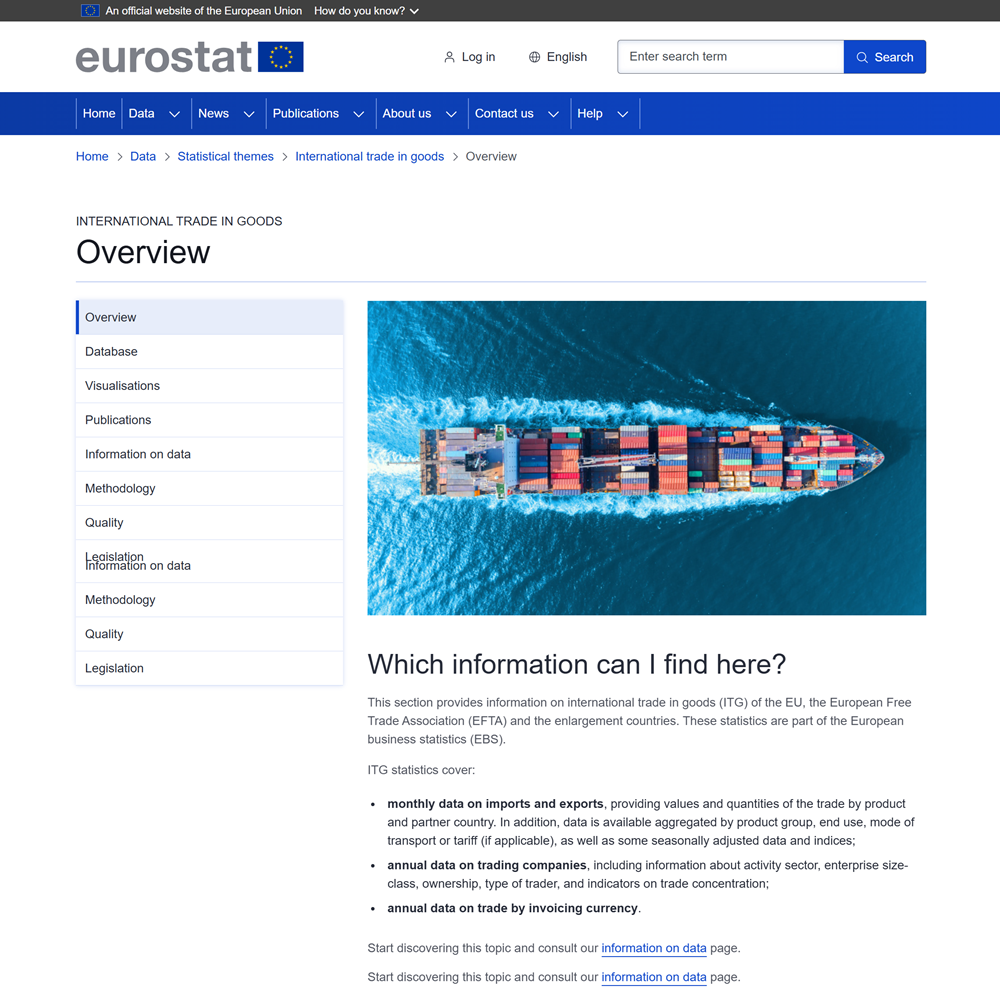
 Eurostat International Trade in Goods
Eurostat is the European Union’s (EU) statistical office, responsible for collecting, processing, and publishing comparable and harmonized statistics across EU member states and partner countries. Eurostat provides monthly data on imports and exports, values and quantities of trade by product and partner country, annual data on trading companies, and annual data on trade by invoicing currency.
International Monetary Fund (IMF) Data
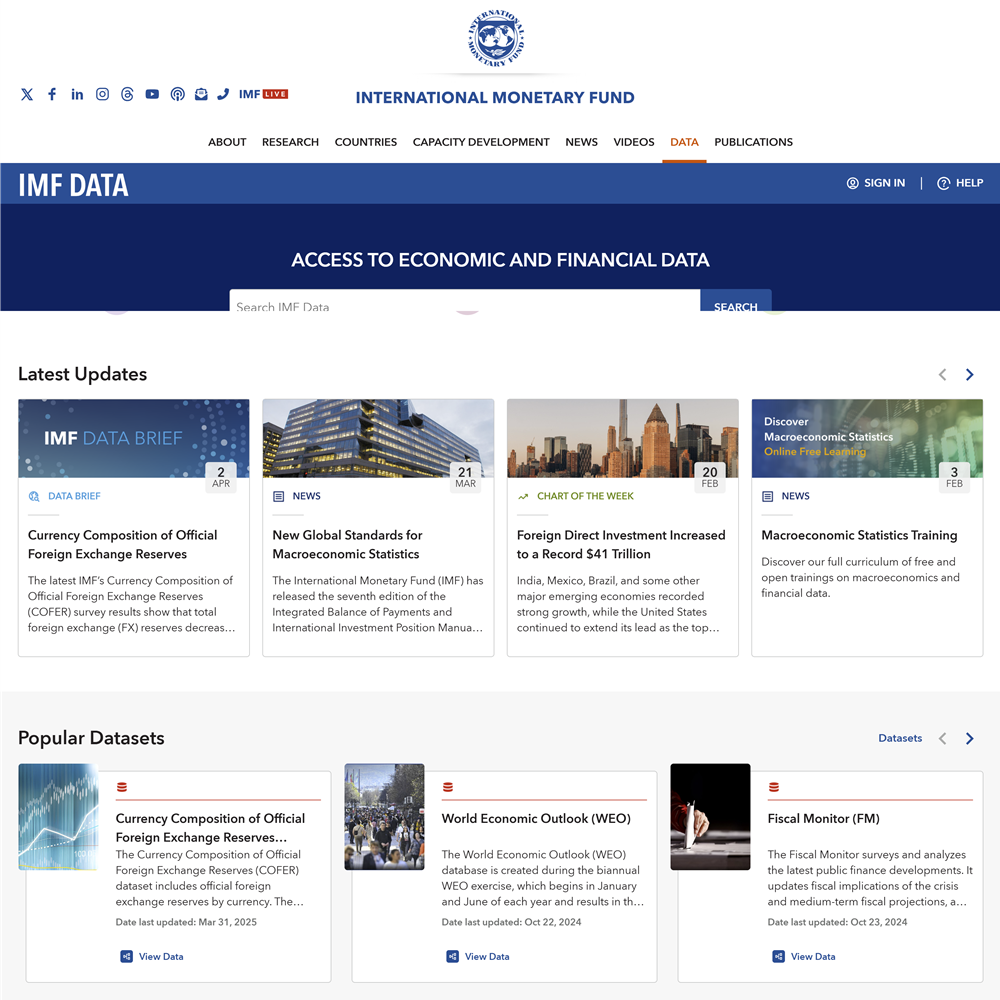
The International Monetary Fund (IMF) Data platform provides access to a wide range of global economic and financial datasets collected and maintained by the International Monetary Fund, including:
-
-
- International Trade in Goods (ITG) – Provides detailed information about the exports and imports of physical goods between countries, typically based on customs data. It focuses only on tangible merchandise, excluding services.
-
-
-
- International Trade in Goods (by partner country) (IMTS) – IMTS shows the value of exports and imports between countries by partner country and region (monthly and annual).
-
International Trade Centre (ITC) - Trade Map
The International Trade Centre’s (ITC) Trade Map is a comprehensive online tool that provides detailed international trade statistics and market analysis. It enables users to access trade data for over 220 countries and territories, as well as analyze more than 5,300 products categorized under the Harmonized System (HS) at 2-, 4-, and 6-digit levels. Data includes annual, quarterly, and monthly trade flows, including values, volumes, growth rates, and market shares.

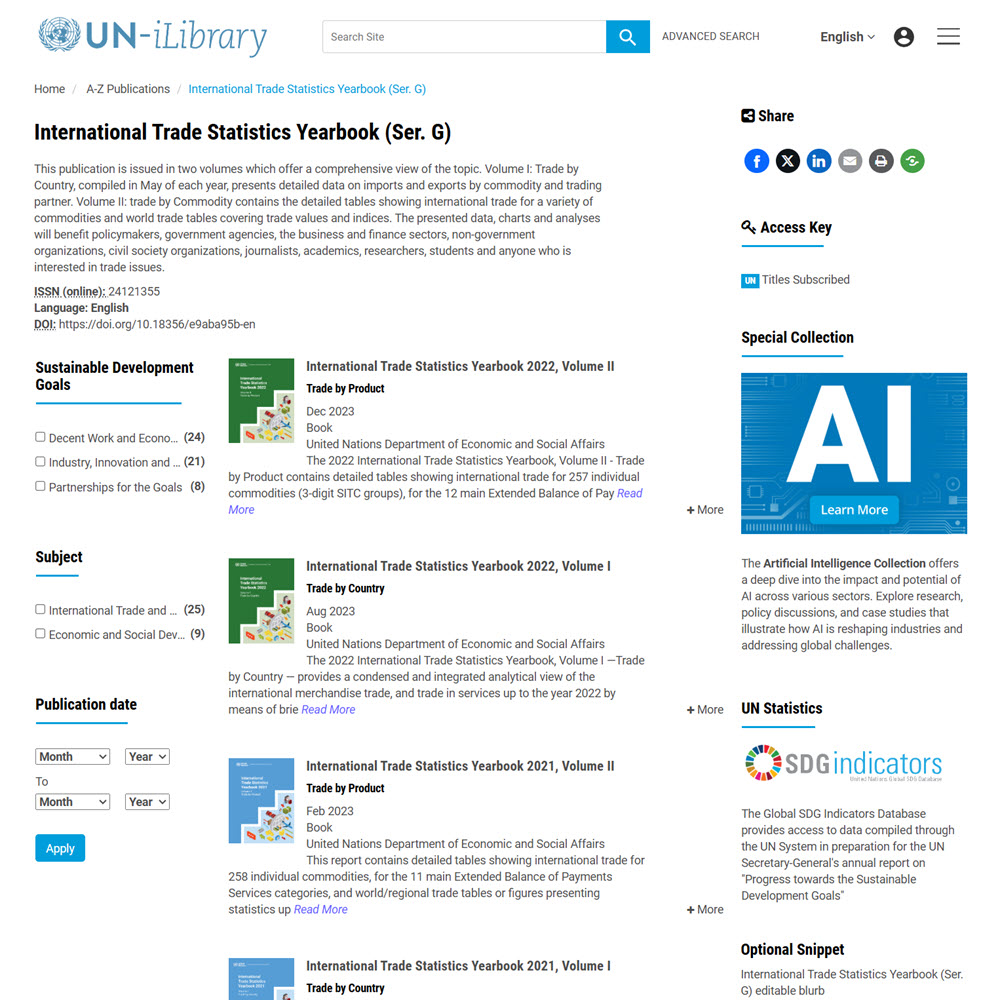
International Trade Statistics Yearbook (ITSY)
The International Trade Statistics Yearbook (ITSY) is an annual publication produced by the United Nations Statistics Division (UNSD) that provides comprehensive international merchandise trade data and analysis. IT is published annually in two volumes: Volume I: Trade by country; and Volume II: Trade by commodity. It presents global trade data by country and product and provides detailed import and export statistics for over 200 countries and territories. It also includes partner countries and product breakdowns using Harmonized System (HS) codes.
Free online versions of ITSY are available from 2011. Older physical or digital copies are available for purchase through the UN Publications website or by searching in your university library catalog.
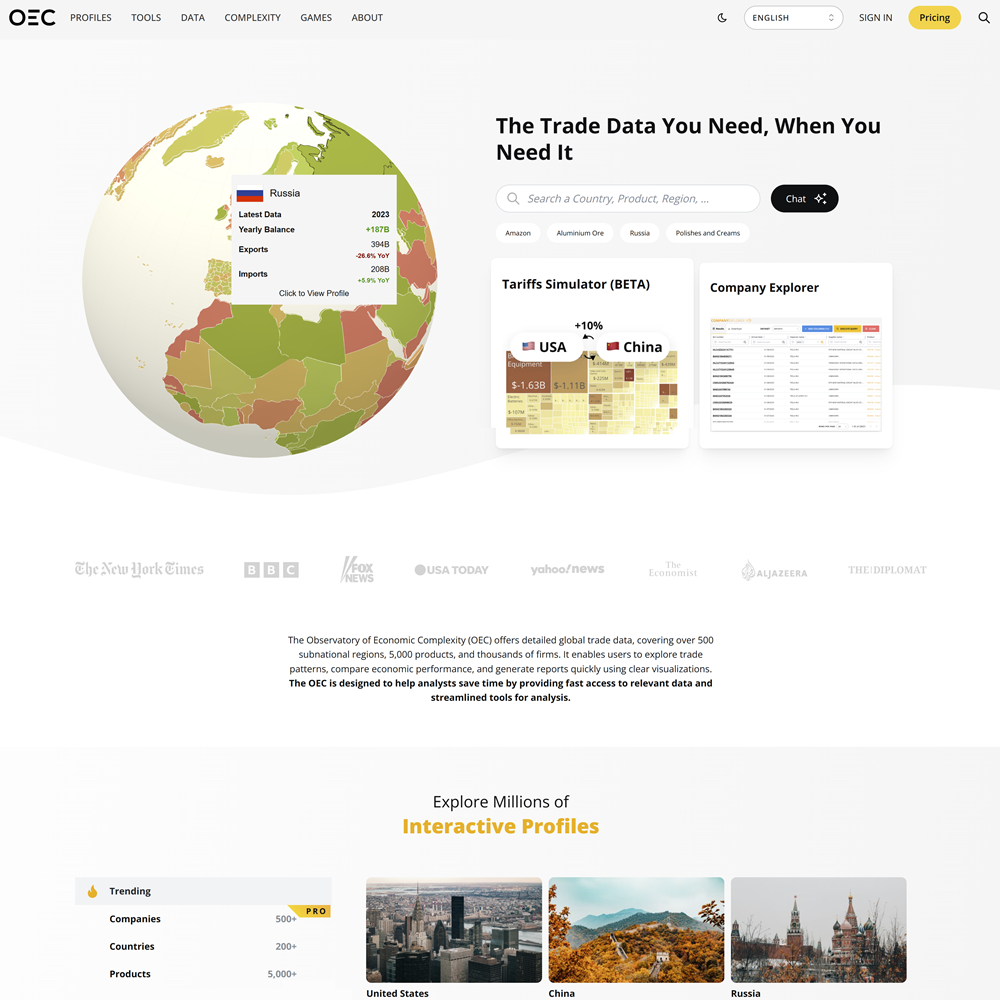
Observatory of Economic Complexity (OEC)
The Observatory of Economic Complexity (OEC) is a free, interactive data visualization platform that provides detailed information and data on global trade. Originally developed at the MIT Media Lab and now maintained by Datawheel, the OEC allows users to explore international trade patterns through visualizations and analytical tools. Users can access over 50 years of international trade data, including 5,000 products and over 200 countries and territories.
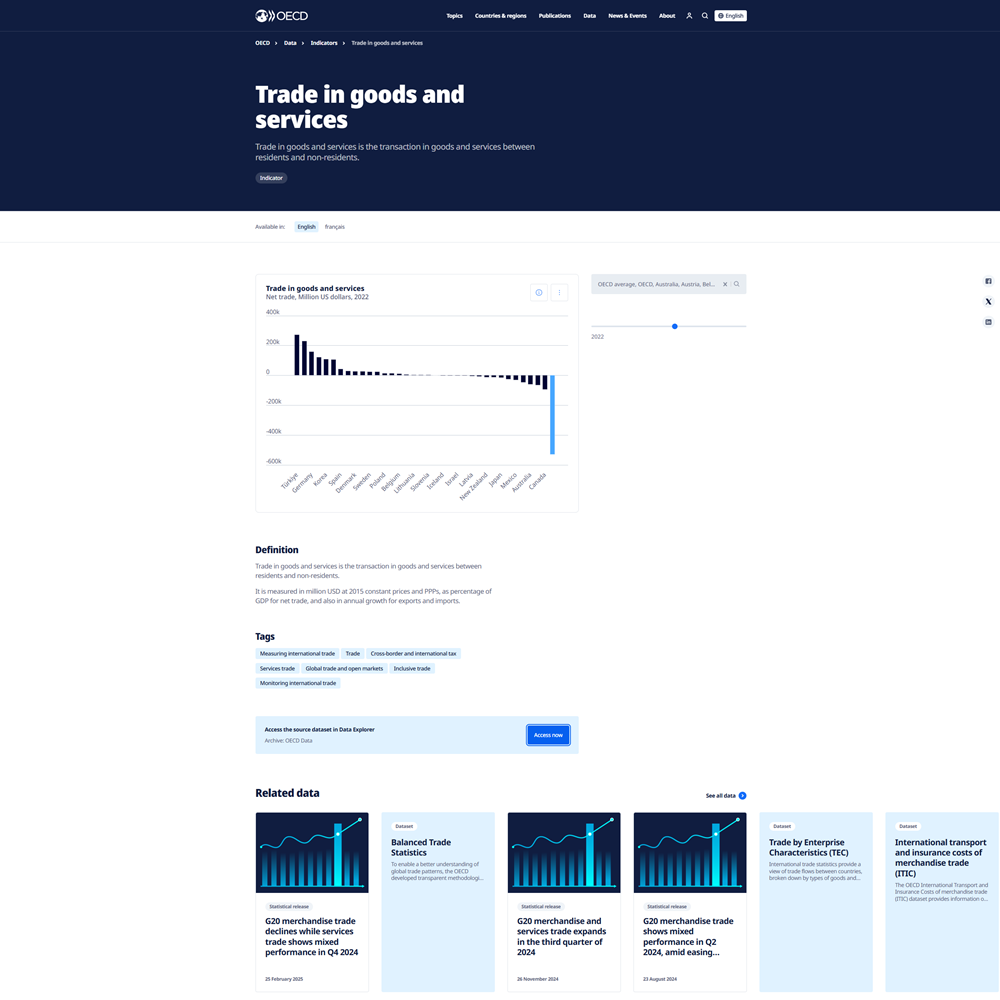
OECD - Trade in Goods and Services Data
OECD Trade in Goods and Services provides access to high-quality, internationally comparable data on merchandise and trade in services for OECD countries and select partner countries. The OECD does not provide as granular detail on goods and services as UN Comtrade (e.g., HS 6-digit level).
While UN Comtrade is designed to be a comprehensive trade data warehouse, storing raw customs-level data reported by countries, the OECD is focused on cross-country comparability and macroeconomic trends. Data is aggregated to make it more uniform and usable across different reporting methods.
UN Comtrade
The UN Comtrade Database is a global trade data repository maintained by the United Nations Statistics Division (UNSD). It provides detailed import and export statistics reported back to 1962 of countries worldwide, covering goods and services traded between nations. It includes trade data from over 200 reporting countries and territories classified using the Harmonized System (HS) and Standard International Trade Classification (SITC) codes, allowing for detailed product-level analysis.
UN Comtrade offers both free and subscription-based access. The free version is sufficient for most needs. However, the premium version provides more advanced features and usability, such as:
- Bulk data downloads.
- Async(-batch) and scheduled downloads.
- Faster performance and priority access to servers.
- Access to more timely data (e.g., preliminary monthly figures).
- Extended API limits (more requests per hour/day).
- Custom query building, saved searches, and automation tools.
- Ability to download entire datasets by country/product over time.
If you’re affiliated with a university, ask your librarian if your library subscribes to the premium version.
BACI (Base pour l’Analyse du Commerce International) is a global trade database developed by CEPII, a French research center in international economics. BACI provides bilateral trade flows between more than 200 countries, broken down by detailed product classification codes (HS 6-digit). BACI is based on UN Comtrade data, but it reconciles discrepancies between what exporters and importers report—a known issue in raw Comtrade data.
World Integrated Trade Solution (WITS)
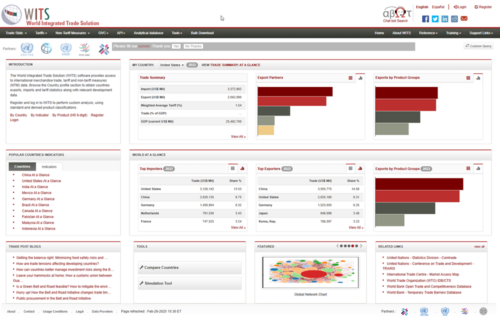
The World Integrated Trade Solution (WITS) is an online data platform that provides comprehensive trade-related data, tariff data, Non-Tariff Measures (NTMs), data on trade agreements, and indicators & Analytical Tools. It was developed by the World Bank, in collaboration with organizations such as the United Nations Conference on Trade and Development (UNCTAD), the International Trade Centre (ITC), the United Nations Statistics Division (UNSD), and the World Trade Organization (WTO).
World Trade Organization (WT0) - International Trade and Tariff Data
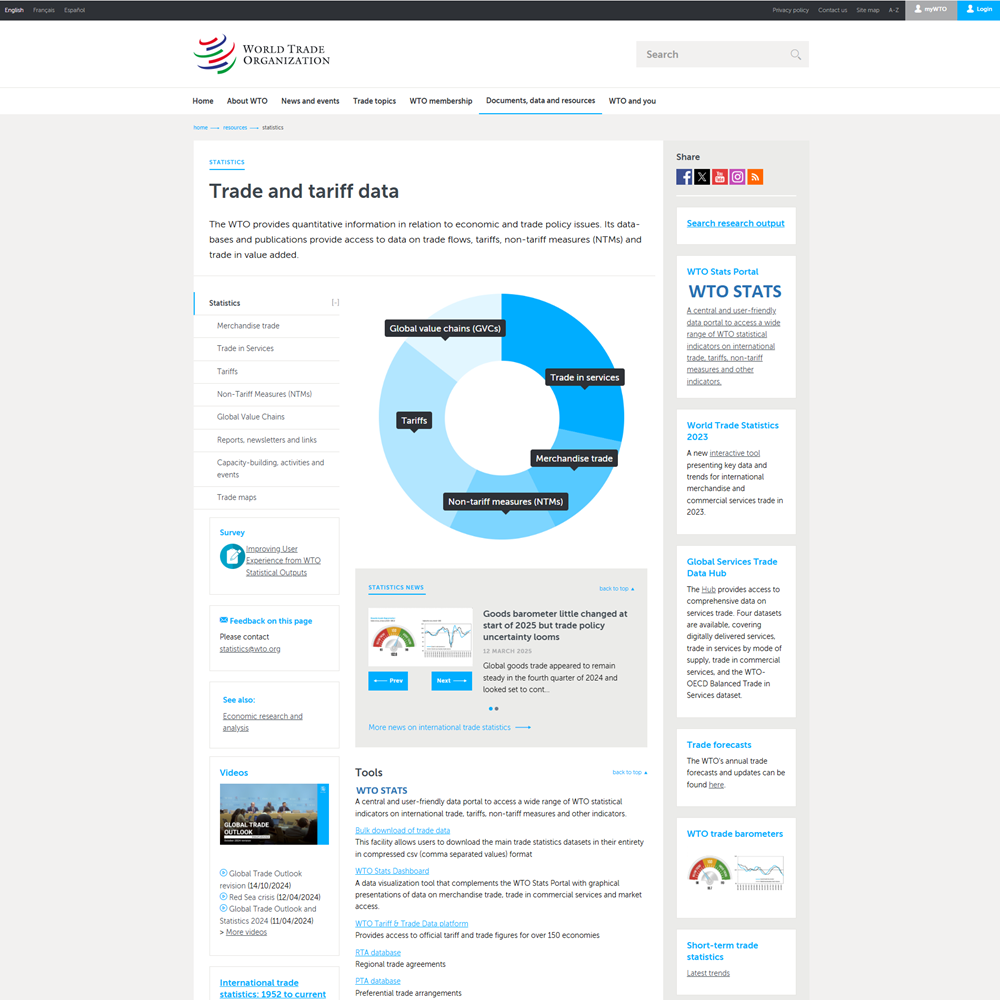
The World Trade Organization (WTO) Trade and Tariff Data Portal provides access to official data on international trade flows, tariffs, and trade policy measures for WTO member countries. Data includes merchandise trade by country, product category, and partner, and trade services data. Also provides official tariff and trade figures for over 150 economies.
U.S. / North American Statistics
DataWeb: U.S. Trade and Tariff Data
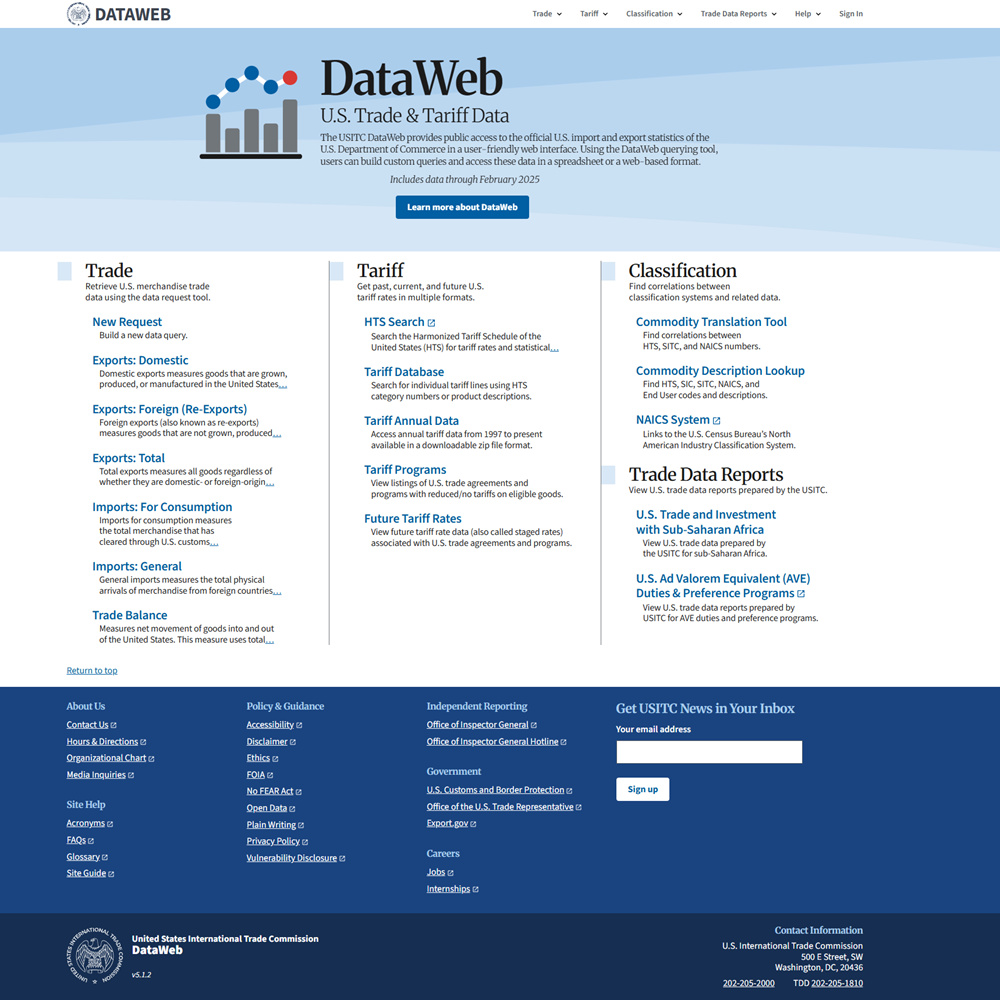
DataWeb is provided by the U.S. International Trade Commission (USITC), which offers public access to extensive U.S. trade and tariff data. It integrates official U.S. import and export statistics from the U.S. Department of Commerce with detailed tariff and customs information, enabling users to retrieve and analyze trade data across various parameters.
International Trade Administration (ITA)
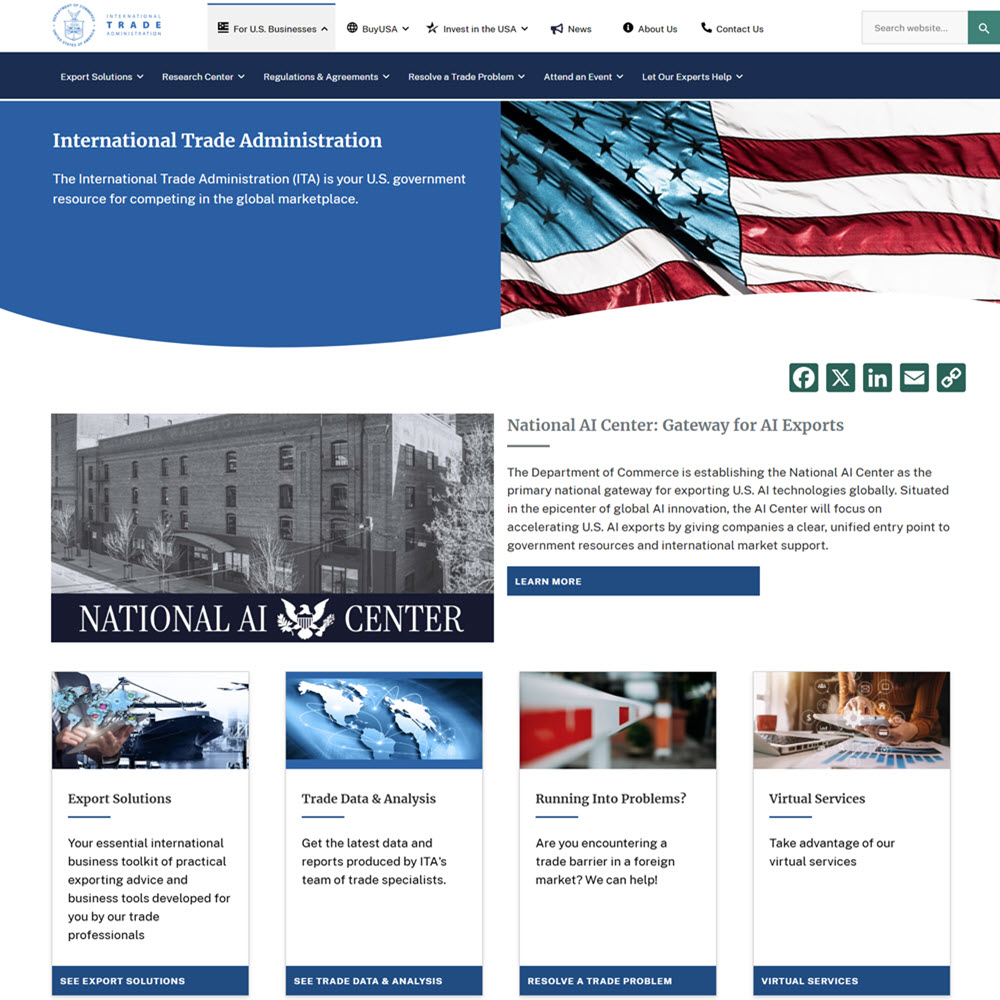
International Trade Administration (ITA) provides practical U.S. trade data, market insights, and export resources to help users understand global business opportunities and U.S. trade activity. It is the part of the U.S. government that helps American businesses sell their products and services in other countries. The ITA actively supports and promotes that trade.
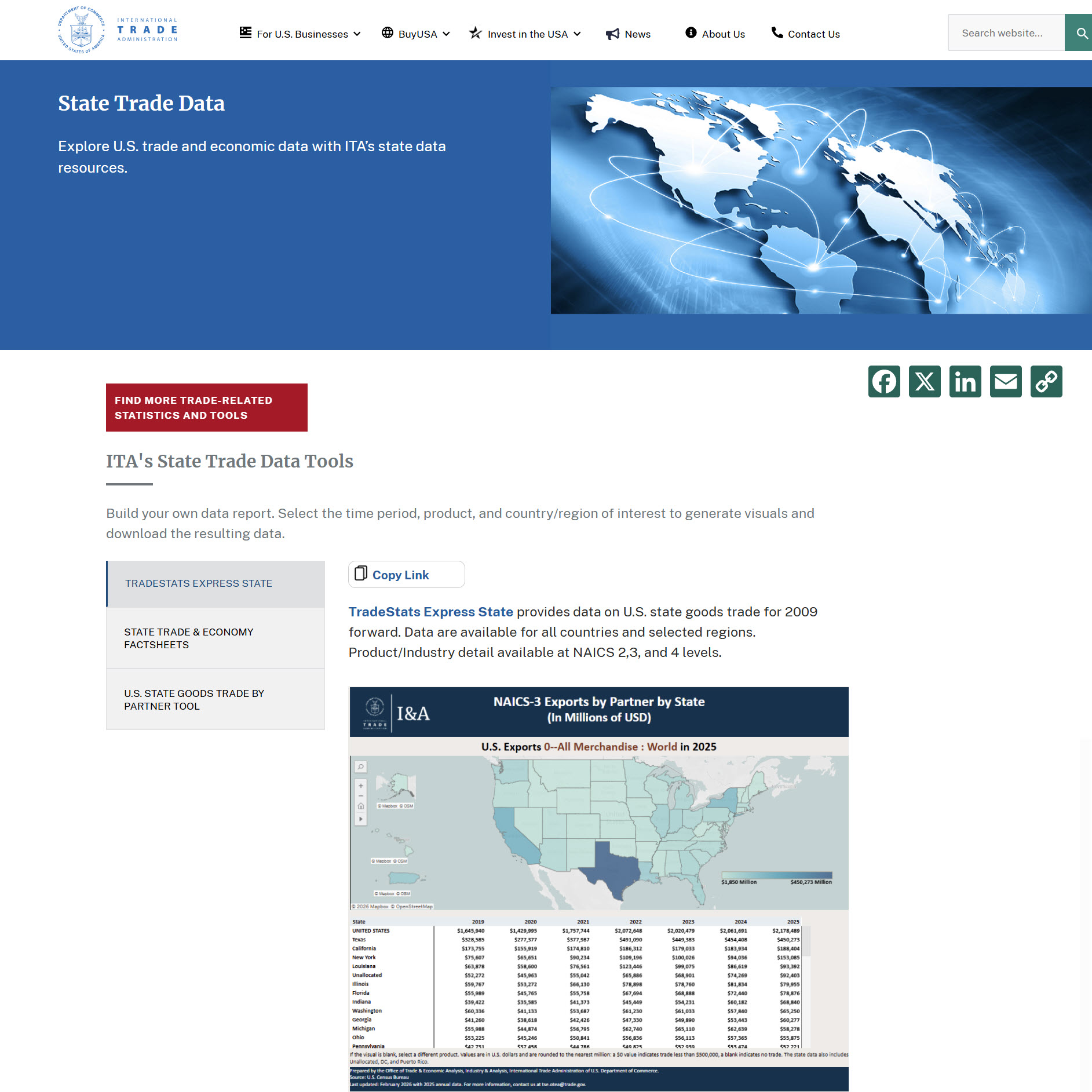
State Trade Data (Trade.gov)
State Trade Data (Trade.gov) provides state-by-state export and import statistics, helping users compare trade activity, top markets, and leading industries across the United States. State Trade Data tells you what each specific state exports and imports and to which countries.
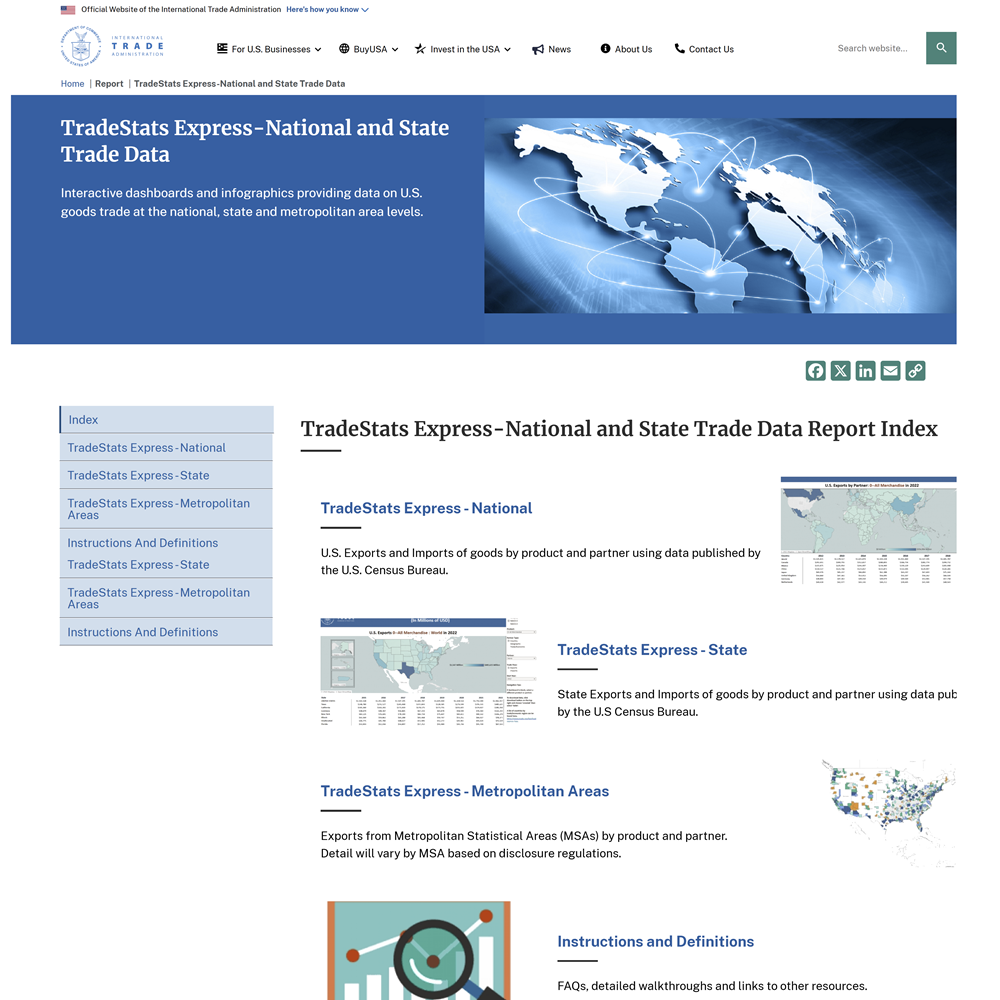
TradeStats Express-National and State Trade Data Report Index
The TradeStats Express – National and State Trade Data Report Index is an interactive online platform developed by the U.S. Department of Commerce’s International Trade Administration (ITA). It offers comprehensive U.S. goods trade statistics at the national, state, and metropolitan levels.
- TradeStats Express – National – Users can analyze U.S. exports and imports by partner or product, including trade flows of particular goods using the HS (Harmonized System), NAICS (North American Industry Classification System), or SITC (Standard International Trade Classification).
- TradeStats Express – State – Review exports and imports between individual U.S. states and international partners.
- TradeStats Express – Metropolitan Areas – Access export data for over 380 U.S. Metropolitan Statistical Areas (MSAs), including top products and destinations.
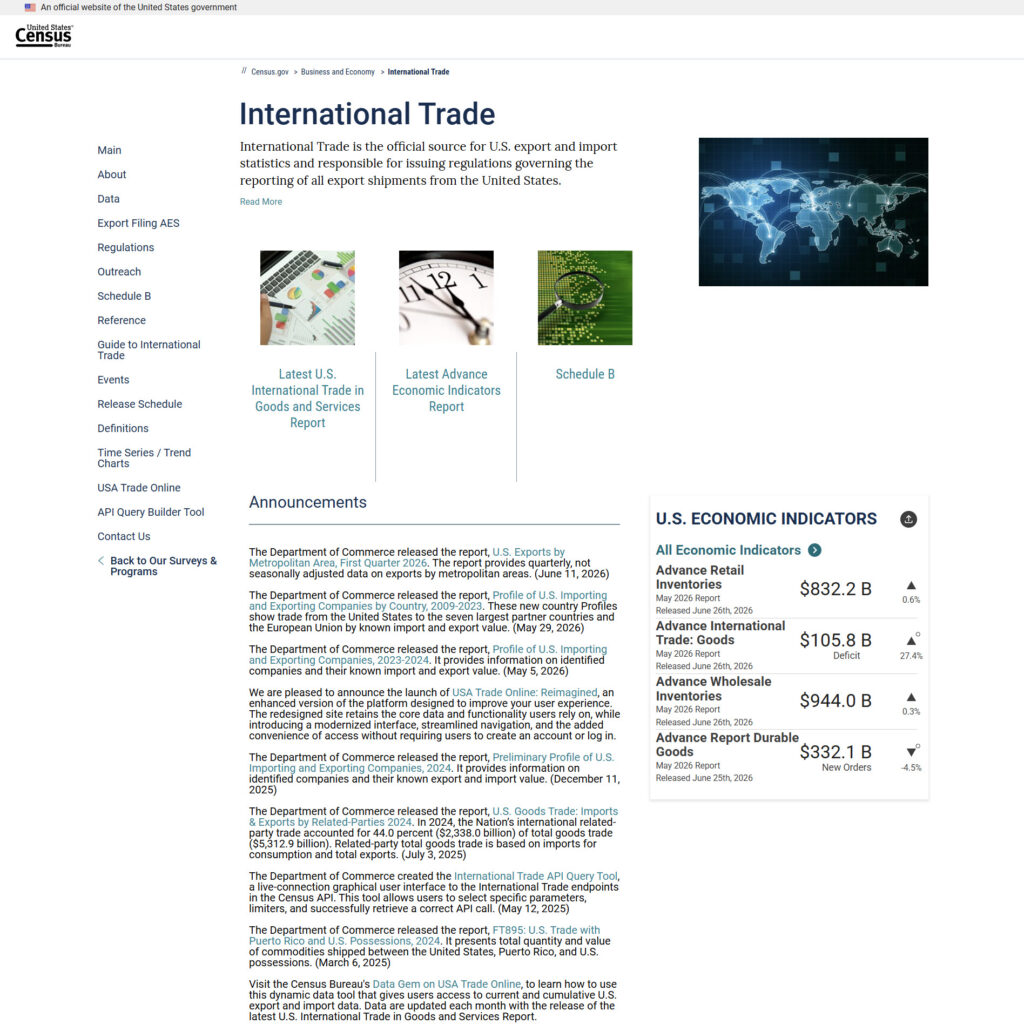
U.S. Census Bureau – International Trade
United States Census Bureau – International Trade is the official source for U.S. import and export data, offering clear statistics on what the United States trades, with whom, and how trade changes over time. The U.S. Census Bureau’s International Trade program tracks the flow of goods between the United States and other countries. It collects, compiles, and publishes this data, producing the official U.S. import and export statistics.
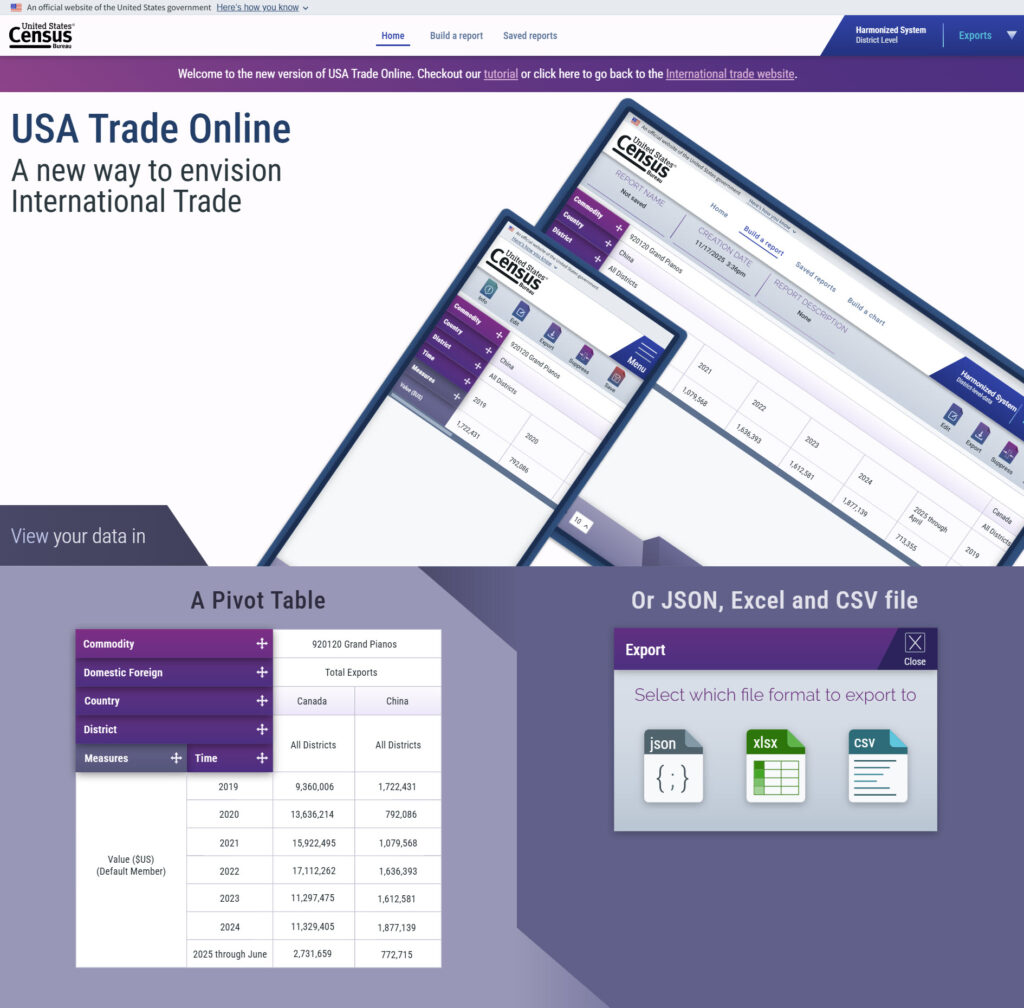
U.S. Census Bureau – USA Trade Online
USA Trade Online is a Census Bureau tool providing detailed U.S. import and export data for exploring how goods move in and out of the United States. Users can search for monthly and annual trade statistics, find trade data by product, country, commodity (HS), port-level data, time period, and port, and download customizable reports for research or analysis. One of the best resources for researchers who need commodity-level analysis and historical trade trends.
Title
“Lorem ipsum dolor sit amet, consectetur adipiscing elit, sed do eiusmod tempor incididunt ut labore et dolore magna aliqua. Ut enim ad minim veniam, quis nostrud exercitation ullamco laboris nisi ut aliquip ex ea commodo consequat. Duis aute irure dolor in reprehenderit in voluptate velit esse cillum dolore eu fugiat nulla pariatur. Excepteur sint occaecat cupidatat non proident, sunt in culpa qui officia deserunt mollit anim id est laborum.”