Political Data
A comprehensive listing of political research datasets, including publicly available and subscription-based resources.

Overview
The study of political data involves collecting and analyzing information on political activities, such as voting patterns and public opinion, to understand and predict political behavior. This section provides a comprehensive listing of political research datasets, including publicly available and subscription-based resources. Be sure to check your library catalog for access to specific datasets.
Multidisciplinary
The following multidisciplinary databases provide datasets and statistical information for multiple disciplines and subject areas. Data from these resources come primarily from government agencies, international organizations, research institutions, and private companies.
 Cross-National Times-Series Data Archive
The Cross-National Time-Series (CNTS) Data Archive is a longitudinal data set that provides annual country-level data for a wide range of political, economic, and demographic variables. The dataset covers over 200 countries from 1815 to the present. See listings of all coverage and data points.
Data Planet (Sage Data)
Data Planet by SAGE Publishers is a comprehensive statistical database offering an extensive collection of authoritative data across diverse subjects, including economics, demographics, healthcare, crime, education, and energy. With over 70 billion data points sourced from more than 550 organizations—ranging from government agencies to private entities and international institutions—it provides in-depth global and U.S. statistics spanning multiple disciplines.
 Our World in Data
Our World in Data (OWID) is a free, open-access online data resource. It is a non-profit project based at the University of Oxford led by Max Roser. The platform collects, visualizes, and analyzes data from reputable sources, such as the United Nations (UN), World Bank, and the World Health Organization (WHO).
Statista
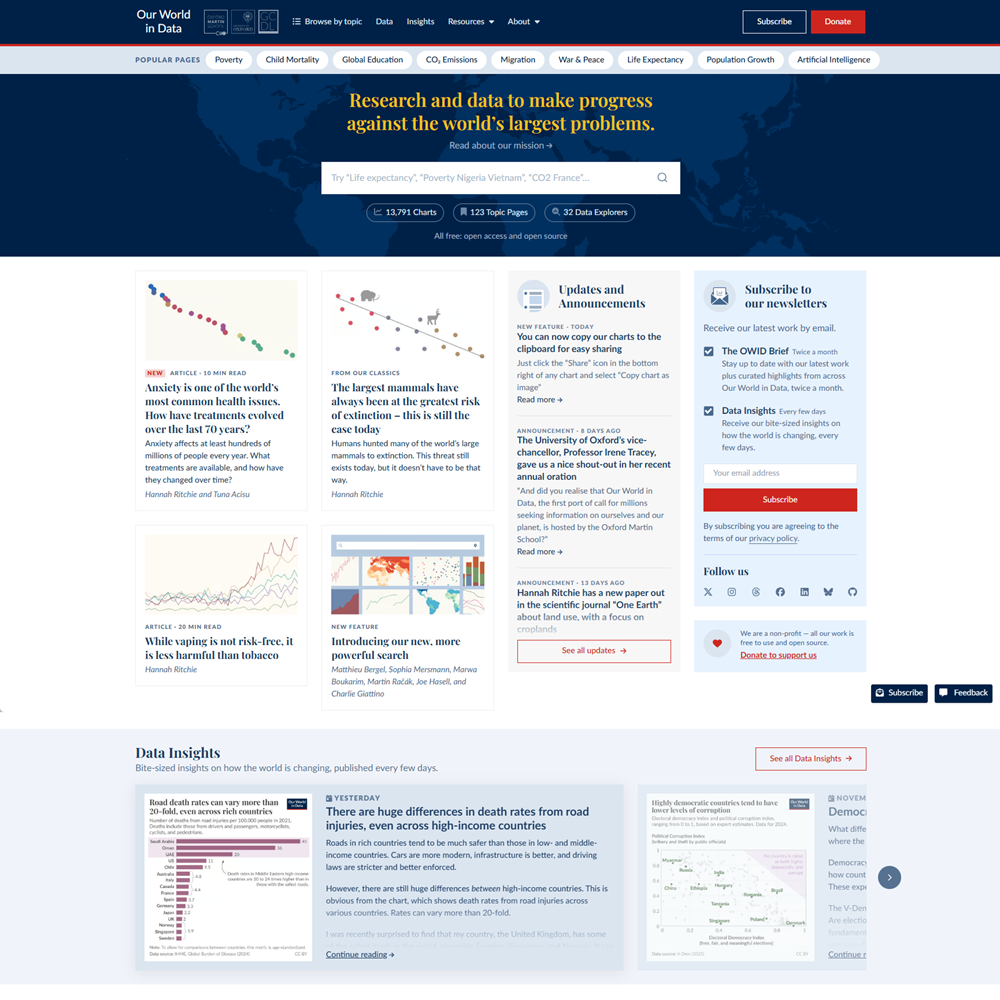
Statista provides data, statistics, and reports on various industries, markets, and consumer trends. It aggregates data from multiple sources, including market research firms, government agencies, industry associations, and company reports. Statista is known for its colorful charts, infographics, and tables. Although some data and charts are free, a subscription is necessary to access premium reports, downloadable datasets, and additional research tools.
Statistical Insight (ProQuest)
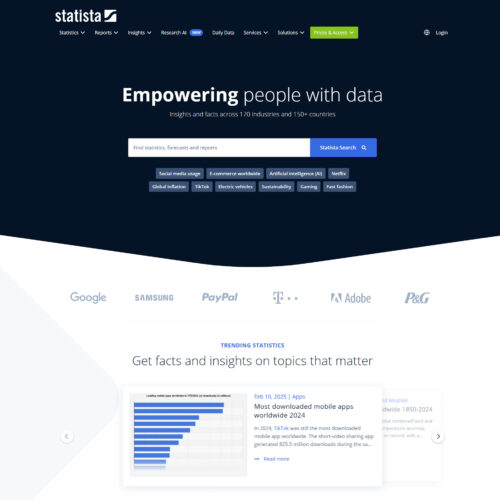
ProQuest Statistical Insight provides over a million statistics, tables, statistical reports, publication abstracts, and datasets from more than 22,500 sources. The database provides statistical data from U.S. federal agencies, state governments, private organizations, and major intergovernmental organizations such as the UN, OECD, and EU.
Data Repositories
A data repository is a centralized storage location for archived data where researchers, institutions, or organizations store and maintain datasets for future use. Data repositories often support data sharing, preservation, and collaboration, allowing users to access raw datasets for analysis.
Harvard Dataverse
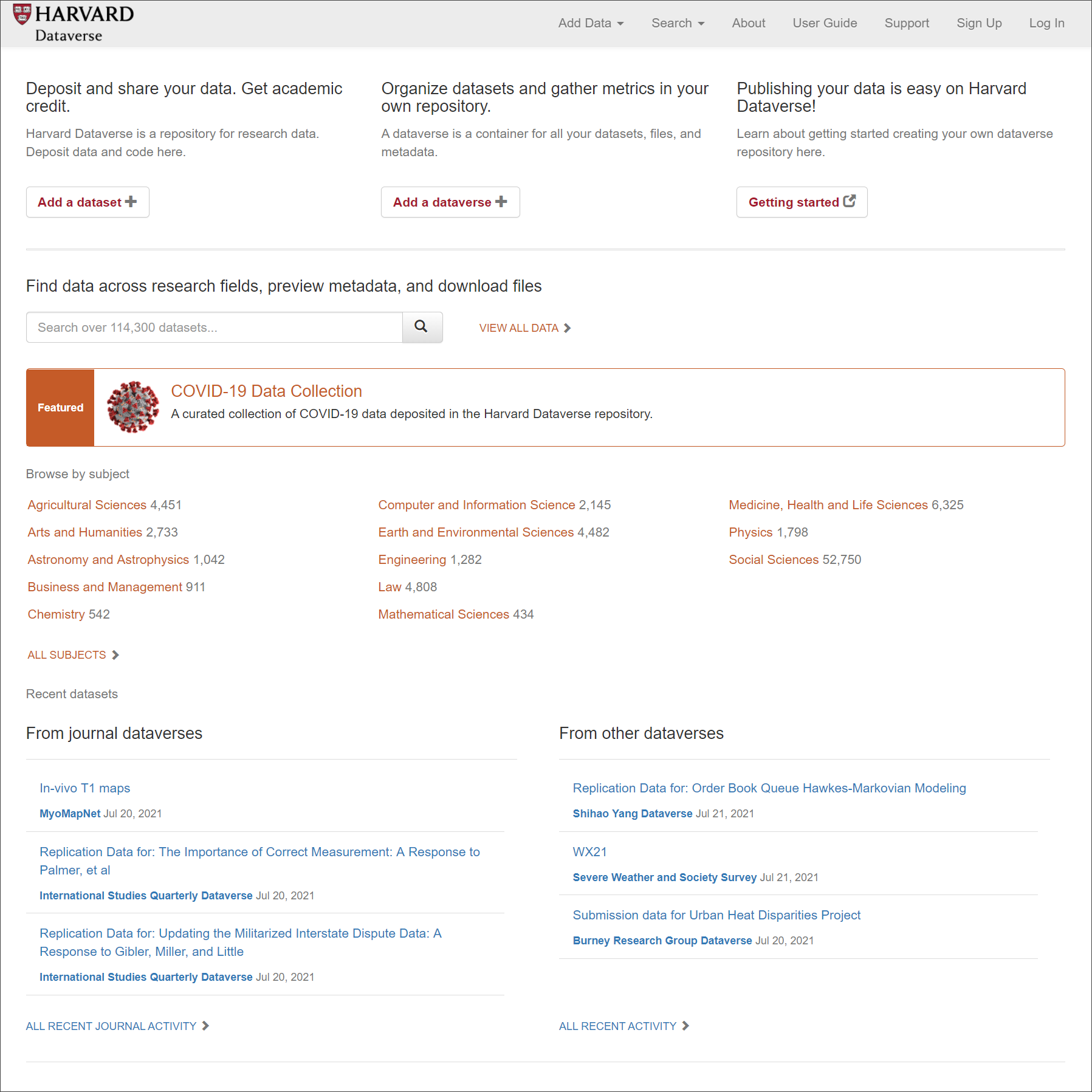
Harvard Dataverse is an open-access data repository developed and maintained by Harvard University that allows researchers to share, store, cite, and explore research data across multiple disciplines. It is part of the Dataverse Project, an open-source platform institutions use worldwide to manage and disseminate datasets. Although anyone can search for and download datasets, some may restricted.
Inter-University Consortium for Political and Social Research (ICPSR)
The Inter-University Consortium for Political and Social Research (ICPSR) is a global consortium of more than 810 academic institutions and organizations that provides access to an extensive social science data repository. Based at the University of Michigan, the ICPSR offers access to datasets in most areas of social science research, including political science, sociology, economics, education, public health, and criminal justice.
The following links are to other well-known multidisciplinary repositories of research data. However, social science is not the major concern of these resources, making each limited in scope.
- Dryad – An open-access repository for data published with scientific publications.
- Figshare – An open-access research repository designed for academic research data management and research data dissemination.
- Zenodo – An open-access data repository developed by CERN (The European Organization for Nuclear Research).
Electoral Systems
Researchers analyze electoral systems to understand how countries design electoral processes to elect representatives and leaders. The following resources offer datasets on comparative electoral systems. For information specific to U.S. elections and voting, visit U.S. Elections and Voting.
Comparative Study of Electoral Systems (CSES)
Comparative Study of Electoral Systems (CSES) is a collaborative research project that combines national election studies from around the globe, providing a cross-national, public dataset that analyzes and compares electoral systems, voter behavior, and political institutions.
European NUTS-Level Election Data (EU-NED)
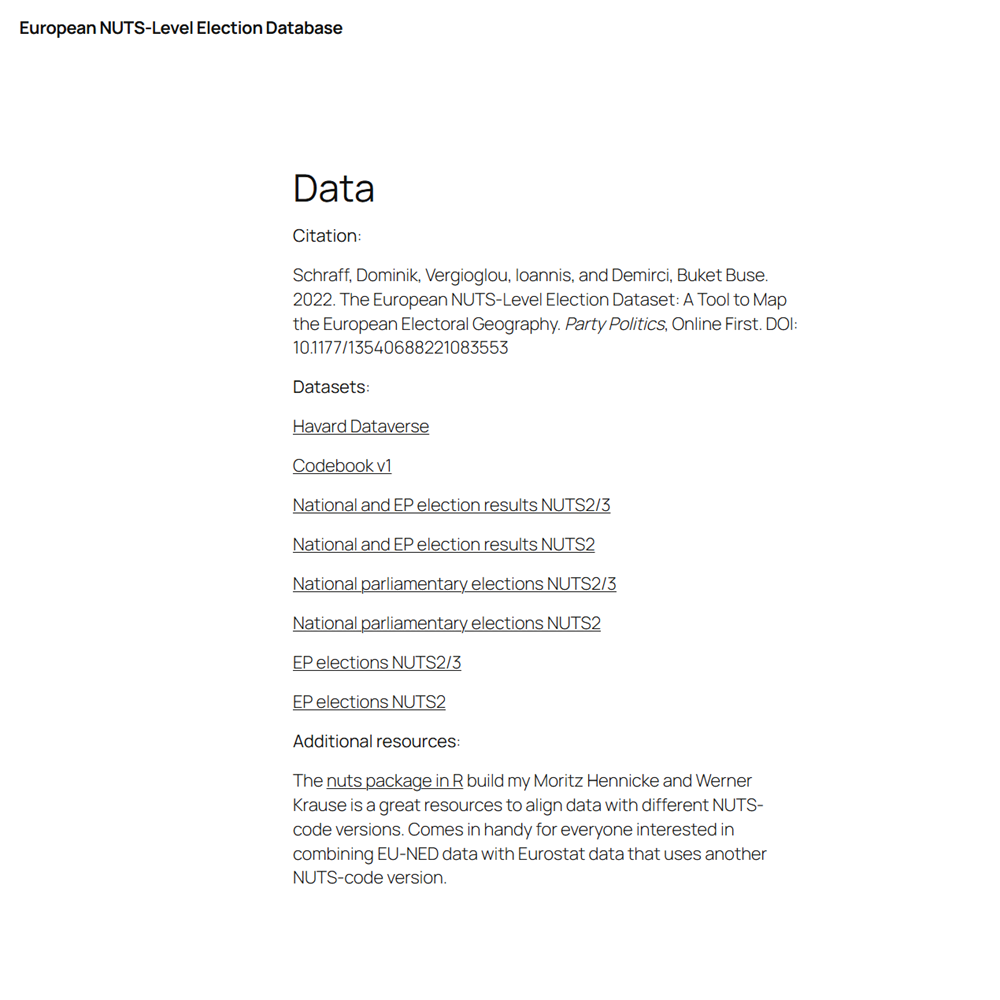
The European NUTS-Level Election Database (EU-NED) is a dataset of subnational election data offering national and European parliamentary election results aligned with Eurostat’s Nomenclature of Territorial Units for Statistics (NUTS) at levels 2 and 3. Nuts covers all European Union member states and associated countries over 30 years 1990 to 2020, providing consistent and detailed subnational electoral data.
Manifestos Project Database
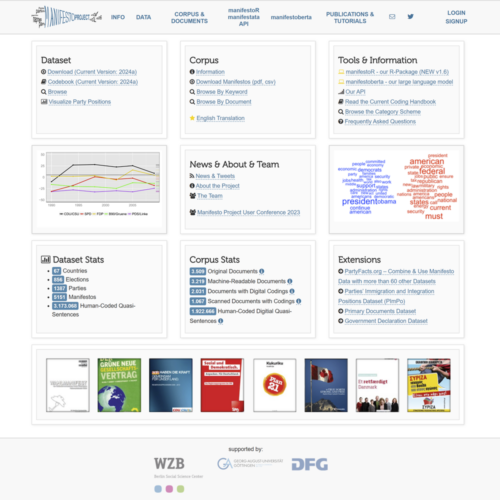
The Manifesto Project Database (MPD) provides political parties’ election manifestos from over 50 countries, covering democratic elections since 1945. The database offers valuable insights into parties’ policy positions and ideological shifts over the past 80 years.
National Elections Across Democracy and Autocracy (NELDA)
The National Elections Across Democracy and Autocracy (NELDA) dataset is a resource that compiles detailed information on national election events worldwide from 1945 to 2020. It provides data for national executive positions, such as presidents, and national legislative bodies, including parliaments and constituent assemblies.
The Elections Archive: THEA
The Elections Archive (THEA) (formerly the Constituency-Level Elections Archive) is a repository of subnational election results that provides detailed constituency-level results for both upper- and lower-house elections worldwide. THEA was developed by the University of Michigan’s Center for Political Studies.
Political Corruption
Political corruption data measures levels of corruption in political systems. Corruption in politics involves unethical or illegal actions by government officials, politicians, or institutions, often for personal or partisan gain. Common forms include bribery, embezzlement, nepotism, election fraud, and abuse of power.
Transparency International
Transparency International (TI) is a global non-governmental organization (NGO) founded in 1993 that focuses on combating corruption and promoting transparency, accountability, and integrity in governments, businesses, and civil society. Transparency International provides several datasets, including the Corruption Perceptions Index (CPI), which ranks countries based on perceived levels of corruption in the public sector from 1 (highly corrupt) to 10 (very clean), and the Government Defence Integrity Index (GDI), which measures the risk of corruption in defense and security institutions.
The International Country Risk Guide (ICRG)
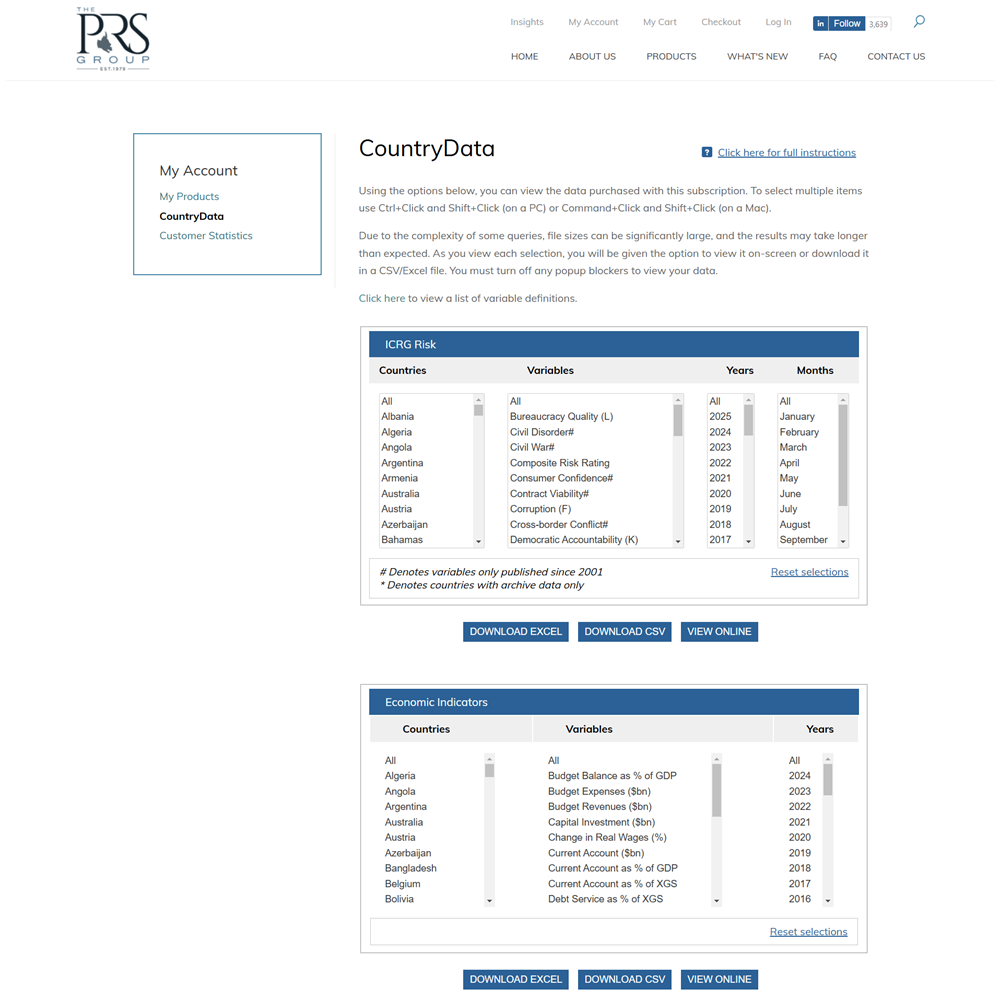
The International Country Risk Guide (ICRG) is a dataset that provides political, economic, and financial risk ratings for countries worldwide. It is produced by the Political Risk Services (PRS) Group and is primarily used to assess the stability and risk levels of different countries. Political indicators provided include corruption, bureaucratic quality, internal conflict, military in politics, and control of political corruption.
Political Economy
Political economy is how politics affects the economy and how the economy shapes politics. Political economy data analyzes the relationship between politics and economics, showing how political institutions, policies, and governance impact economic performance.
CountryData Online
CountryData Online from PRS (Political Risk Services Group) is a dataset that provides country-specific political, economic, and financial risk assessments. PRS is known for its International Country Risk Guide (ICRG), which evaluates risk factors that affect investment and economic stability across nations, and Country Reports and Economic Forecasts (CREF).
Economist Intelligence Unit (EIU) Viewpoint
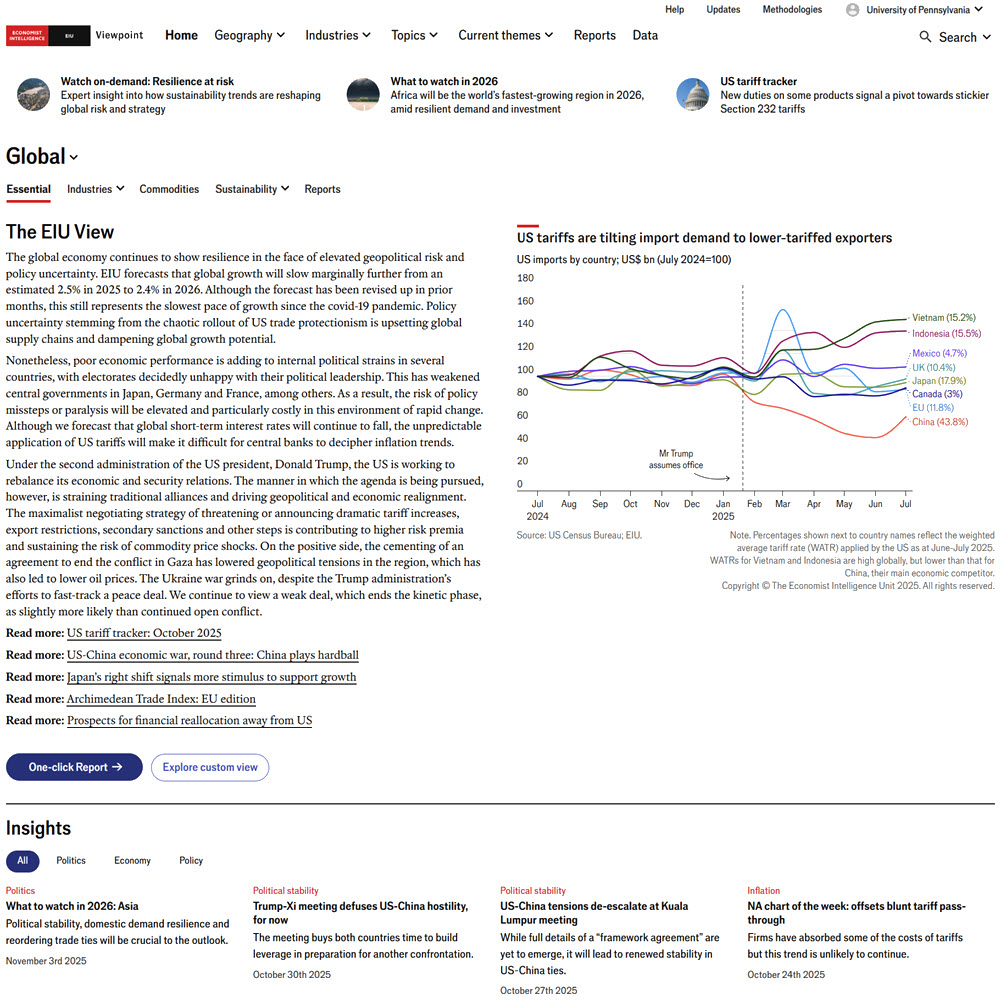
EIU Viewpoint (formerly Viewswire) is the new EIU platform that combines three products: Country Analysis, Financial Risk, and Operational Risk. Access to individual products depends on an institution’s description. EIU Viewpoint provides political, policy, and economic analysis and data. It includes in-depth country reports, forecasts, analysis, and expert opinions on matters of economic and geopolitical significance.
EIU Viewpoint includes a Data Tool providing access to key economic historical, current, and forecasted country data.
Organization for Economic Cooperation and Development (OECD)
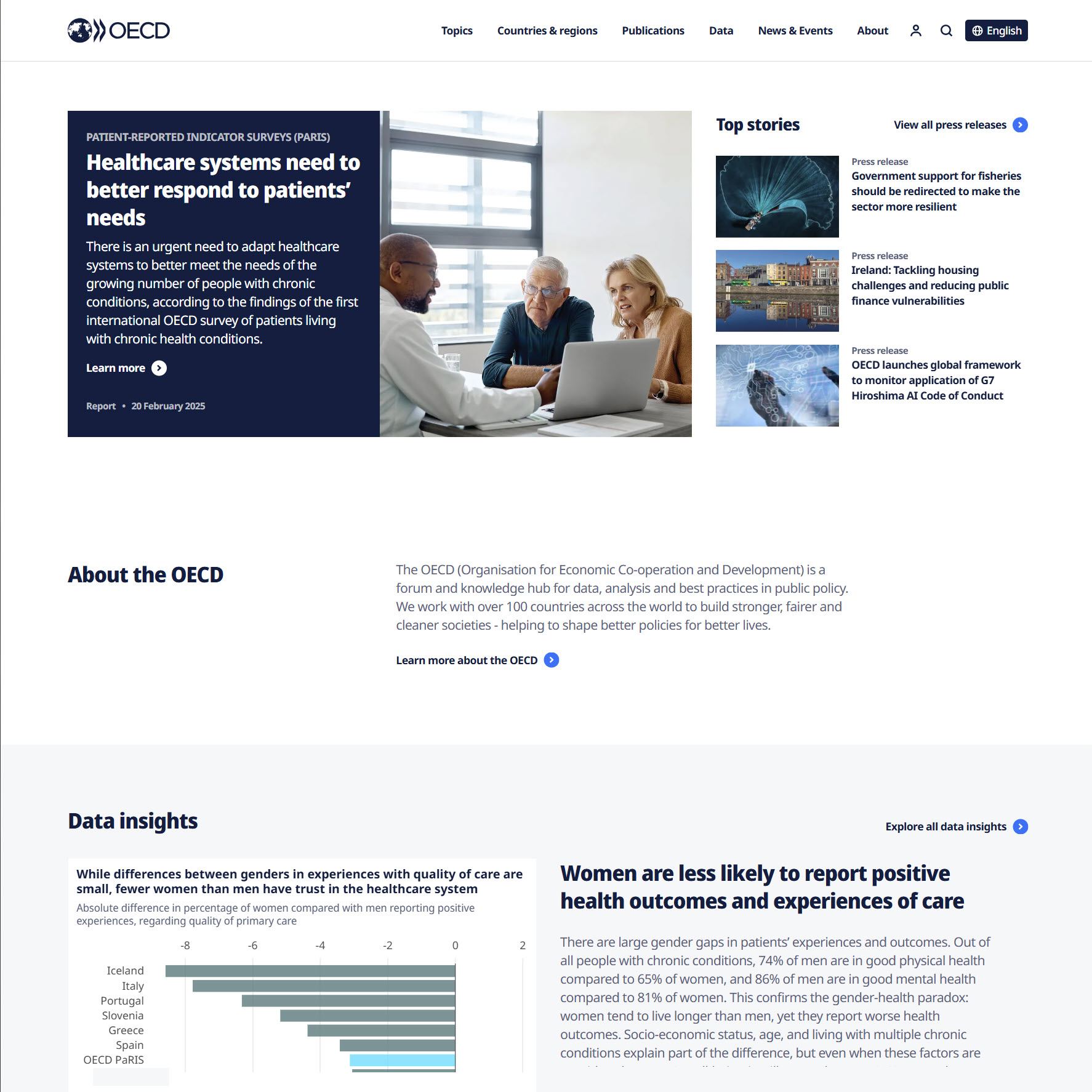
The OECD (Organisation for Economic Co-operation and Development) is an international organization that promotes economic growth, trade, and policy coordination among its 38 member countries. The OECD collects both economic and political data, though its primary focus is economic analysis, policy recommendations, and governance.
Quality of Government (QoG) Data
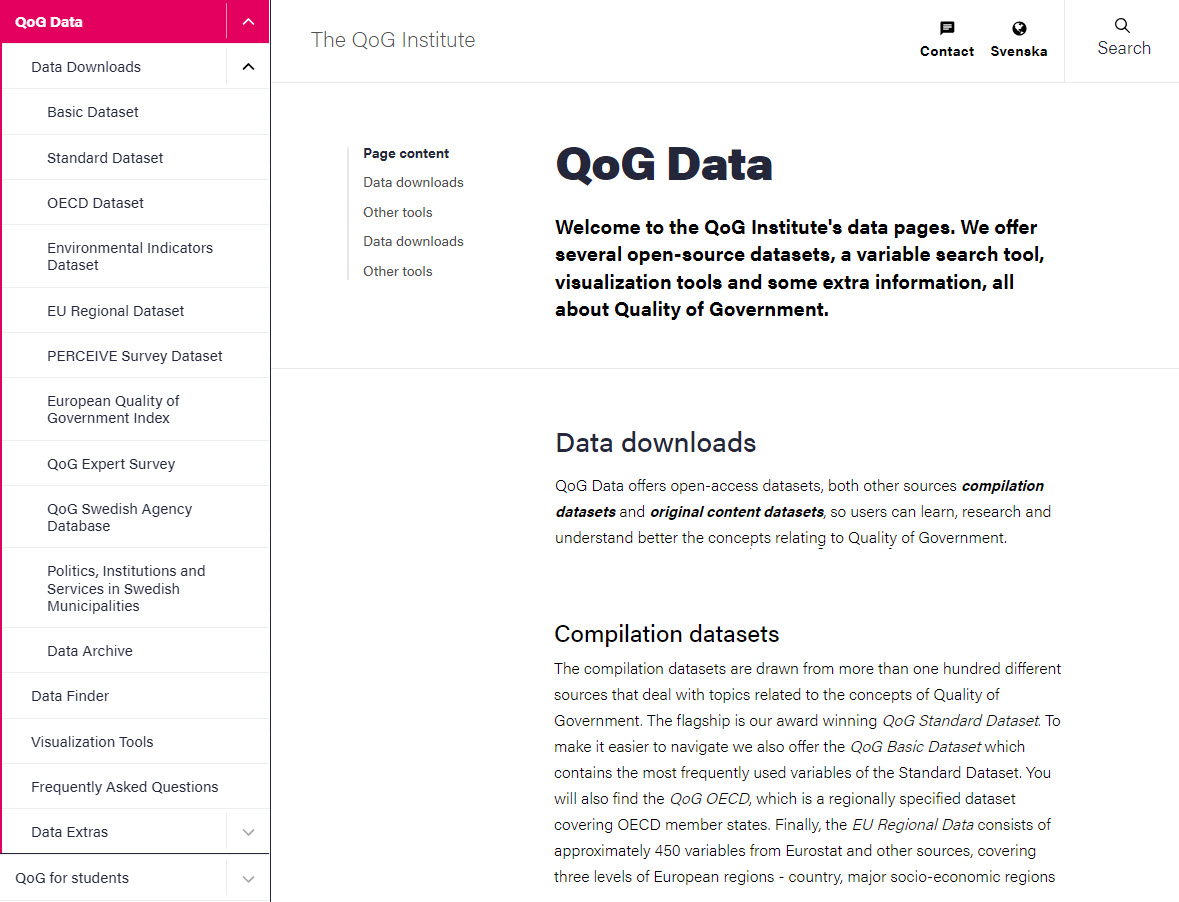
The Quality of Government (QoG) is a research institute based at the University of Gothenburg, Sweden, publishing research on good governance, corruption, and public administration. It provides free high-quality, comparative political data on government effectiveness, transparency, and corruption worldwide.
Datasets provided include:
- QoG Standard Dataset: The most comprehensive dataset, compiling over 2,500 governance indicators from 100+ sources.
- QoG Basic Dataset: A simplified version of the Standard Dataset.
- QoG OECD Dataset: Focuses on OECD countries including political, economic, and social indicators.
- QoG Expert Survey Dataset: Based on surveys of governance experts about public administration, bureaucracy, and corruption.
- QoG EU Regional Dataset: Focuses on governance and corruption at the regional level in the European Union.
Datasets are available in Excel, CSV, Stata, and R downloadable files.
United Nations (UN) Comtrade
The UN Comtrade Database is a global trade data repository maintained by the United Nations Statistics Division (UNSD). It provides detailed import and export statistics reported back to 1962 of countries worldwide, covering goods and services traded between nations. It includes trade data from over 200 reporting countries and territories classified using the Harmonized System (HS) and Standard International Trade Classification (SITC) codes, allowing for detailed product-level analysis.
UN Comtrade offers both free and subscription-based access. The free version is sufficient for most needs. However, the premium version provides more advanced features and usability, such as:
- Bulk data downloads.
- Async(-batch) and scheduled downloads.
- Faster performance and priority access to servers.
- Access to more timely data (e.g., preliminary monthly figures).
- Extended API limits (more requests per hour/day).
- Custom query building, saved searches, and automation tools.
- Ability to download entire datasets by country/product over time.
If you’re affiliated with a university, ask your librarian if your library subscribes to the premium version.
BACI (Base pour l’Analyse du Commerce International) is a global trade database developed by CEPII, a French research center in international economics. BACI provides bilateral trade flows between more than 200 countries, broken down by detailed product classification codes (HS 6-digit). BACI is based on UN Comtrade data, but it reconciles discrepancies between what exporters and importers report—a known issue in raw Comtrade data.
United Nations Conference on Trade and Development (UNCTAD) Data Hub
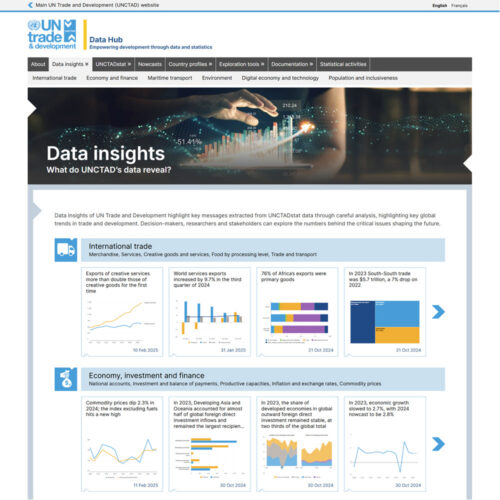
The United Nations Conference on Trade and Development (UNCTD) is a part of the United Nations Secretariat and focuses on promoting international trade and development, particularly in developing countries. The UNCTD Data Hub provides access to a wide range of global economic and trade data, including international trade and investment, trade in services, financial flows and markets, economic development indicators, and technology and innovation metrics.
World Bank Open Data
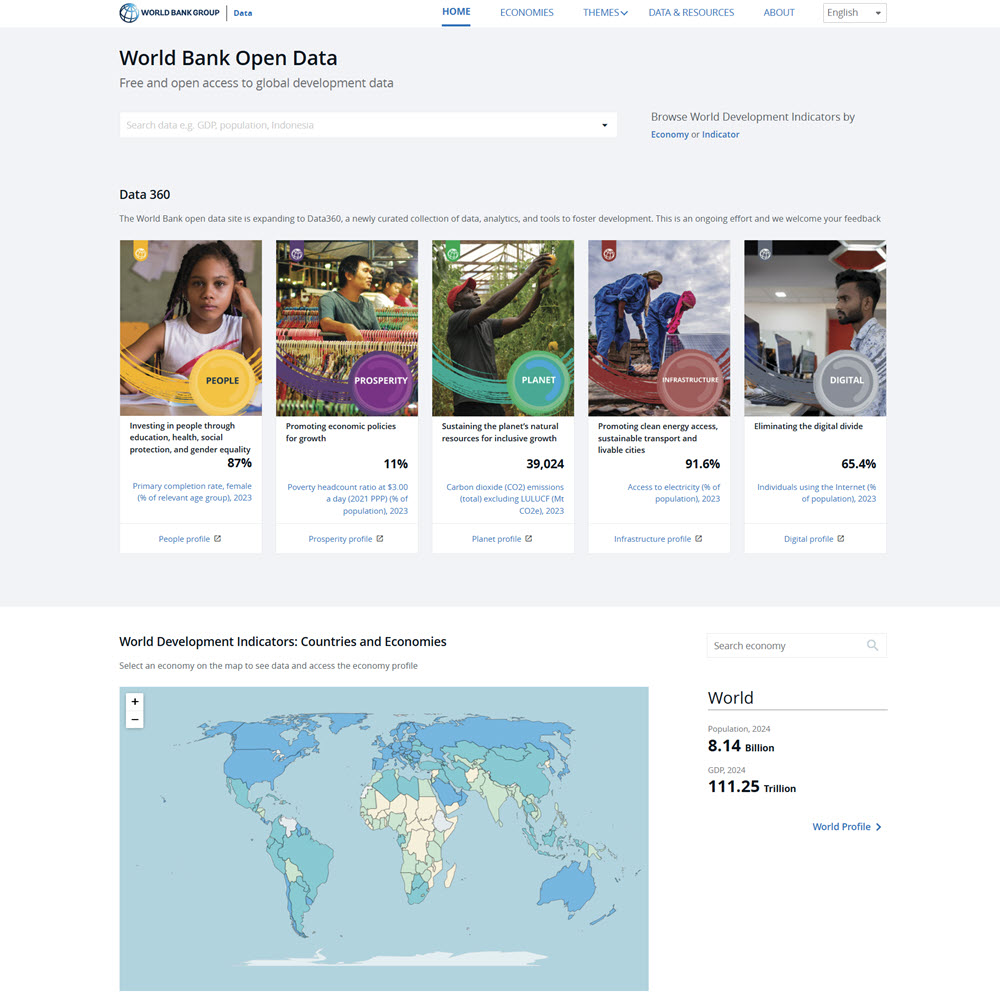
World Bank Open Data is a publicly available series of global development datasets produced by the World Bank Group. Each dataset provides a wide range of global development data, including economic, social, and financial datasets from over 200 countries and territories. The data is collected from national statistical agencies, international organizations (IMF, UN), and World Bank research.
World Integrated Trade Solution (WITS)
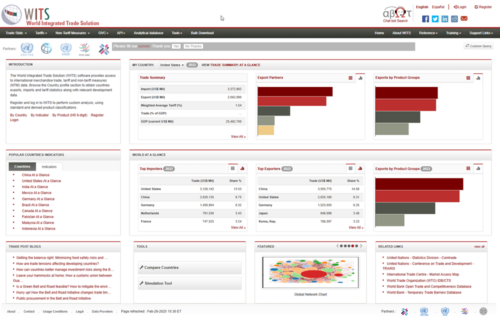
The World Integrated Trade Solution (WITS) is an online data platform that provides comprehensive trade-related data, tariff data, Non-Tariff Measures (NTMs), data on trade agreements, and indicators & Analytical Tools. It was developed by the World Bank, in collaboration with organizations such as the United Nations Conference on Trade and Development (UNCTAD), the International Trade Centre (ITC), the United Nations Statistics Division (UNSD), and the World Trade Organization (WTO).
Political Institutions
Institutional political data includes data on governments, legal frameworks, electoral systems, public institutions, and organizations that shape political decision-making and governance.
Database of Political Institutions
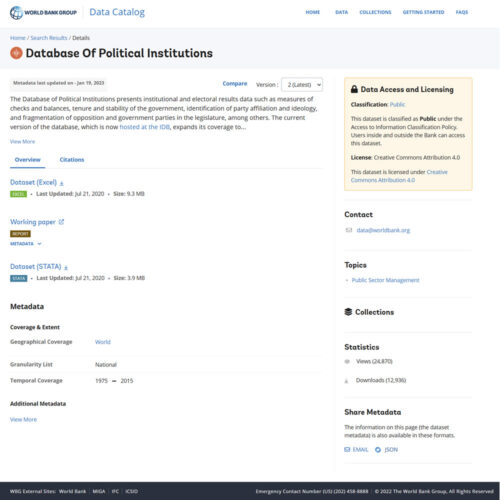
Developed by the World Bank, the Database of Political Institutions (DPI) provides data on government’s political and institutional characteristics worldwide, including checks and balances, tenure and stability of the government, identification of party affiliation and ideology, and fragmentation of opposition and government parties in the legislature.
Freedom House - Countries and Territories
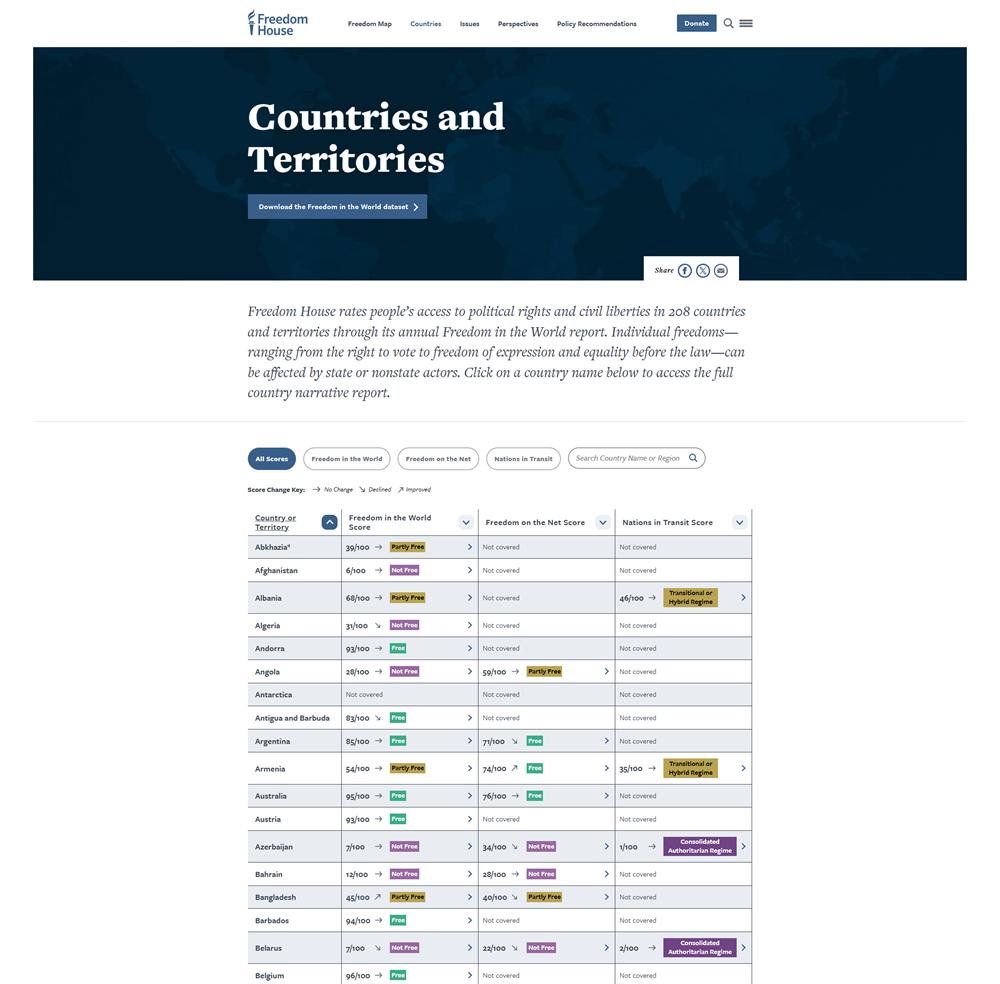
Freedom House is a non-governmental organization (NGO) based in the United States that conducts research and advocacy on democracy, political rights, and civil liberties worldwide. Freedom House – Countries and Territories provides ratings of citizens’ access to political rights and civil liberties in 210 countries and 15 territories, ranging from 1 (most free) to 7 (least free).
International Country Risk Guide (ICRG)
The International Country Risk Guide (ICRG) is a dataset that provides political, economic, and financial risk ratings for countries worldwide. It is produced by the Political Risk Services (PRS) Group and is primarily used to assess the stability and risk levels of different countries. Political indicators provided include corruption, bureaucratic quality, internal conflict, military in politics, and control of political corruption.
Polity Project
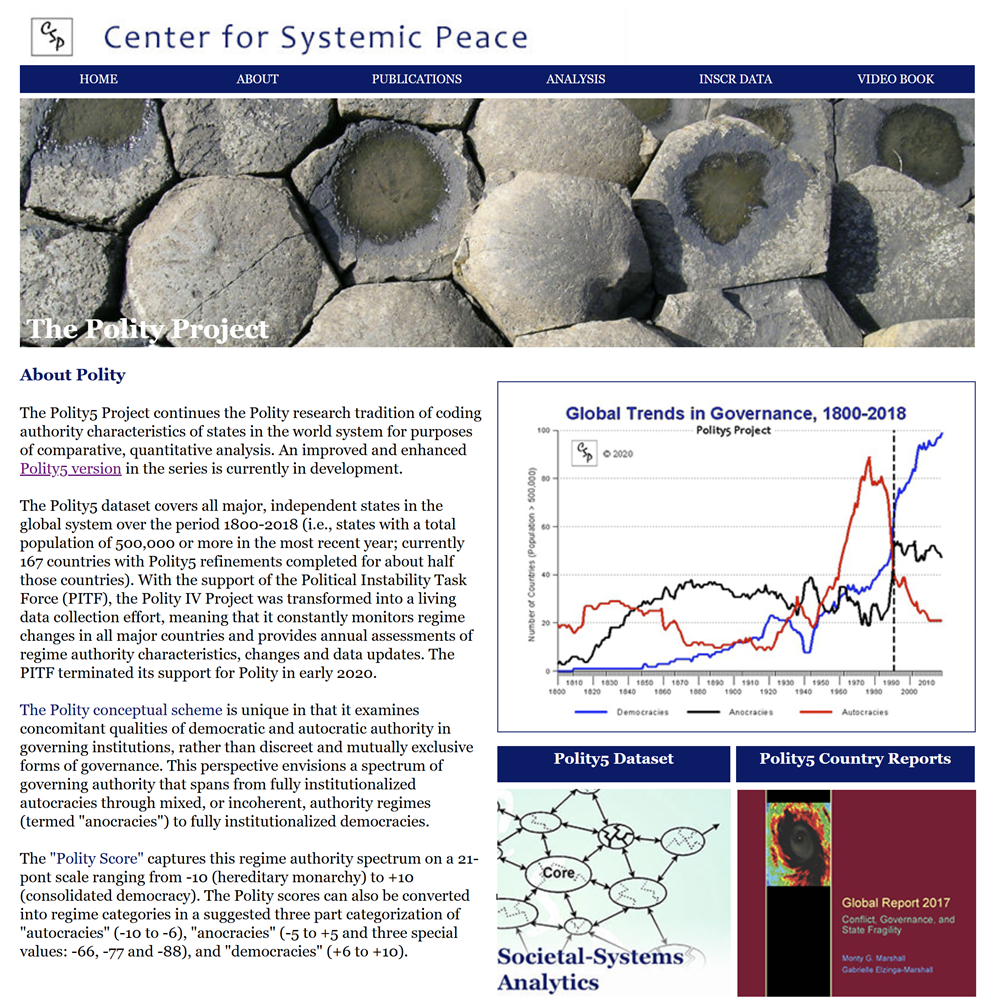
The Polity5 is the latest version of the Polity Project, a dataset that measures the level of democracy and autocracy in political systems worldwide from -10 (full autocracy) to +10 (full democracy). It provides annual data on the institutional characteristics of governments, allowing researchers to analyze trends in governance and regime changes across countries.
Quality of Government (QoG)
The Quality of Government (QoG) is a research institute based at the University of Gothenburg, Sweden, publishing research on good governance, corruption, and public administration. It provides free high-quality, comparative political data on government effectiveness, transparency, and corruption worldwide.
Datasets provided include:
- QoG Standard Dataset: The most comprehensive dataset, compiling over 2,500 governance indicators from 100+ sources.
- QoG Basic Dataset: A simplified version of the Standard Dataset.
- QoG OECD Dataset: Focuses on OECD countries including political, economic, and social indicators.
- QoG Expert Survey Dataset: Based on surveys of governance experts about public administration, bureaucracy, and corruption.
- QoG EU Regional Dataset: Focuses on governance and corruption at the regional level in the European Union.
Datasets are available in Excel, CSV, Stata, and R downloadable files.
Varieties of Democracy (V-Dem)
The Varieties of Democracy (V‑Dem) dataset measures and tracks democracy across the globe. The dataset gathers detailed information on various aspects of democracy—such as electoral processes, liberal institutions, participatory practices, deliberative standards, and egalitarian principles. Users can analyze trends and shifts in democratic governance over time and across nearly 200 countries.
World Governance Assessment (WGA)
The World Governance Assessment (WGA) is a global initiative that evaluates and analyzes governance quality across various countries. Launched by the Overseas Development Institute (ODI), the WGA focuses on six key principles of governance: participation, fairness, decency, accountability, transparency, and efficiency.
Public Opinion, Surveys and Polling
The following opinion, survey, and polling data resources are collected responses from people on various topics. These surveys and polls gauge public opinion, behaviors, attitudes, and trends on issues such as politics, economics, social matters, technology, and culture.
[wptabs id=”7681″]
Terrorism, War, & Conflict
Terrorism, war, and conflict studies is a broad interdisciplinary field within political science, international relations, history, and security studies. It examines the causes, strategies, and consequences of violence, armed conflicts, and political instability.
Armed Conflict Location & Event Data (ACLED)
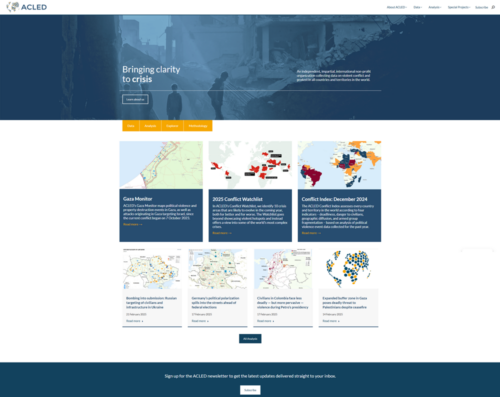
The Armed Conflict Location & Event Data Project (ACLED) tracks political violence and protest events worldwide, including conflict data involving state forces, rebels, militias, civilians, and political groups. Data includes battles and armed clashes, explosions and remote violence, violence against civilians, riots, and protests. The ACLED Conflict Index calculates where conflicts in every country and territory vary according to four indicators – deadliness, danger to civilians, geographic diffusion, and the number of armed groups.
Global Terrorism Database (GTD)
The Global Terrorism Database is a publicly available dataset that records terrorist attacks worldwide since 1970. It provides details such as when and where an attack occurred, who was targeted, and the tactics used, allowing users to track patterns and compare trends over time.