
Economic Data
Quantitative information that measures the production, distribution, and consumption of goods and services, along with the conditions that shape them.
Source: iStock
Overview
We’ve listed core economic data portals for U.S. and international data in the main Economics guide. However, these portals provide many categories of economic data. Knowing these categories can help you locate the right resource more quickly.
Business and Industry
Business and industry data provide statistics on the structure, performance, and activity of businesses and industries. These data sources include business formation and closures, industrial and manufacturing output, employment, productivity, sales, inventories, and industry trends.
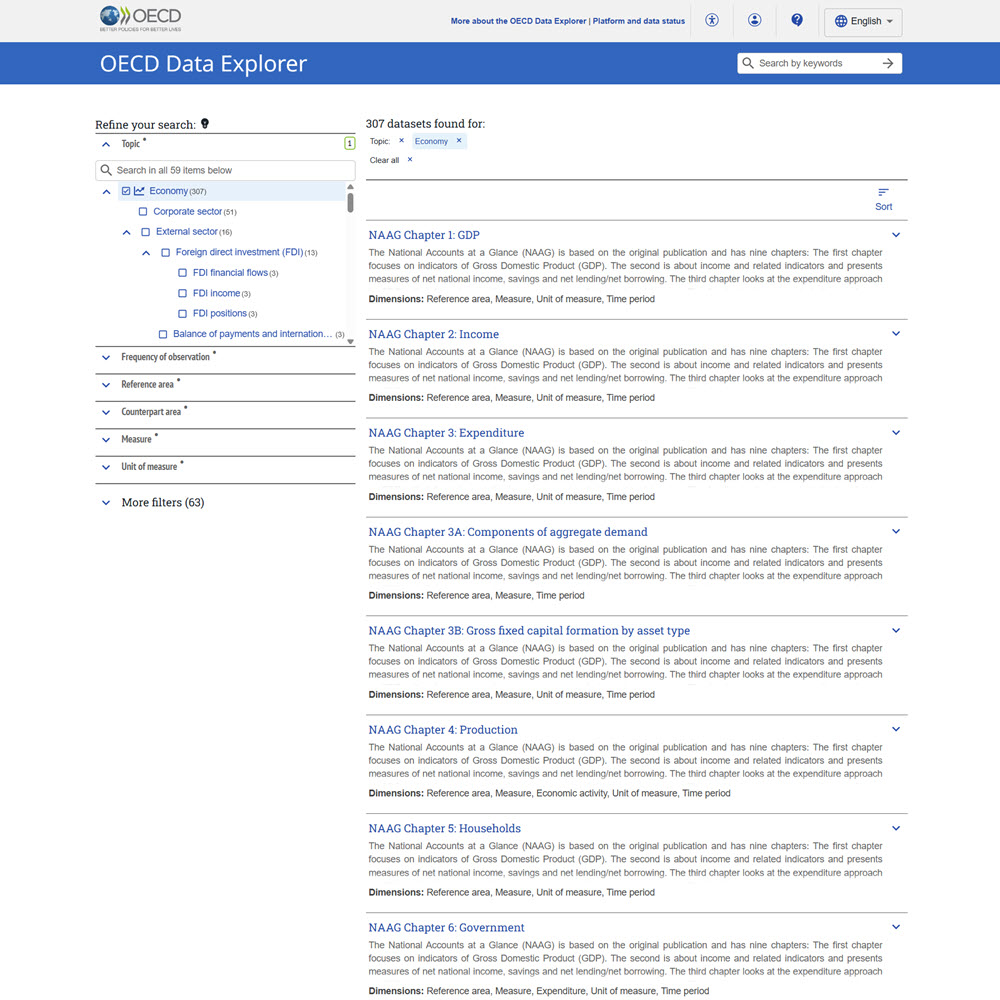
CEIC Data is a commercial economic and financial data platform specializing in macroeconomic, industry, and alternative data. It is particularly strong for data in emerging markets, including China, India, Southeast Asia, Latin America, and Eastern Europe, while providing coverage of more than 200 countries. CEIC provides a broad range of time-series economic indicators.
Examples of the topics and types of data covered by CEIC include the following:
- Trade data
- Mobility trends
- Consumption and production
- Labor markets
- Supply chain
- Prices
- Environment
- Real estate
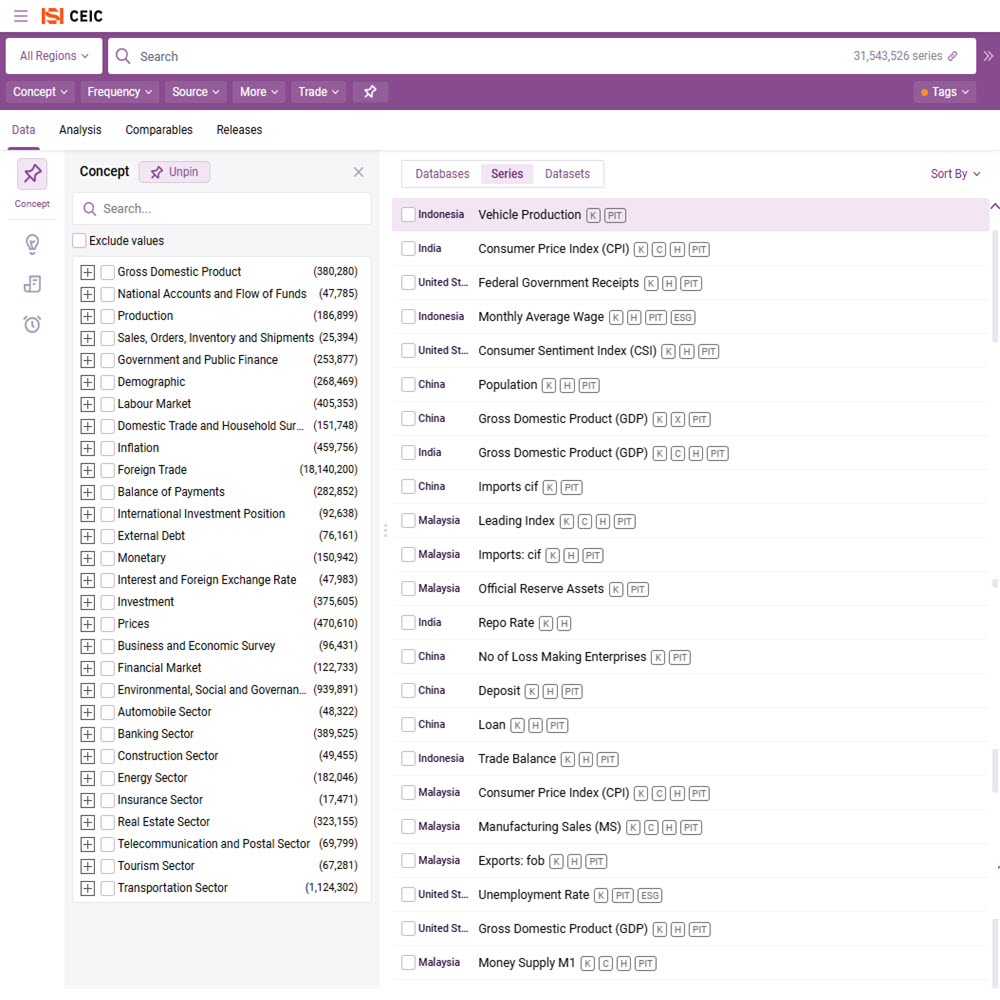
Eurostat is the European Union’s (EU) statistical office, responsible for collecting, processing, and publishing comparable and harmonized statistics across EU member states and partner countries. Eurostat provides monthly data on imports and exports, values and quantities of trade by product and partner country, annual data on trading companies, and annual data on trade by invoicing currency.
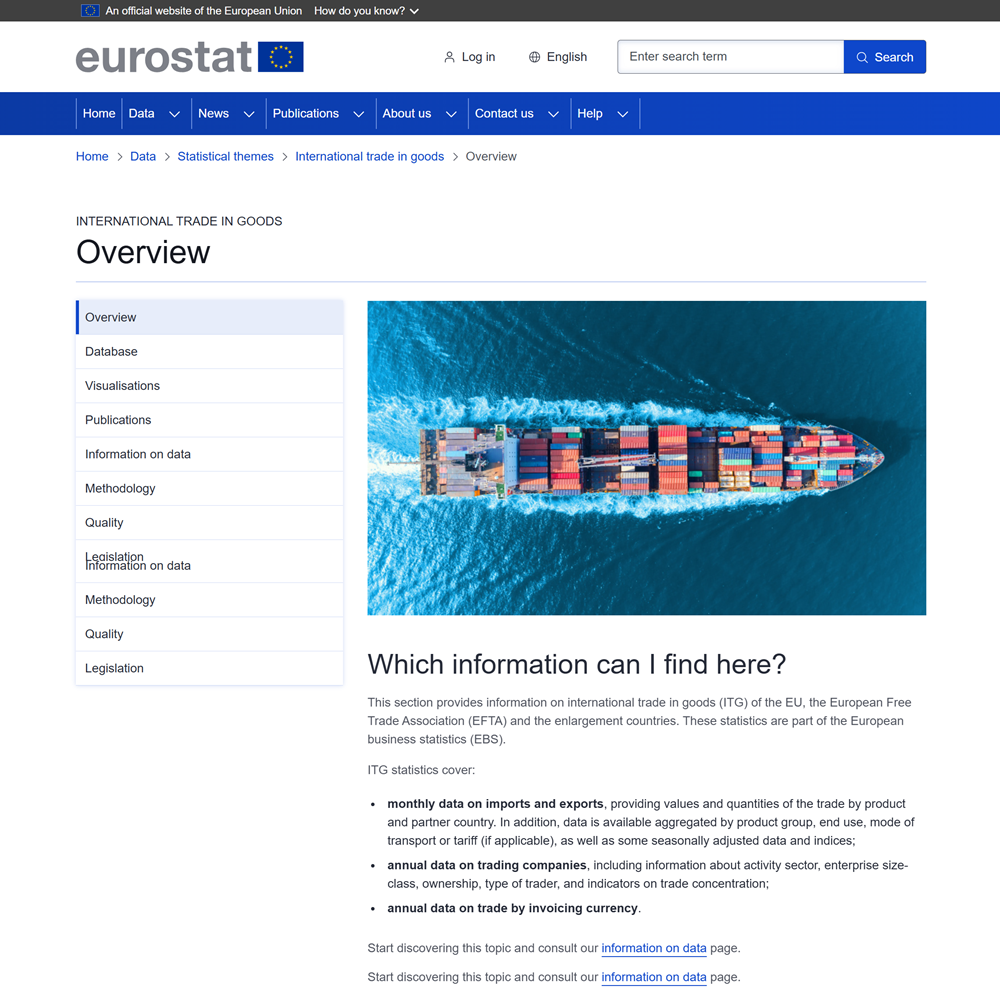
OECD Data Explorer is the OECD’s central statistical data platform, providing free access to official economic, social, environmental, and policy statistics for OECD member countries and partner economies. It provides international and cross-country comparisons, with data covering topics such as national accounts, prices, employment, trade, education, health, demographics, taxation, government finance, development, industry, productivity, and the environment.
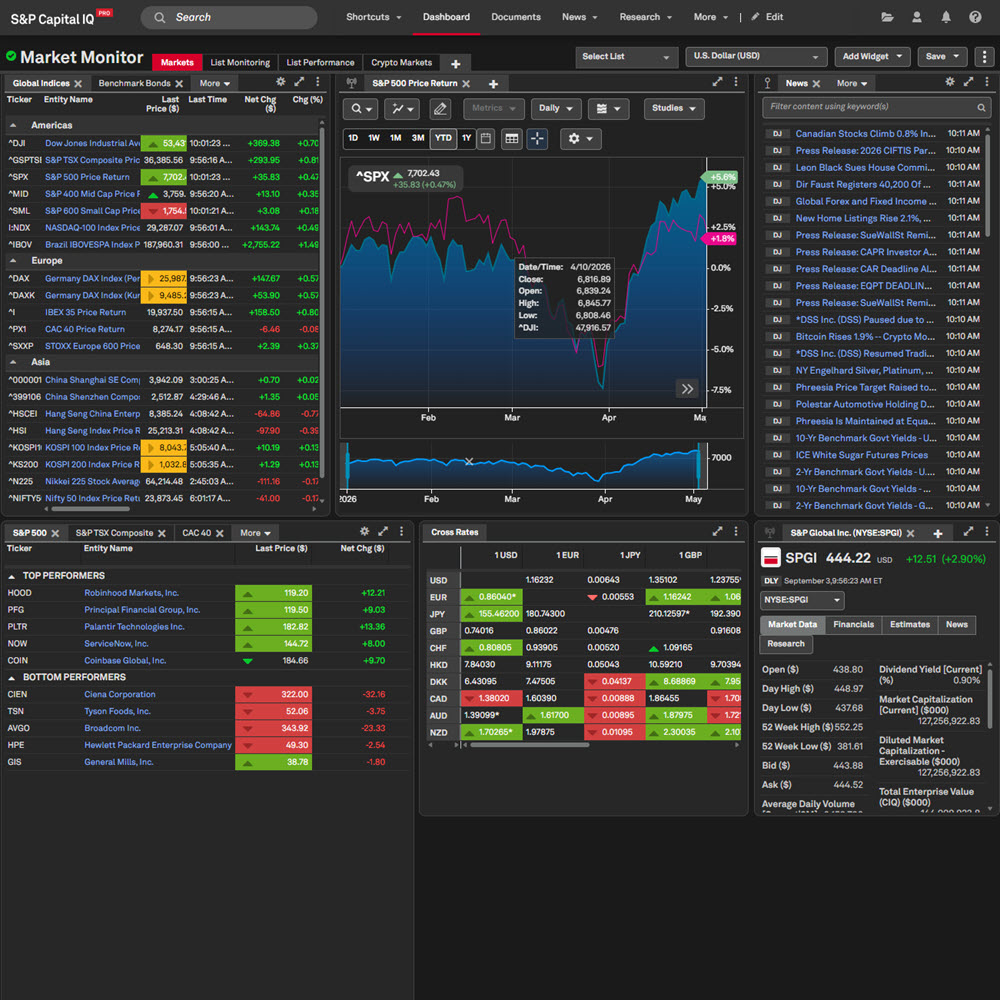
S&P Capital IQ Pro is a subscription-based financial and market intelligence platform from S&P Global Market Intelligence. It provides extensive company, financial-market, industry, transaction, economic, and investment research data with tools for screening, analysis, visualization, and financial modeling. Although used by business professionals, it is often available at universities.
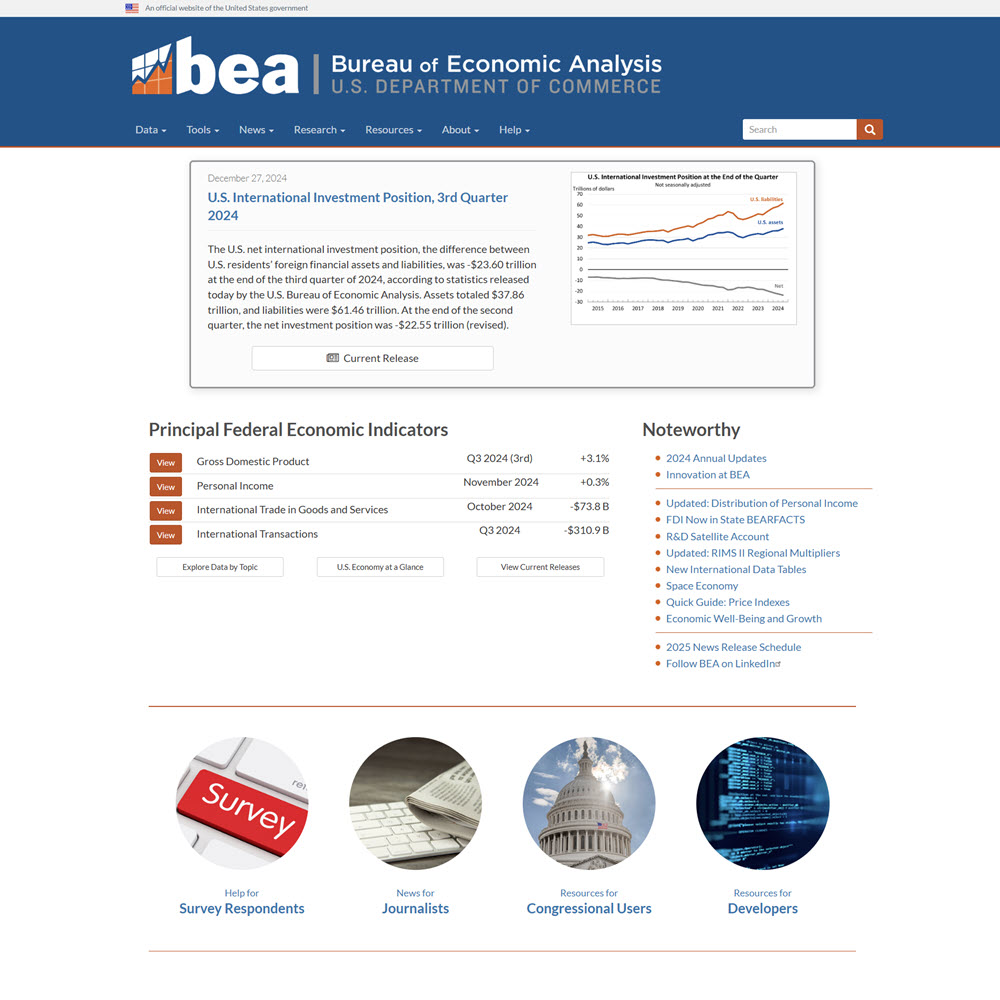
The Bureau of Economic Analysis (BEA) is an agency of the United States Department of Commerce responsible for collecting, analyzing, and reporting official U.S. economic data and statistics. The BEA provides data for Gross Domestic Product (GDP), regional and state-level economies within the United States, industries and sectors of the U.S. economy, international economic data, research and economic analysis, and economic accounts data. The BEA and the U.S. Census Bureau jointly release monthly data on the nation’s imports, exports, and trade balance.
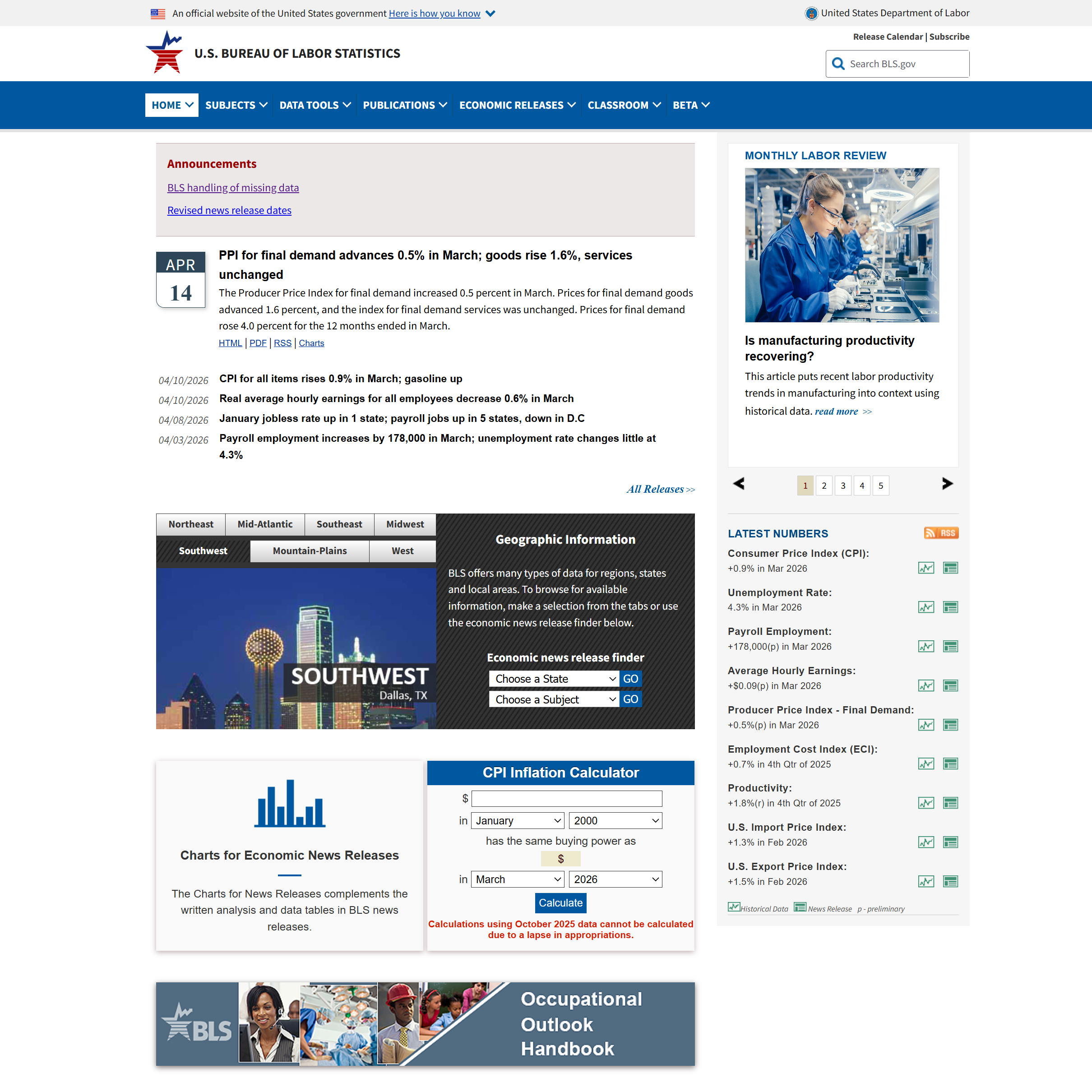
The Bureau of Labor Statistics (BLS) is a U.S. government agency that collects and publishes data on jobs, wages, inflation, productivity, and working conditions. Its reports include the following:
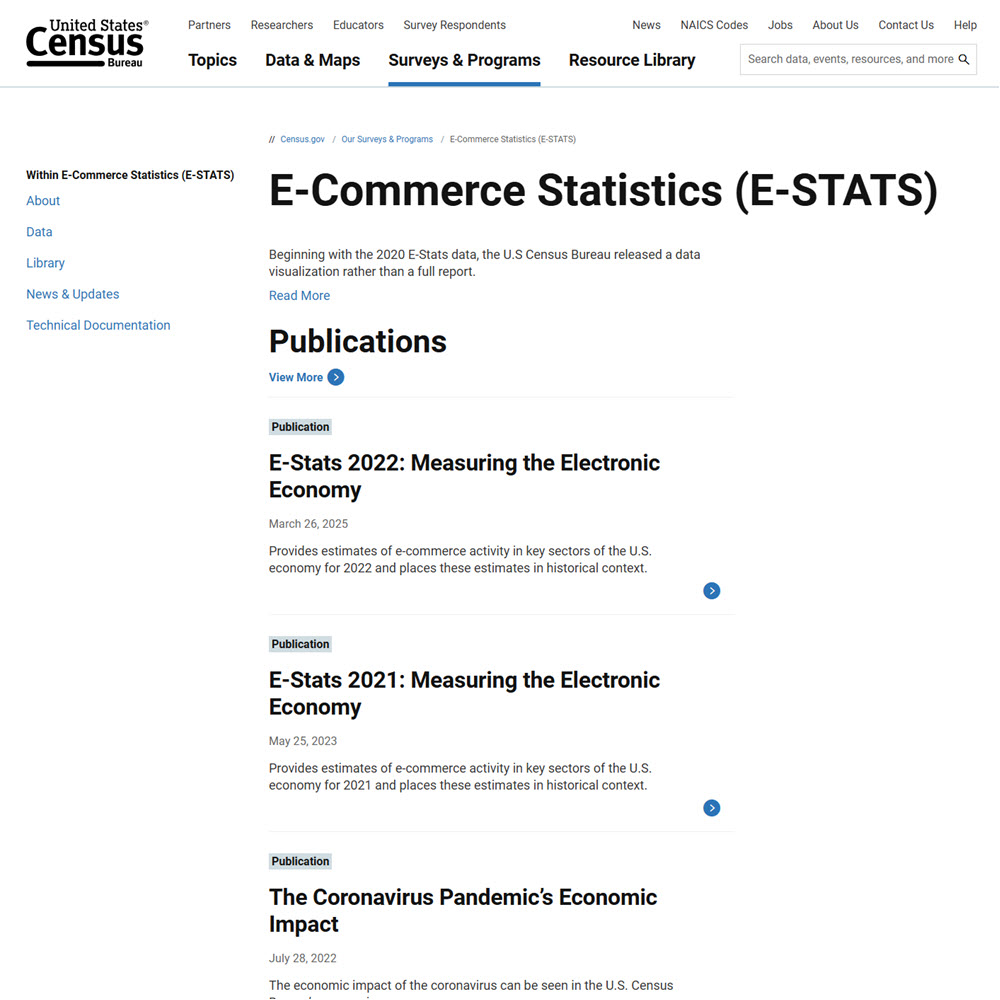
The U.S. Census Bureau E-Commerce Statistics (E-STATS) program provides data on e-commerce activity across major sectors of the U.S. economy. It measures electronic sales, shipments, and revenues in areas such as manufacturing, wholesale trade, retail trade, and selected service industries.
Beginning with 2020 E-STATS, the Census Bureau stopped producing the traditional comprehensive E-STATS report and moved to an interactive data visualization. The underlying e-commerce statistics continue to come from several separate Census Bureau surveys—the Annual Survey of Manufactures, Annual Wholesale Trade Survey, Annual Retail Trade Survey, and Service Annual Survey.
Consumer Goods
Consumer goods data tracks the production, sale, and consumption of products purchased by individuals and households for personal use, as opposed to goods bought by businesses or governments. These would include items such as food, clothing, and household supplies.
[Place Bricks Template Here]
[Place Bricks template Here]
Economic Development
Economic development data measures how a country’s or region’s economy is growing and how living standards and well-being are changing over time. Examples include GDP, gross national income, and the Gini coefficient.
[Place Bricks Template Here]
[Place Bricks template Here]
Economic Growth and National Accounts
National accounts are a country’s record of economic activity, such as production, income, spending, and saving. Economic growth is the rate at which output expands over time, usually measured as the change in real GDP. The two are linked because economic growth is calculated directly from the national accounts.
[Place Bricks Template Here]
[Place Bricks template Here]
Energy Commodities
Energy commodities data tracks the prices, production, consumption, trade, and inventories of raw energy resources. It’s compiled by agencies like the U.S. Energy Information Administration and the International Energy Agency, along with commodity exchanges. Examples include crude oil, natural gas, coal, and renewable energy such as solar, wind, and hydroelectric.
[Place Bricks Template Here]
[Place Bricks template Here]
Housing and Real Estate
Housing and real estate data track the construction, sales, prices, financing, and occupancy of residential and commercial property. Data examples include housing starts and building permits, new and existing home sales, median home prices, mortgage rates and applications, and homeownership rates.
[Place Bricks Template Here]
[Place Bricks template Here]
Income, Wealth and Poverty
Income, wealth, and poverty data measure how much people earn, what they own, and how many fall below minimum living standards, along with how these are distributed across the population. Examples include per capita income, income distribution by quintile, and the Gini coefficient.
[Place Bricks Template Here]
[Place Bricks template Here]
Investment/Foreign Direct Investment (FDI)
Investment and Foreign Direct Investment data track capital spending within an economy and cross-border investment, where a company or individual in one country acquires a lasting ownership stake in a business in another. Examples include business investment in equipment and structures, portfolio investment flows, and reinvested earnings of foreign affiliates.
[Place Bricks Template Here]
[Place Bricks template Here]
Labor and Employment
Labor and employment data measures the size, activity, and conditions of the workforce, including who is working, who is looking for work, what they earn, and how labor markets are changing.
[Place Bricks Template Here]
[Place Bricks template Here]
Money and Banking
Money and banking data track the supply of money, the activities of banks and other financial institutions, and the tools central banks use to manage the financial system. Examples include bank reserves and reserve requirements, commercial bank loans and deposits, and consumer and commercial credit outstanding.
[Place Bricks Template Here]
[Place Bricks template Here]
Population and Demographics
Population and demographic data describe the size, structure, and characteristics of a population, which shape labor supply, consumer demand, government spending, and long-term growth. Examples include, working-age population (15–64), the dependency ratio (children and elderly per worker), and birth and fertility rates.
[Place Bricks Template Here]
[Place Bricks template Here]
Prices and Inflation
Prices and inflation data measure the general level of prices in an economy and how quickly they change over time, affecting purchasing power, interest rates, and monetary policy. Examples include the Consumer Price Index (CPI), Core CPI (excluding food and energy), and the Personal Consumption Expenditures (PCE) price index.
[Place Bricks Template Here]
[Place Bricks template Here]
Regional and Local Economies
Regional and local economies data measure economic activity at the state, metropolitan, county, or city level, revealing how conditions differ across geographic areas within a country.
[Place Bricks Template Here]
[Place Bricks template Here]
Trade Statistics
Trade statistics provide information on the goods and services that are imported and exported by countries, where those products come from or go to, and how trade changes over time.
United States Trade Statistics
U.S. trade statistics are the official figures tracking the country’s imports and exports of goods and services with the rest of the world. They’re compiled primarily by the U.S. Census Bureau (goods) and the Bureau of Economic Analysis (services and balance-of-payments adjustments), and released each month jointly in the “U.S. International Trade in Goods and Services” report.
The Bureau of Economic Analysis (BEA) is an agency of the United States Department of Commerce responsible for collecting, analyzing, and reporting official U.S. economic data and statistics. The BEA provides data for Gross Domestic Product (GDP), regional and state-level economies within the United States, industries and sectors of the U.S. economy, international economic data, research and economic analysis, and economic accounts data. The BEA and the U.S. Census Bureau jointly release monthly data on the nation’s imports, exports, and trade balance.
DataWeb is provided by the U.S. International Trade Commission (USITC), which offers public access to extensive U.S. trade and tariff data. It integrates official U.S. import and export statistics from the U.S. Department of Commerce with detailed tariff and customs information, enabling users to retrieve and analyze trade data across various parameters.
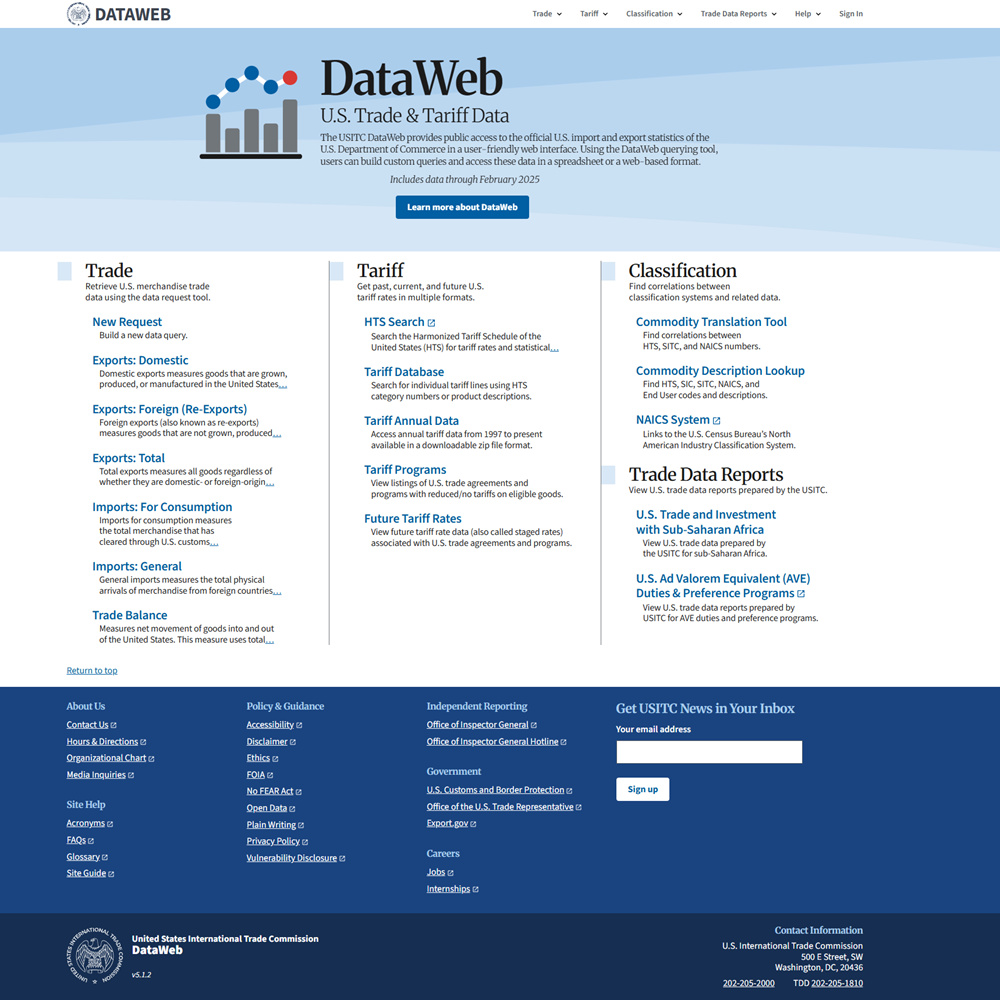
DataWeb is provided by the U.S. International Trade Commission (USITC), which offers public access to extensive U.S. trade and tariff data. It integrates official U.S. import and export statistics from the U.S. Department of Commerce with detailed tariff and customs information, enabling users to retrieve and analyze trade data across various parameters.
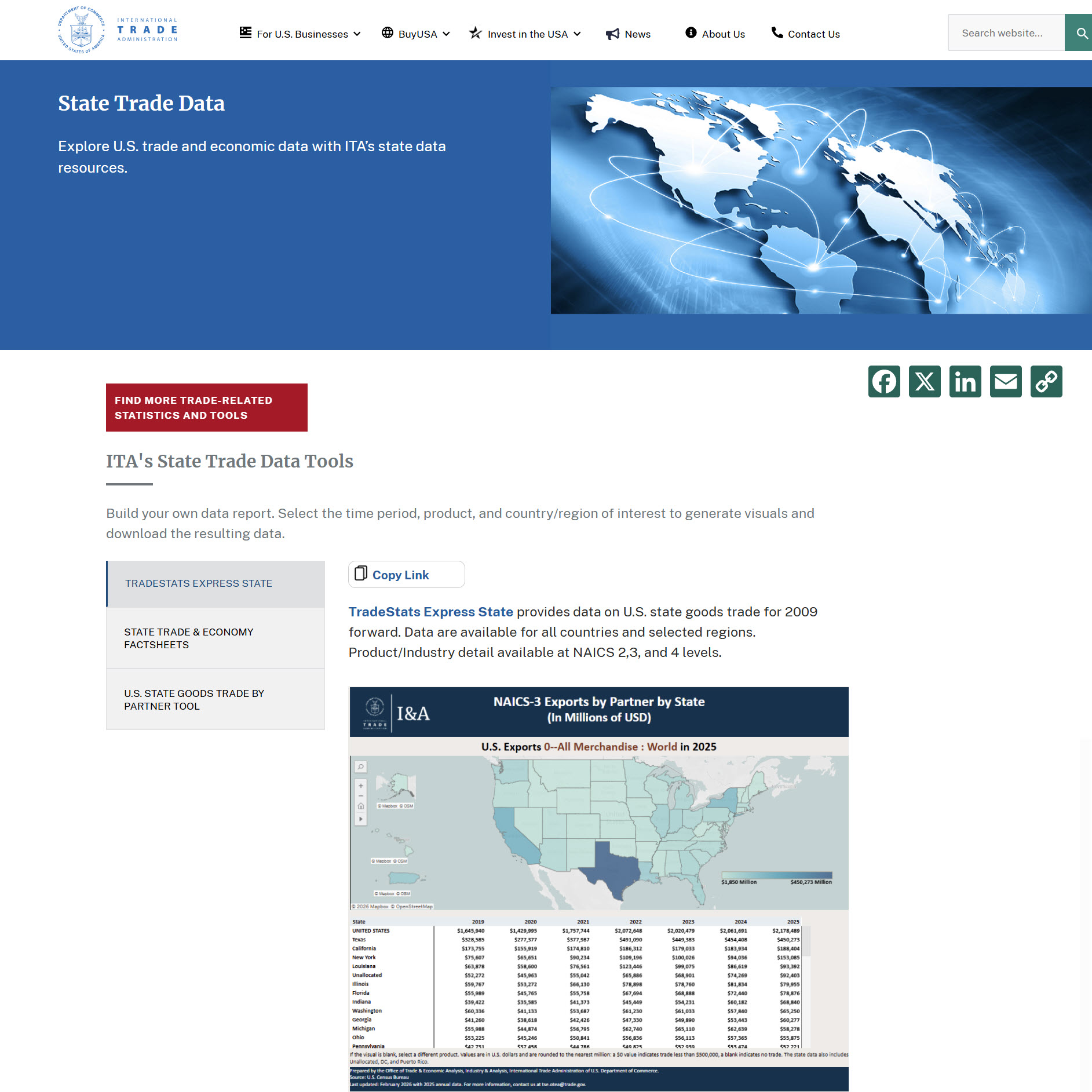
State Trade Data (Trade.gov) provides state-by-state export and import statistics, helping users compare trade activity, top markets, and leading industries across the United States. State Trade Data tells you what each specific state exports and imports and to which countries.
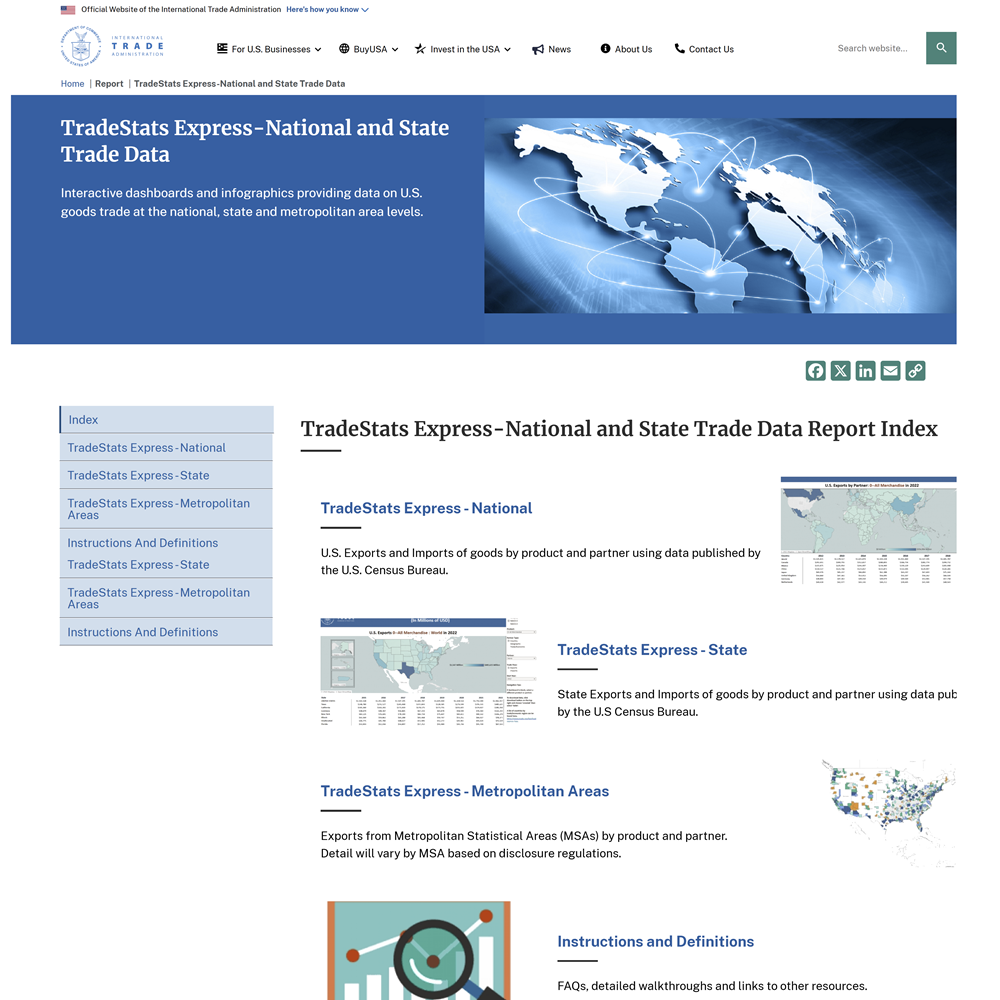
The TradeStats Express – National and State Trade Data Report Index is an interactive online platform developed by the U.S. Department of Commerce’s International Trade Administration (ITA). It offers comprehensive U.S. goods trade statistics at the national, state, and metropolitan levels.
- TradeStats Express – National – Users can analyze U.S. exports and imports by partner or product, including trade flows of particular goods using the HS (Harmonized System), NAICS (North American Industry Classification System), or SITC (Standard International Trade Classification).
- TradeStats Express – State – Review exports and imports between individual U.S. states and international partners.
- TradeStats Express – Metropolitan Areas – Access export data for over 380 U.S. Metropolitan Statistical Areas (MSAs), including top products and destinations.
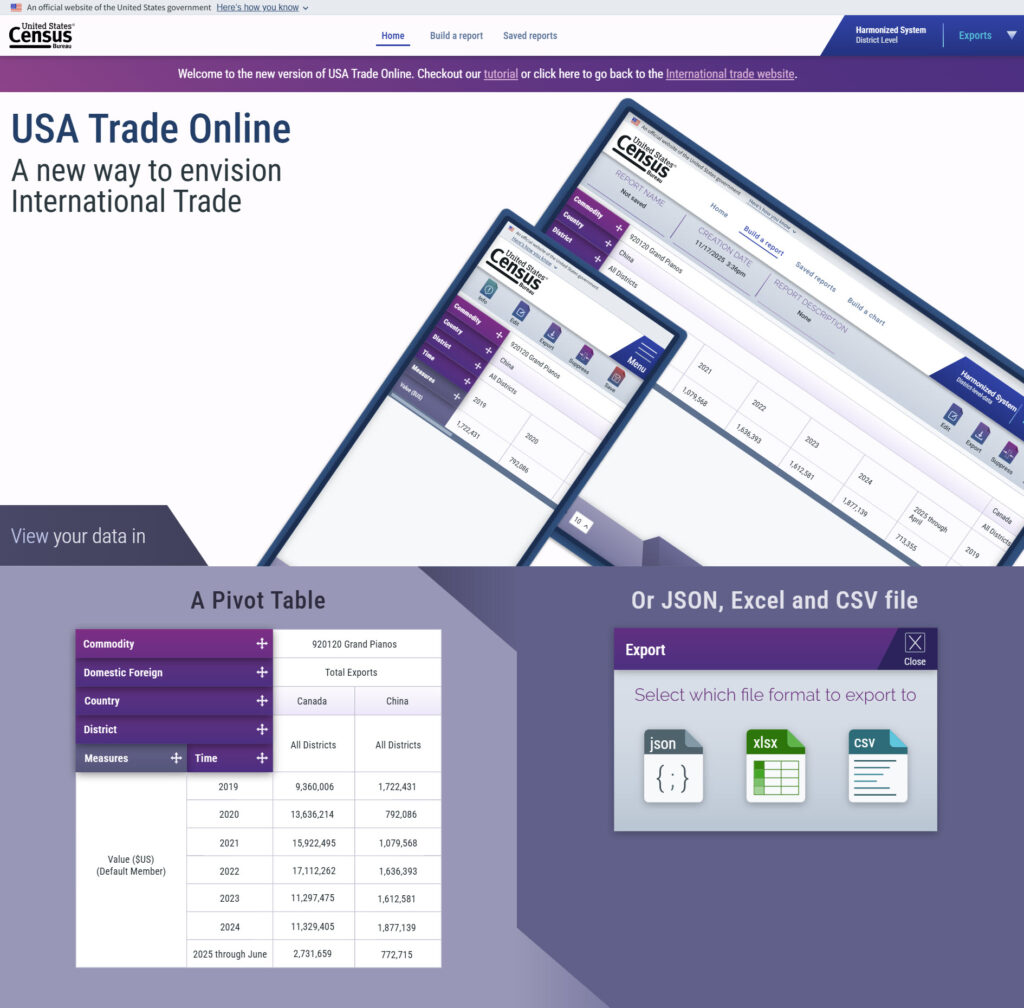
USA Trade Online is a Census Bureau tool providing detailed U.S. import and export data for exploring how goods move in and out of the United States. Users can search for monthly and annual trade statistics, find trade data by product, country, commodity (HS), port-level data, time period, and port, and download customizable reports for research or analysis. One of the best resources for researchers who need commodity-level analysis and historical trade trends.
International Trade Statistics
International trade statistics are the systematic measurement of the flow of goods and services across national borders, compiled by individual countries and aggregated by international organizations. They record what each country exports and imports, to and from whom, and in what quantities and values.
Eurostat is the European Union’s (EU) statistical office, responsible for collecting, processing, and publishing comparable and harmonized statistics across EU member states and partner countries. Eurostat provides monthly data on imports and exports, values and quantities of trade by product and partner country, annual data on trading companies, and annual data on trade by invoicing currency.
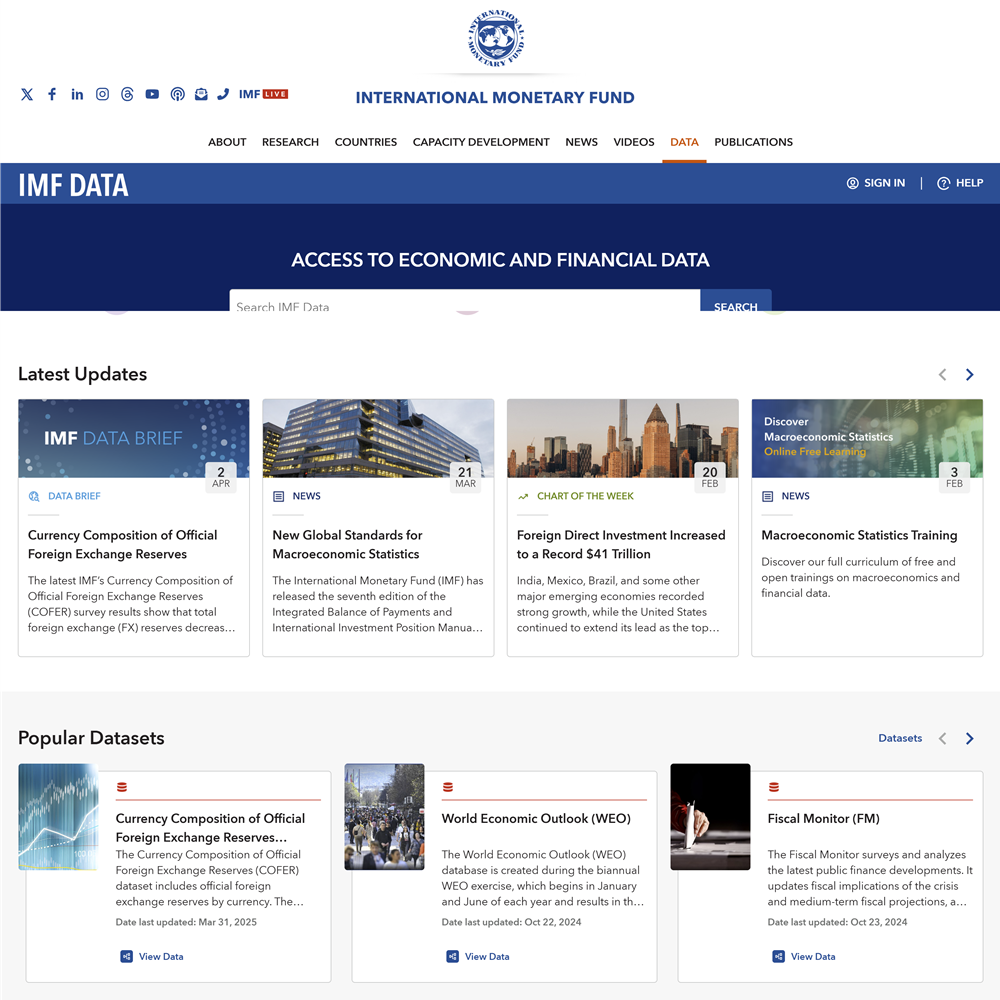
The International Monetary Fund (IMF) Data platform provides access to a wide range of global economic and financial datasets collected and maintained by the International Monetary Fund, including:
-
-
- International Trade in Goods (ITG) – Provides detailed information about the exports and imports of physical goods between countries, typically based on customs data. It focuses only on tangible merchandise, excluding services.
-
-
-
- International Trade in Goods (by partner country) (IMTS) – IMTS shows the value of exports and imports between countries by partner country and region (monthly and annual).
-
The International Trade Centre’s (ITC) Trade Map is a comprehensive online tool that provides detailed international trade statistics and market analysis. It enables users to access trade data for over 220 countries and territories, as well as analyze more than 5,300 products categorized under the Harmonized System (HS) at 2-, 4-, and 6-digit levels. Data includes annual, quarterly, and monthly trade flows, including values, volumes, growth rates, and market shares.

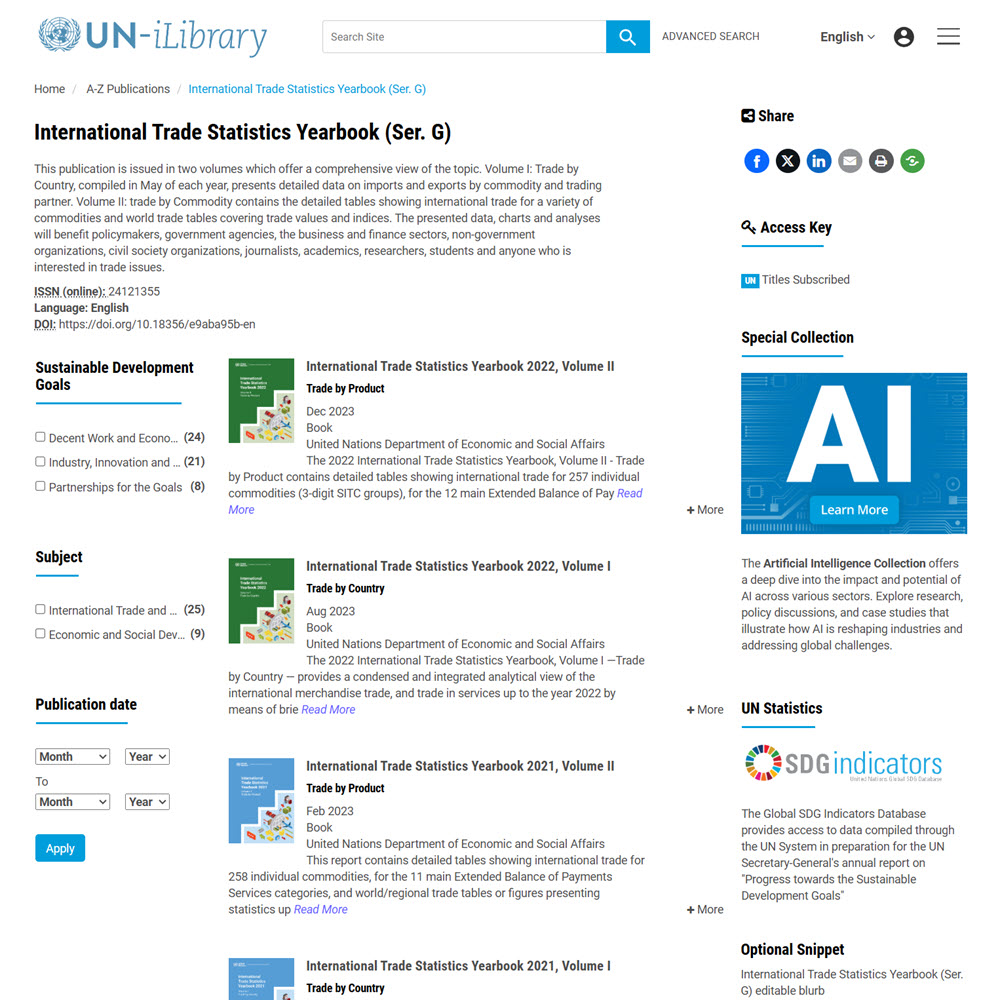
The International Trade Statistics Yearbook (ITSY) is an annual publication produced by the United Nations Statistics Division (UNSD) that provides comprehensive international merchandise trade data and analysis. IT is published annually in two volumes: Volume I: Trade by country; and Volume II: Trade by commodity. It presents global trade data by country and product and provides detailed import and export statistics for over 200 countries and territories. It also includes partner countries and product breakdowns using Harmonized System (HS) codes.
Free online versions of ITSY are available from 2011. Older physical or digital copies are available for purchase through the UN Publications website or by searching in your university library catalog.
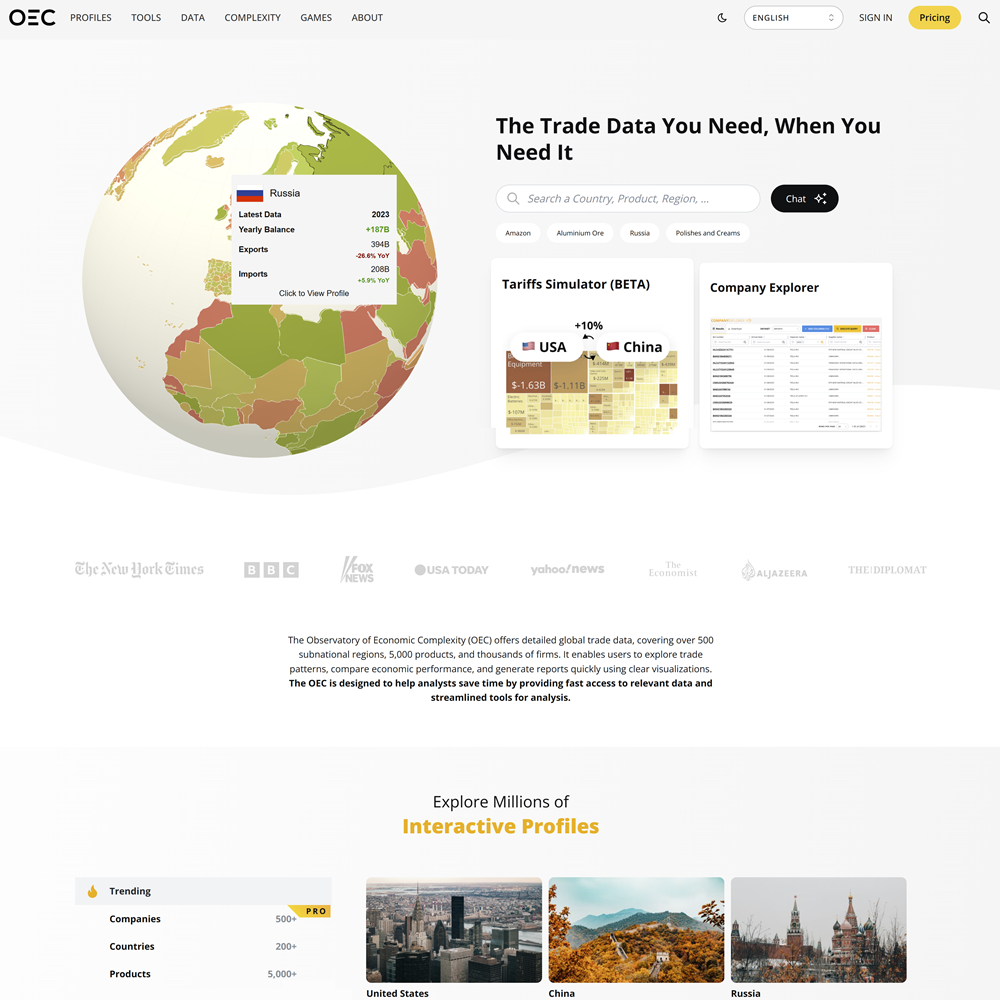
The Observatory of Economic Complexity (OEC) is a free, interactive data visualization platform that provides detailed information and data on global trade. Originally developed at the MIT Media Lab and now maintained by Datawheel, the OEC allows users to explore international trade patterns through visualizations and analytical tools. Users can access over 50 years of international trade data, including 5,000 products and over 200 countries and territories.
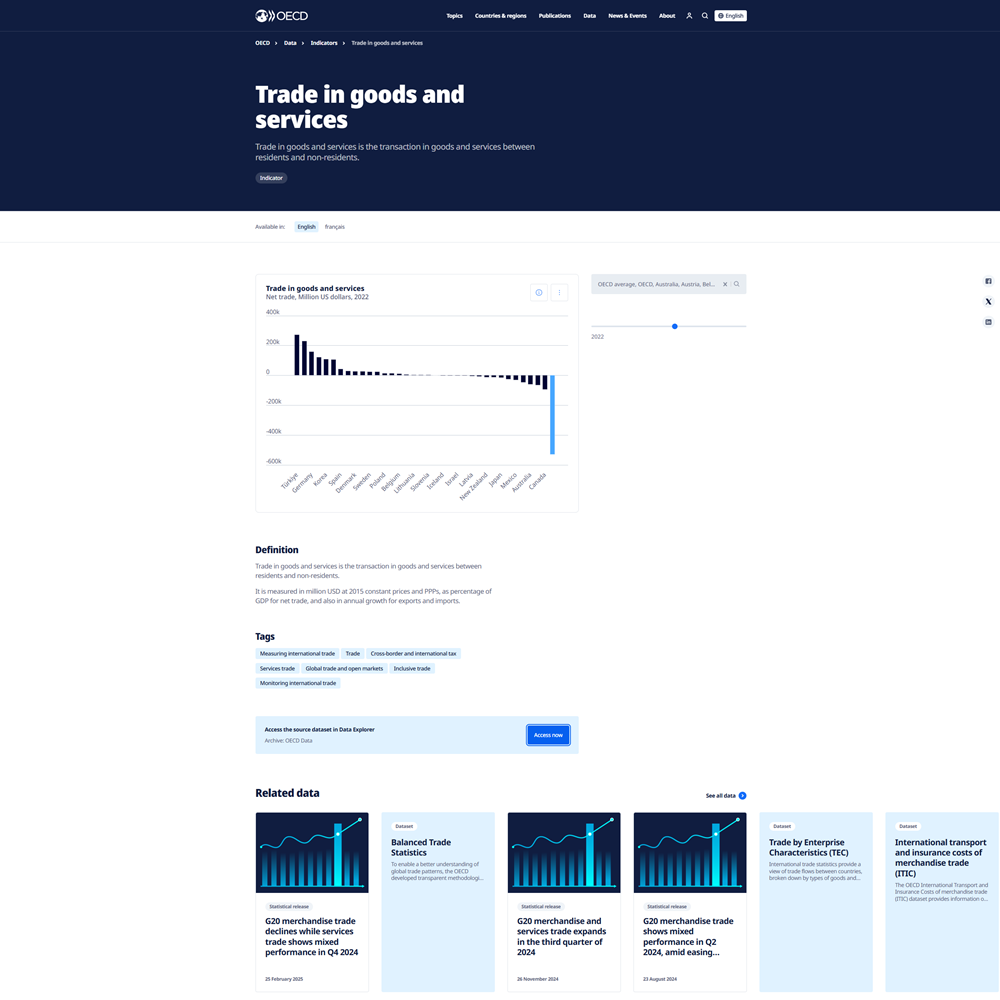
OECD Trade in Goods and Services provides access to high-quality, internationally comparable data on merchandise and trade in services for OECD countries and select partner countries. The OECD does not provide as granular detail on goods and services as UN Comtrade (e.g., HS 6-digit level).
While UN Comtrade is designed to be a comprehensive trade data warehouse, storing raw customs-level data reported by countries, the OECD is focused on cross-country comparability and macroeconomic trends. Data is aggregated to make it more uniform and usable across different reporting methods.
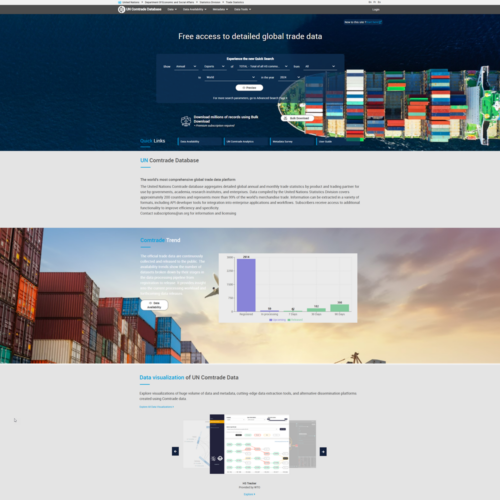
The UN Comtrade Database is a global trade data repository maintained by the United Nations Statistics Division (UNSD). It provides detailed import and export statistics reported back to 1962 of countries worldwide, covering goods and services traded between nations. It includes trade data from over 200 reporting countries and territories classified using the Harmonized System (HS) and Standard International Trade Classification (SITC) codes, allowing for detailed product-level analysis.
UN Comtrade offers both free and subscription-based access. The free version is sufficient for most needs. However, the premium version provides more advanced features and usability, such as:
- Bulk data downloads.
- Async(-batch) and scheduled downloads.
- Faster performance and priority access to servers.
- Access to more timely data (e.g., preliminary monthly figures).
- Extended API limits (more requests per hour/day).
- Custom query building, saved searches, and automation tools.
- Ability to download entire datasets by country/product over time.
If you’re affiliated with a university, ask your librarian if your library subscribes to the premium version.
BACI (Base pour l’Analyse du Commerce International) is a global trade database developed by CEPII, a French research center in international economics. BACI provides bilateral trade flows between more than 200 countries, broken down by detailed product classification codes (HS 6-digit). BACI is based on UN Comtrade data, but it reconciles discrepancies between what exporters and importers report—a known issue in raw Comtrade data.
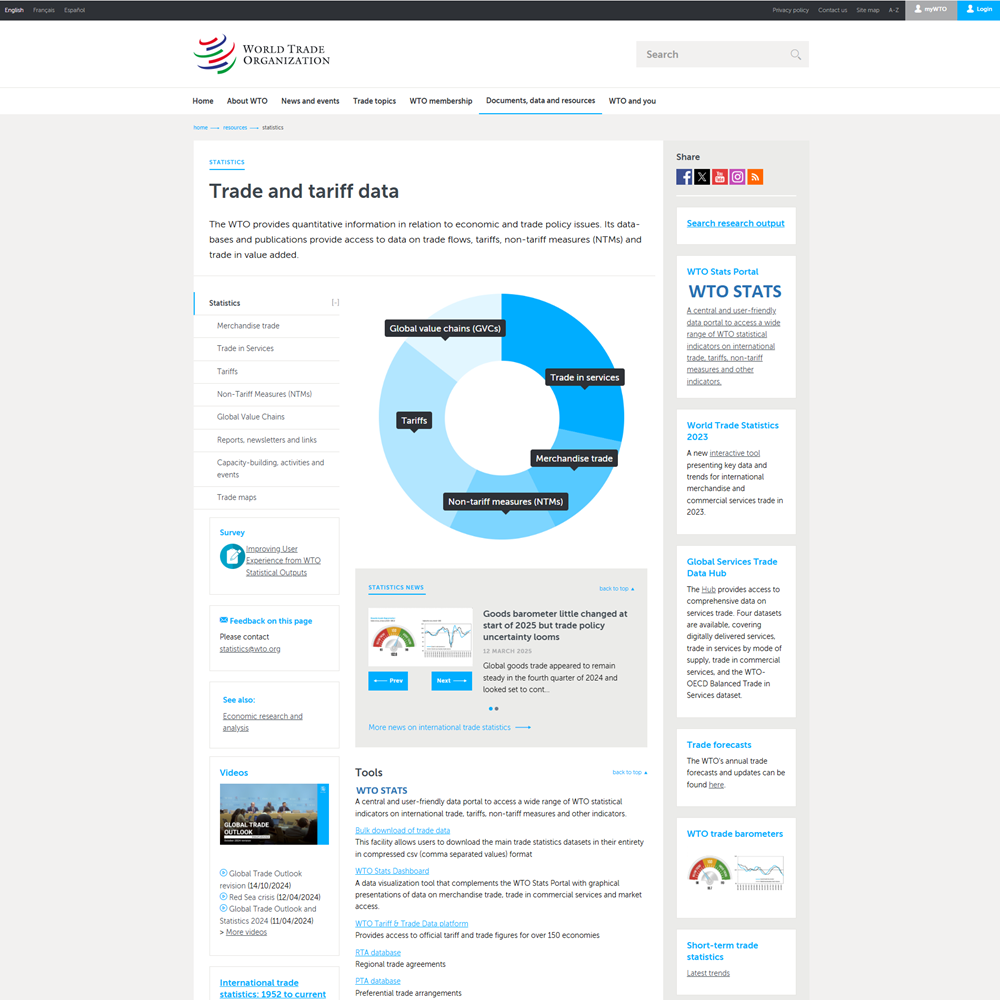
The World Trade Organization (WTO) Trade and Tariff Data Portal provides access to official data on international trade flows, tariffs, and trade policy measures for WTO member countries. Data includes merchandise trade by country, product category, and partner, and trade services data. Also provides official tariff and trade figures for over 150 economies.
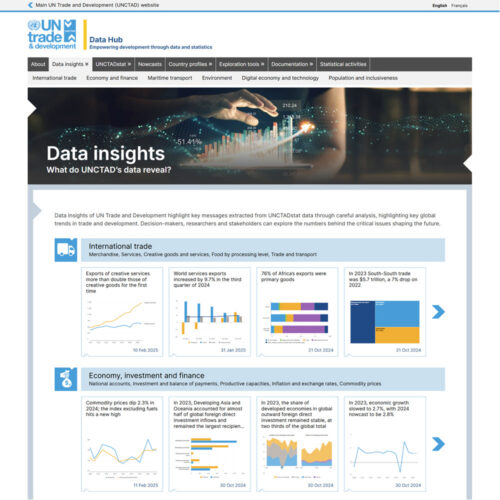
The United Nations Conference on Trade and Development (UNCTD) is a part of the United Nations Secretariat and focuses on promoting international trade and development, particularly in developing countries. The UNCTD Data Hub provides access to a wide range of global economic and trade data, including international trade and investment, trade in services, financial flows and markets, economic development indicators, and technology and innovation metrics.
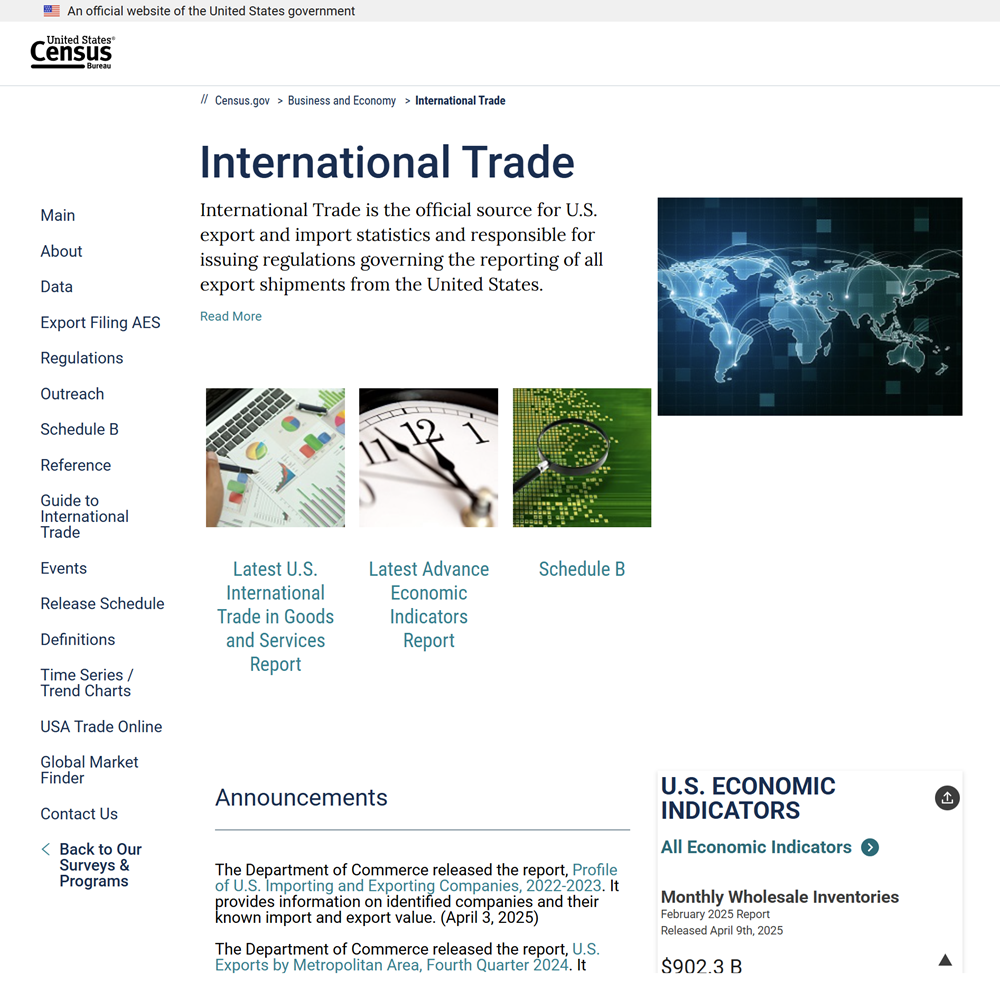
International Trade is the official source for U.S. export and import statistics. It is responsible for collecting, analyzing, and publishing data on the import and export of goods and services between the United States and other countries, and issuing regulations governing the reporting of all export shipments from the United States. The Census Bureau releases monthly trade statistics in reports such as the “U.S. International Trade in Goods and Services” report (jointly with the Bureau of Economic Analysis).
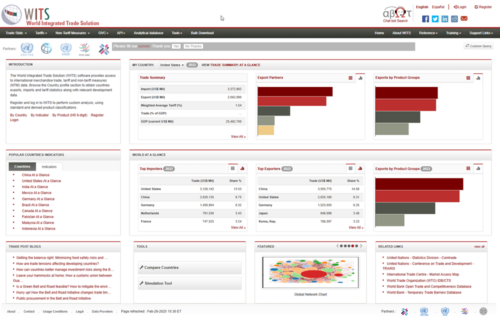
The World Integrated Trade Solution (WITS) is an online data platform that provides comprehensive trade-related data, tariff data, Non-Tariff Measures (NTMs), data on trade agreements, and indicators & Analytical Tools. It was developed by the World Bank, in collaboration with organizations such as the United Nations Conference on Trade and Development (UNCTAD), the International Trade Centre (ITC), the United Nations Statistics Division (UNSD), and the World Trade Organization (WTO).
The icons next to each resource indicate its access requirements.
Open source/ Free
Subscription required

Unemployment doesn't measure everyone without a job. In U.S. statistics, someone generally must be without a job, available for work, and have actively looked for work recently to be classified as unemployed. Someone who stops looking for work may no longer be counted as unemployed.